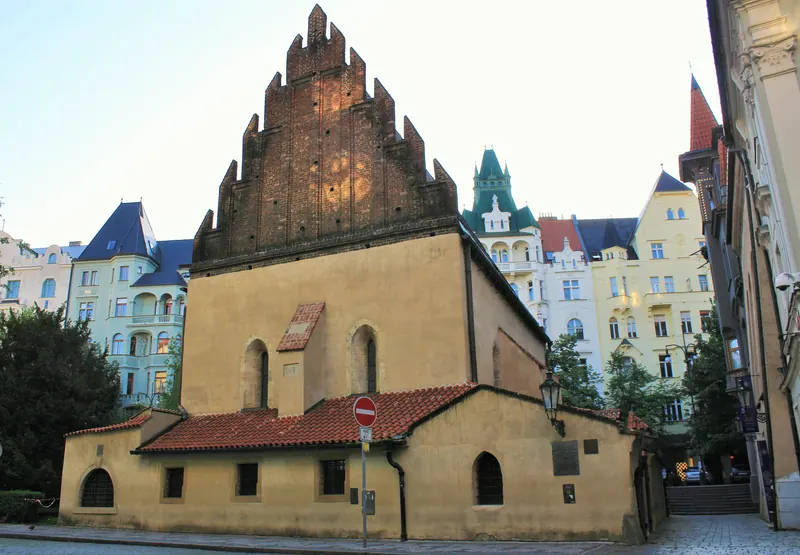
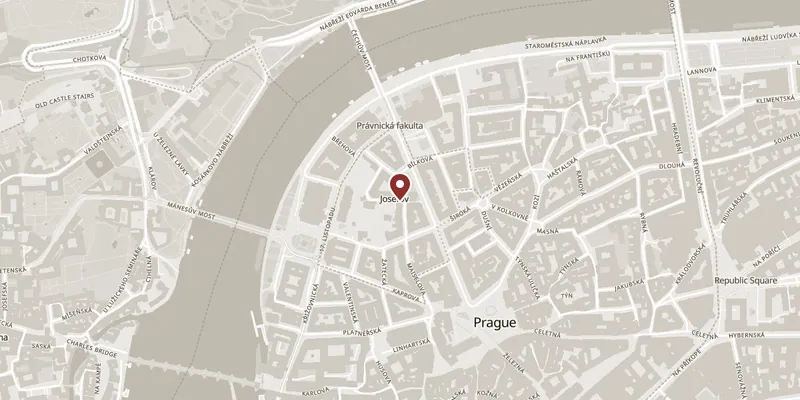
The synagogue went up in about 1270, when the Jewish quarter on the Vltava’s right bank was a walled town of its own. Stonemasons from the royal building lodge — the same craft tradition then at work on the castle and the Old Town churches — built it as a twin-nave hall, the standard plan for a large medieval synagogue, with two octagonal piers down the middle carrying six bays of vaulting. Look up: the vaults have five ribs instead of the usual four, and the tradition is that the fifth was added so the ribs would not form a cross. Twelve narrow windows, one for each tribe of Israel, are cut high in the walls.
At the centre, the raised bimah is enclosed by a late-Gothic wrought-iron grille of the 15th century. Beside the east wall a seat marked with a Star of David is kept empty; it is called Rabbi Loew’s chair, and no one has sat in it since. The banner hanging in the nave records the privilege granted to the Prague Jewish community by Charles IV in 1357 to carry its own flag; the one on display is an 18th-century successor.
The attic is the reason many people come. Rabbi Judah Loew ben Bezalel, the Maharal (d. 1609), is said in the legend to have made a golem of Vltava clay to guard the community and, having deactivated it, to have stored the body under the roof. There is no access to the attic, and there never has been for visitors: the external staircase on the south side stops short. The building itself survived the demolition of the Jewish quarter in 1893–1913, which took nearly everything around it.
It is still a working synagogue of the Jewish Community of Prague, not a museum. Men are given a paper kippah at the door; women sit in the outer annexes built in the 15th and 16th centuries, from which the medieval hall is seen through narrow slits in the wall.