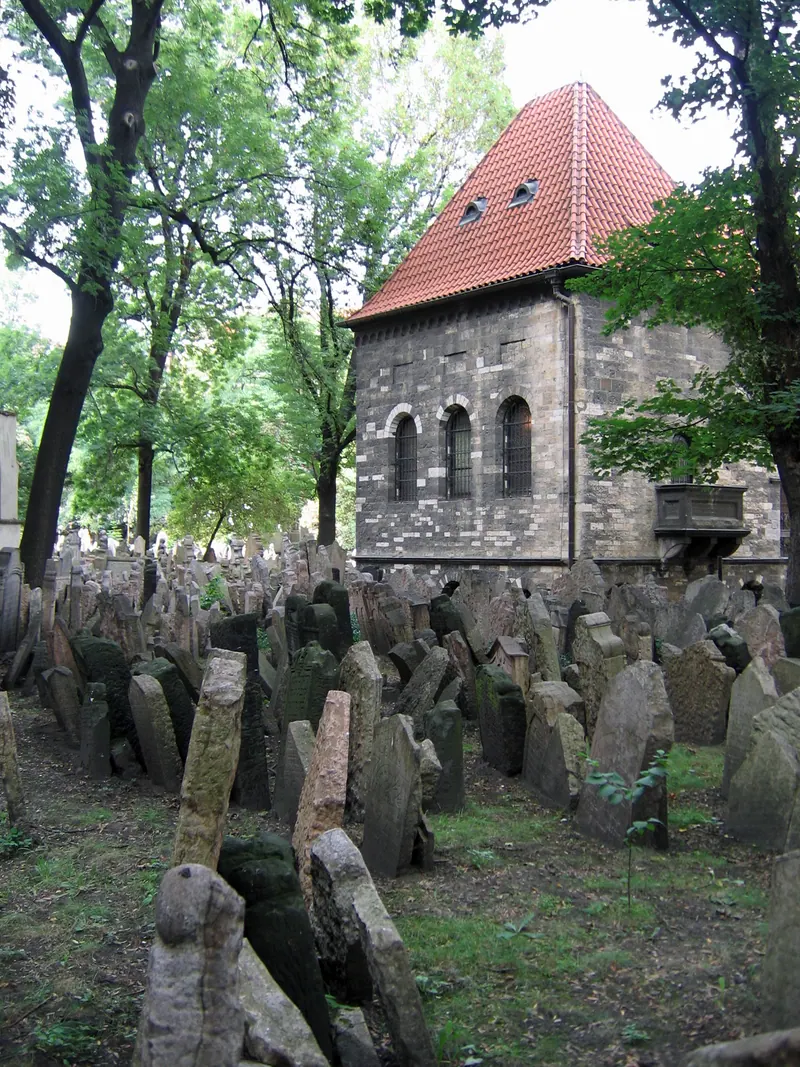
Jewish law forbids disturbing a grave, and the Prague community was not allowed to buy more land. The result is the densest burial ground in Europe: earth was carted in and laid over the full graves, and the older headstones were lifted and reset in the new surface, so the same stones now stand above several generations. Researchers estimate up to ten layers. The ground is metres higher than the street outside, which is why you walk down into the surrounding lanes and up into the cemetery.
The cemetery was in use between 1439 and 1787, when Joseph II banned burials inside the city. The oldest legible stone is that of the poet and scholar Avigdor Kara, who died in 1439 and who wrote an eyewitness elegy on the Prague pogrom of 1389 — the original of his stone is in the Maisel Synagogue and a copy stands in the cemetery. Reading the rest is a craft in itself: the carved emblems are the surname or the calling. Scissors mean a tailor, a mortar an apothecary, a pair of hands raised in blessing a Kohen, a jug a Levite, a lion a man named Judah or Löw, a bunch of grapes a fruitful life.
The stone people stop at is the tiered Renaissance tomb of Rabbi Judah Loew ben Bezalel, the Maharal, who died in 1609 — the scholar to whom the golem legend attached itself. It is covered in folded paper notes and pebbles. Nearby lie the astronomer and chronicler David Gans (d. 1613), who knew Tycho Brahe and Kepler, and the mayor and financier Mordecai Maisel (d. 1601), who paved the ghetto’s streets at his own expense.
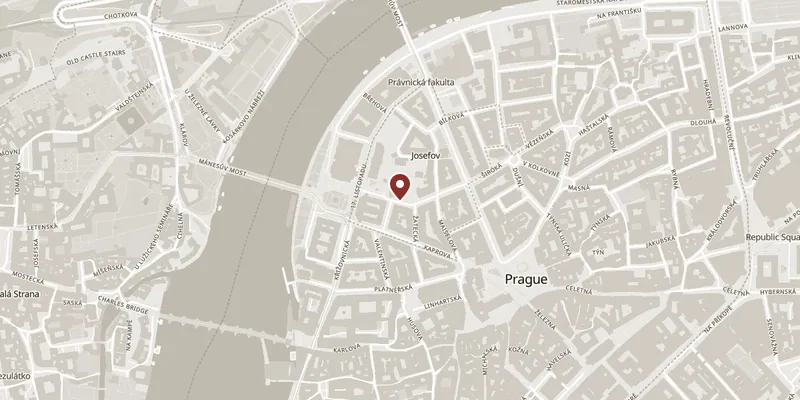
Entry is from Široká 3, through the Pinkas Synagogue, and the route through the cemetery is one-way. Allow about 30 minutes. Nothing may be taken out of the cemetery, and photography rules are posted at the gate.