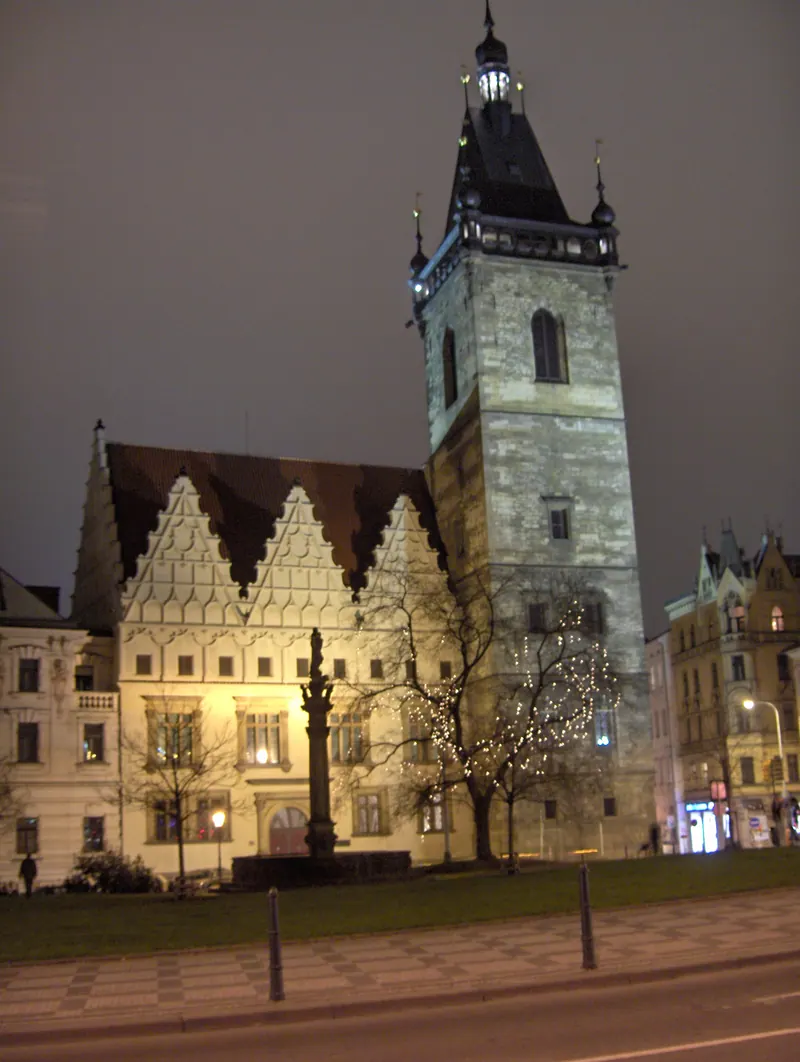
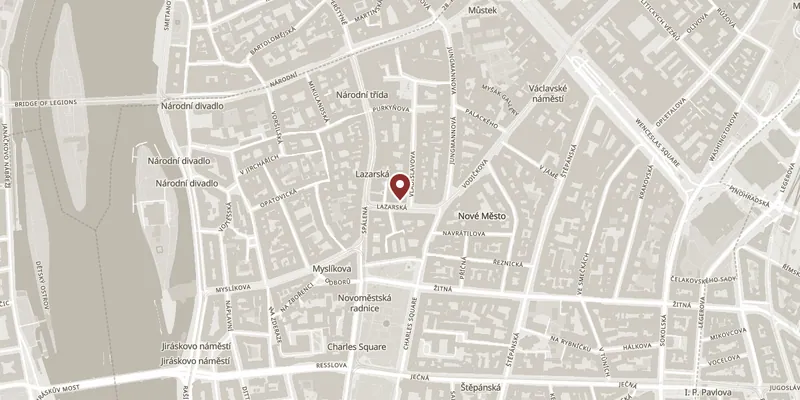
Charles IV laid out the New Town in 1348 on a scale larger than all the existing towns of Prague together, and it got its own council and its own town hall on the north end of the cattle market — now Charles Square. Building began soon after the foundation; the corner tower went up in the 1450s.
On 30 July 1419 a procession led by the preacher Jan Želivský came here to demand the release of Hussite prisoners. Someone threw a stone from a window; the crowd stormed the building and threw the judge, the burgomaster and about a dozen councillors out of the windows onto the pikes of the people below. Those who survived the fall were killed in the square. King Wenceslas IV died of a stroke a fortnight later. Historians treat this — the First Defenestration of Prague — as the opening act of the Hussite revolution. You can stand in the room.
Inside, the Mázhaus on the ground floor is a two-aisled Gothic hall on cross-ribbed vaults, said to carry the highest vault of any secular building in Prague, and it now holds a permanent exhibition on the history of the New Town. There is a chapel, Gothic in origin and Baroqued later, and gallery rooms used for temporary shows. The building was given a Renaissance overhaul in 1520–26 and heavily restored in 1904–05 and again between 1976 and 1996.
The tower is 221 steps with no lift, and gives you the New Town from above — Charles Square, the largest square in Prague and one of the largest in Europe, laid out by Charles IV as a market and used for the annual display of the imperial relics.
Admission was CZK 100 as of August 2026, which is the cheapest historic interior on this list. It is open Tuesday to Sunday and closed on Mondays, with a lunch break in the middle of the day.