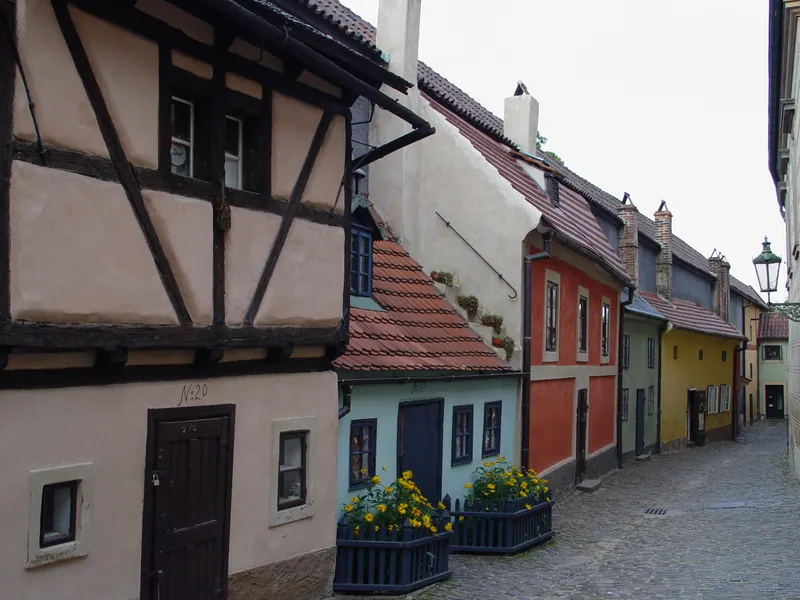
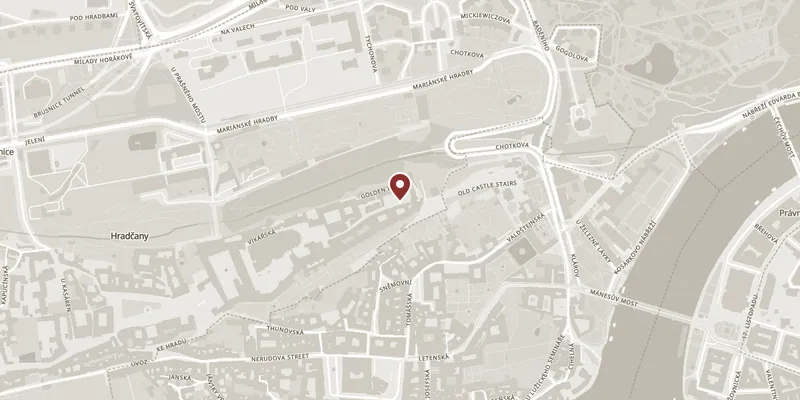
The wall came first. Benedikt Ried built the castle’s northern fortification in the 1490s with a defensive corridor along the top; around 1600 small houses were pushed into the arcades below it, for the twenty-four castle marksmen of Rudolf II and then for goldsmiths, servants and, by the 19th century, the poor. The alchemists of the tourist story never lived here. Franz Kafka worked in house No. 22 through the winter of 1916–17. The lane was cleared of residents by 1952, restyled in 1955 and thoroughly restored in 2010–11; nine of the sixteen houses are now fitted out as period interiors — a marksman’s room, a goldsmith’s workshop, a herbalist’s.
The part that earns this place its entry is above your head. From the White Tower at the west end, or the stairs in one of the houses, you get into the defensive corridor that runs the length of the wall: a long, low gallery hung with plate armour, mail, crossbows, halberds and jousting harness, plus an exhibition on the castle’s defence. It is the only sustained display of arms and armour on the castle circuit and most people walk under it without noticing it exists.
At the east end stands Daliborka, a cannon tower Ried built in 1496 into the slope above the Stag Moat and which served as a prison for three centuries. Go down: the vaulted basement has four cells and a round hole in the floor through which prisoners were lowered by pulley into the pit below, with no other way in or out. Its first inmate, in 1498, was the knight Dalibor of Kozojedy, who had sheltered rebellious serfs; he was executed, and Smetana turned him into an opera in 1868. At the other end the White Tower was also a prison.
After the circuit closes for the day, the lane itself can normally be walked without a ticket, with all the houses and the corridor shut.