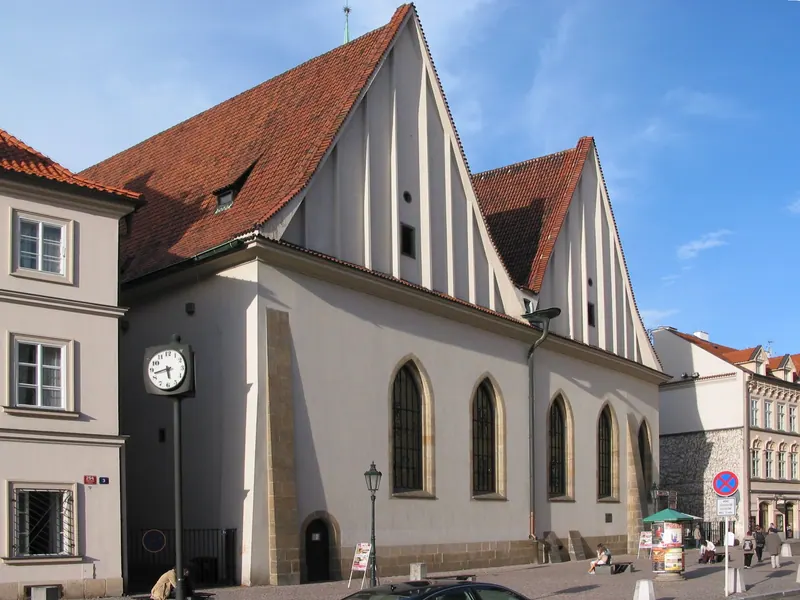
Two Prague burghers, Hanuš of Mühlheim and the merchant Kříž, endowed a chapel in 1391 on one condition: the sermons had to be in Czech. It was built as a plain preaching barn — a wide, low hall with no aisles, seating around 3,000, with the pulpit central and everything subordinate to hearing the preacher. Jan Hus was appointed to it in 1402 and preached here until 1412, and the chapel became the address of the Czech reform movement. It stayed Hussite through the wars and was still Utraquist into the 17th century; Thomas Müntzer preached in it in 1521.
It was demolished in 1786 after the Josephine reforms and houses were built over the site. What survived was the sacristy and the preacher’s house, including the room in which Hus lived. In the 1950s the architect Jaroslav Fragner rebuilt the hall on the excavated foundations, using the surviving south wall and the traces of the original windows and doorways, and it reopened on 5 July 1954 — Hus’s feast day. The walls carry painted texts and pictures copied by art students from the Jenský Codex and from Ulrich Richental’s illustrated chronicle of the Council of Constance, where Hus was burned in 1415.
What to look for: on the south wall, the original masonry and the outlines of the medieval window openings, which are the real thing; the doorway to the pulpit; and in the preacher’s house, Hus’s room and an exhibition on the chapel, the reform movement and its rediscovery. Compare the painted Richental scenes with what you know of the Council — the pictures are 20th-century copies of a 15th-century eyewitness source, which is an odd and useful thing to see side by side.
The chapel belongs to the Czech Technical University, which uses it for graduations and concerts and closes it without much warning on those days.