Twelve days, one castle, and a town about 30 km south of Porto that spends the end of July being whichever century the organisers picked this time. Viagem Medieval em Terra de Santa Maria, in Santa Maria da Feira, Portugal, is the country’s biggest medieval recreation by the organisers’ own account, and in English almost nobody writes about it. It runs for about twelve days from late July into early August: the 2026 edition was 29 July to 9 August, and 2027 is expected around 28 July to 8 August, not yet announced. A day ticket was €6 to €8 in 2026. By the end you’ll know which day to pick, what time to arrive, and whether to sleep in Porto or in town.
What is Viagem Medieval em Terra de Santa Maria?
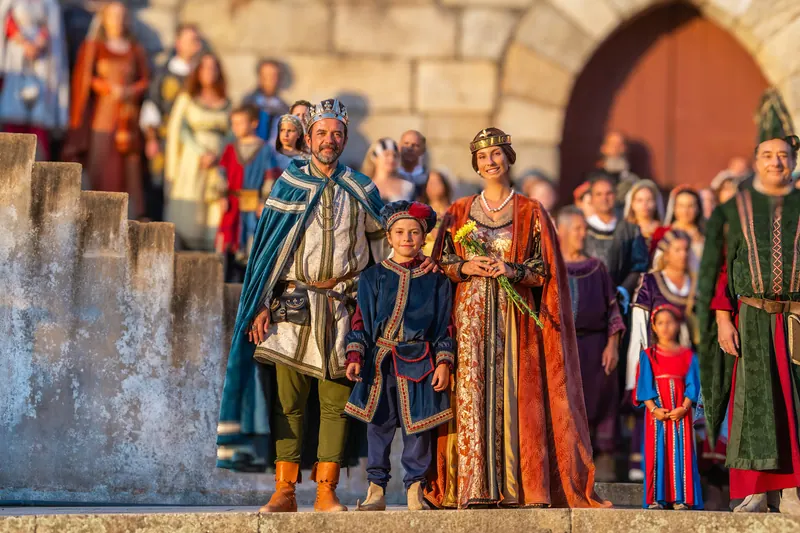
A historical recreation that has dressed the old centre of Santa Maria da Feira as a themed town every summer since 1997; the 2026 edition was the 29th. Each year the programme is built around one reign or episode from Portuguese history. In 2026 it was the Condado Portucalense, the county that became Portugal, and the quarrel between Countess Teresa and her son Afonso Henriques in the years before he made himself king, so the town spent a fortnight staging a family argument with cavalry.
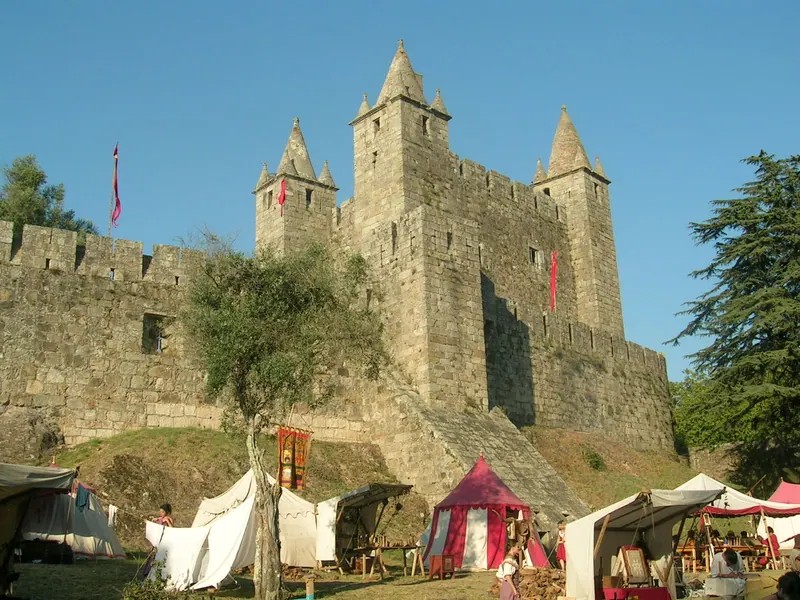
The castle above it is the point. It is a real one, listed as a national monument in 1910 as far as we can find, restored hard since, and with the silhouette every fantasy illustrator has been borrowing for decades: a keep with pointed turrets on a wooded hill, the town at its feet. The recreation fills the streets and squares below the walls with a market, camps, eating houses, craft workshops and stages, and the organisers listed 29 separate programme strands for 2026 alongside hundreds of costumed participants. They call it the largest event of its kind in Portugal. Attendance figures are not published, so nobody else can argue.
What actually happens?
Gates open at 13:00 on weekdays and 12:00 at weekends and the site closes at 00:30; those are the 2026 hours, and they can move, so check the programme on the official site. The day has a shape. Thin and hot until about five, filling through the evening, heaving after eight, and at its best around eleven when the castle shows are on and the heat has gone.
Daytime: the camps, the market, the crafts
Come in at opening on a weekday and you get the place nearly to yourself. The camps are where the participants live for the fortnight: cooking fires, kit on trestles, someone mending a gambeson in the one patch of shade because there is no other sensible thing to do at 14:00 in August. The craft workshops are the part worth slowing down for, because the people in them are there for twelve days and will happily talk you through a forge weld or a potter’s wheel. The market is the tourist end: leather, wooden swords, jewellery. Walk past it on the way in.
Buy nothing before four. You will carry it until midnight.
The parade and the tournament
Daily processions through the streets, theatre, music, dance and a mounted tournament are the fixed elements; siege and battle scenes appear on the programme as the year’s story demands. The tournament ground is the one place to claim a spot early, since a mounted pass is over in seconds and the people in front of you will be taller than you planned. The procession is easier. It moves, so stand anywhere on its route with a wall at your back and let it come to you. Times change from day to day and year to year; the printed daily programme is the thing to photograph at the gate.
After dark: the shows at the castle, the crowds, when to arrive
This is the reason to come. The big scenes are staged at night with the castle lit behind them, and the organisers run the recreations late; nothing closes before 00:30. From about eight the streets fill with the after-dinner crowd from Porto and the coast, and by ten the lanes under the castle are shoulder to shoulder, which on a Saturday is a problem and on a Tuesday is half the fun.
The day ticket does not allow re-entry. Decide before you go in whether you are doing the afternoon or the night, because if you leave at six for a shower you pay again at nine. The 12-day bracelet, €12 in 2026, gets you in and out as you like, and it is the better buy for anyone staying two nights or more.
Arrive at 18:00 on a weekday: the heat is going, the queue isn’t there yet, and you have four hours before the shows.
The food streets: roast pork and the queue strategy
Pork. Roast pork in bread, pork on spits, sausage on grills, and the smoke from all of it lying in the lanes from about seven, so you smell a stall a full street before you see its queue. Eat standing up, because there is nowhere to sit after eight, and eat early, because the queue at any stall with visible fire triples when the first show ends. Our rule: eat at six, drink at ten, and skip anything sold in a horn, which costs more for the horn than the drink. More on what is worth queuing for in what to eat at a medieval festival.
Who will love it, and who won’t?
People who like scale and night-time theatre; anyone with a free evening in Porto in the first week of August; reenactors, who will lose the whole afternoon in the camps talking kit; families with children old enough to walk an evening, since there is a children’s area with workshops and daytime shows and under-sixes go free.
It won’t suit you if you want the castle quietly. For twelve days it is a stage set.
Heat, first: late July inland from the Atlantic is hot, and the afternoon streets have little shade. Then the crowd. On a Friday or Saturday after eight the lanes jam, and a buggy becomes a thing you push through other people’s shins. Parking, because a good part of Porto drives down the A1 on a Saturday evening and arrives when you do. Entry is cheap; the evening is not, once you have fed four people on roast pork and bought the wooden sword you said you wouldn’t.
Getting there from Porto, tickets and sleeping
Santa Maria da Feira is about 30 km south of Porto by the A1 or the A29 and A32, roughly 45 minutes from Porto airport without festival traffic. There is a direct bus from Porto that takes under an hour on recent timetables; the train means a change at Espinho onto the narrow-gauge Vouga line and takes closer to two hours, which is fine as an outing and poor as a way home. We haven’t ridden either on a festival night. Check the last departure before you rely on it, because the site closes at 00:30 and public transport will not wait for the finale.
Tickets, at 2026 prices checked in August 2026: €6 a day Sunday to Thursday, €8 on Friday and Saturday, €12 for the bracelet covering all twelve days, under-sixes free, and the opening evening free. Day tickets are single entry. They were sold online in 2026 through the link on the official site.
Beds are the hard part. The town is small and its rooms go; Porto has all the beds in the region and is 30 km of Saturday traffic away; Espinho, on the coast south of Porto, is on the main railway line and the Vouga branch and makes a sensible compromise. We’d do Porto for one night, the town or Espinho for two or more. The Santa Maria da Feira page covers the town when the castle is just a castle again.
Tips we’d give a friend
- Go on a weekday. It was €6 instead of €8 in 2026, the lanes stay walkable until about nine, and the shows are the same.
- Arrive around 18:00. You miss the worst of the heat and the whole of the gate queue.
- Buy the bracelet if you are staying two nights or more; a day ticket has no re-entry and a shower at six costs you another ticket.
- Eat before the first night show, not after, and eat standing.
- Carry water and a hat for the afternoon. The shade in the camps belongs to the people who have to sleep there.
- Costume hire is available in town during the event. It is optional and nobody minds either way, but wool in August is a commitment.
- If you drive, arrive early and leave late. The car parks empty at the same moment the site does.
How does it compare with Óbidos?
Mercado Medieval de Óbidos is the one most English speakers have heard of, and it is the prettier event: a whole walled town an hour north of Lisbon, the market inside the castle enclosure, ginjinha in a chocolate cup at every corner. It is also smaller, and on a busy Saturday night the gates close when the enclosure is full. The Viagem is bigger, longer and has the hill and the castle as a backdrop rather than a container; you trade charm for scale, and after dark the scale wins.
The ticket models differ. Óbidos charged €12 for adults and €8 for children aged four to eleven in 2026, with €10 for anyone in costume; the Viagem charged €6 to €8 a day or €12 for twelve days. The two sit almost back to back in the calendar: Óbidos ran 16–26 July 2026 and is expected 15–25 July 2027, so a fortnight in Portugal can take both, with a few days on the coast between. Our Óbidos guide covers the town; the rest of the country’s calendar is under Portugal, and the month’s other options under August.
Go on a Tuesday or a Wednesday, get there at six, eat by seven, and be under the castle wall with a drink in a cup at eleven when the lights come up on the battlements. Eight euros at most. If you are in Porto that week and spend the evening on the riverfront instead, you have picked the wrong castle.