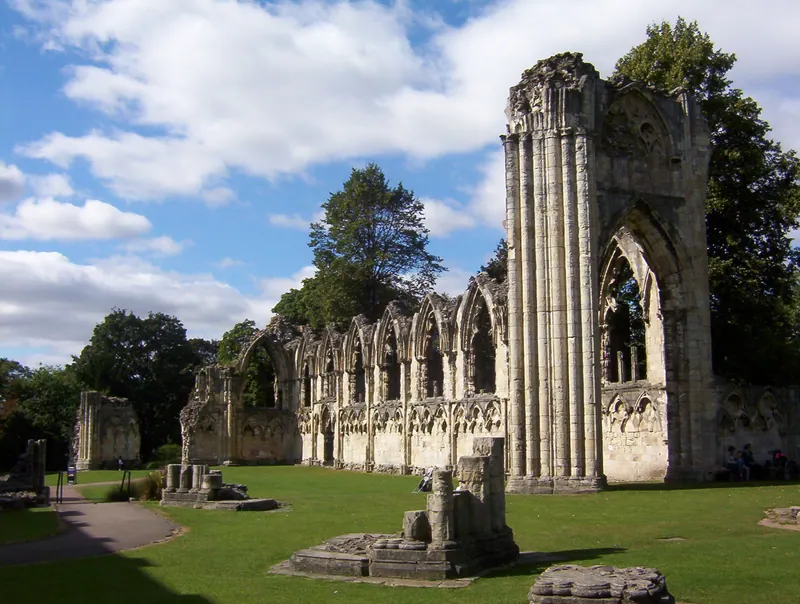
St Mary’s was founded in 1088, a Norman foundation planted to help hold the north, and it grew into the wealthiest Benedictine house in northern England. What you can see now is the church that replaced the first one: rebuilding began in 1271 and took twenty-four years, and the tall lancets and shafted piers standing in the grass are from that campaign. The nave’s north wall and part of the west end survive to something like full height; the outline of the crossing and the cloister is laid out at your feet.
The abbey’s best story is a failure of discipline. In October 1132 a faction inside the house argued that the rule of St Benedict was being kept slackly and demanded stricter observance. The argument turned into a riot, and thirteen reform-minded monks left — expelled, by most accounts — walked north into the valley of the Skell and founded the Cistercian abbey of Fountains, which became one of the greatest monasteries in Europe. Two of the most famous ruins in England begin at this spot on the same day.
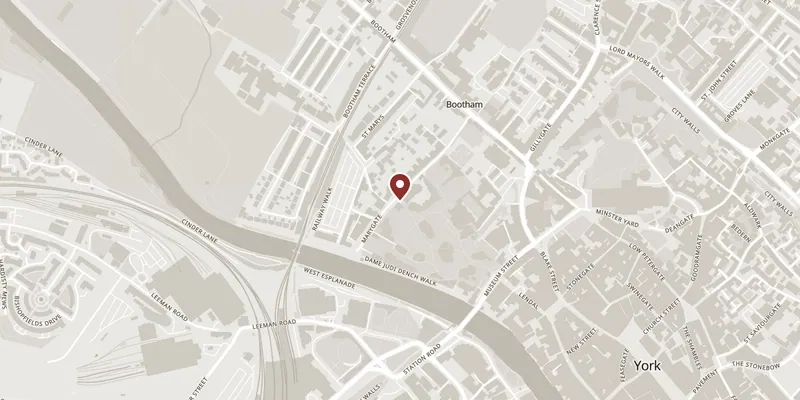
Do not stop at the church. The precinct wall built in the 1260s still runs along Marygate and up towards Bootham with its towers and gate, and it is described by the site’s own custodians as the most complete set of abbey walls in the country — it was defensive in earnest, because the abbey and the city spent centuries in dispute. Inside the gardens, the Hospitium is the abbey’s surviving guest house, the vaulted undercroft of St Leonard’s Hospital stands at the Museum Street end, and the Multangular Tower is the west corner tower of the Roman fortress with medieval courses built straight on top of the Roman ones. Four periods, one lawn.
The abbey was dissolved and the monks pensioned off in 1540, after which the buildings were converted into a royal palace for visits north — the range that became the King’s Manor. The best of the abbey’s carved stone was taken indoors and is now in the Yorkshire Museum, thirty seconds’ walk away: twelfth-century life-size saints and prophets, shown through a surviving arcade. See the ruins and the sculpture in the same hour.
Entry is free. The ruins are also the standing set for the large-scale open-air productions of the York Mystery Plays — if one is being staged during your visit, part of the site will be fenced for the build.