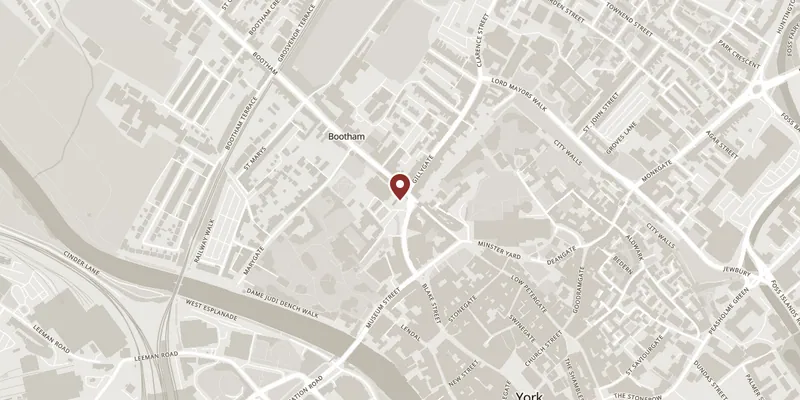
The walls are about 3.4 km — a little over two miles — and the full circuit, wall-top plus the street-level links, takes roughly two hours. Most of the standing masonry is 13th and 14th century, and much of it sits on the bank of the Roman fortress and the earth ramparts thrown up in the Anglo-Scandinavian city. There is no ticket, no gate fee and no guide: you climb a set of stone steps and walk.
The wall-top is not continuous. It survives in three long walkable stretches with gaps between them, and the gaps are historically honest rather than damage. Bootham Bar to Monk Bar and on to Layerthorpe is the stretch to walk if you walk only one: it looks down into the Minster precinct from the outside, and it is the one section with railings the whole way. Between Layerthorpe and the Red Tower there is no wall because there never was one — the Normans dammed the Foss and flooded the ground into the King’s Fishpool, and the marsh did the defending until it silted up in the 17th century. From the Red Tower (brick, 1490) the wall runs to Walmgate Bar and Fishergate Postern; then the castle and the two rivers break the line again; then Baile Hill to Micklegate Bar and down to Barker Tower at Lendal Bridge. Where you have to come down to street level, the route is marked by small brass studs in the pavement showing a battlemented tower.
The four bars are each worth a stop. Bootham Bar stands over the north-west gate of the Roman fortress and keeps the oldest stonework. Monk Bar is the tallest, four storeys of about 1300, with a portcullis still in working order. Walmgate Bar is the only town gate in England that still has its barbican, the walled funnel in front of the arch, and there is a café in the gatehouse. Micklegate Bar was the monarch’s ceremonial entrance and the place where traitors’ heads were displayed — Richard, Duke of York, was set above it in 1460 wearing a paper crown.
Read the closing times before you start. The gates open at 08:00 and shut from dusk, and the walk is closed in ice and high wind.