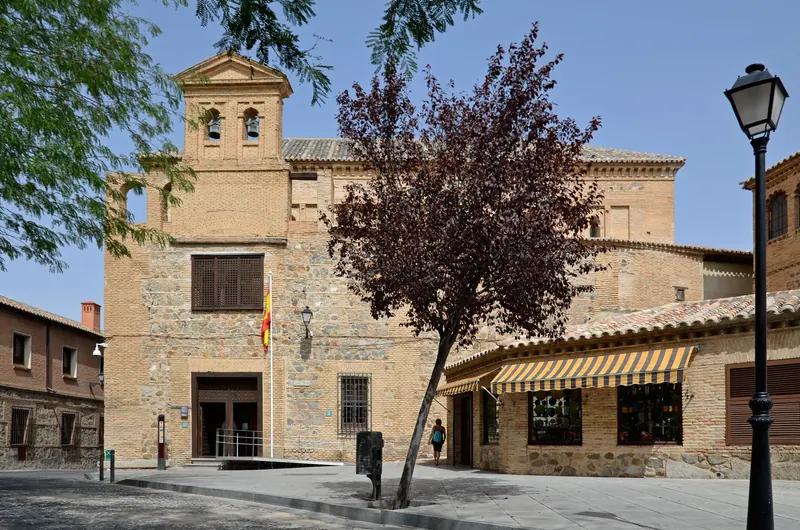
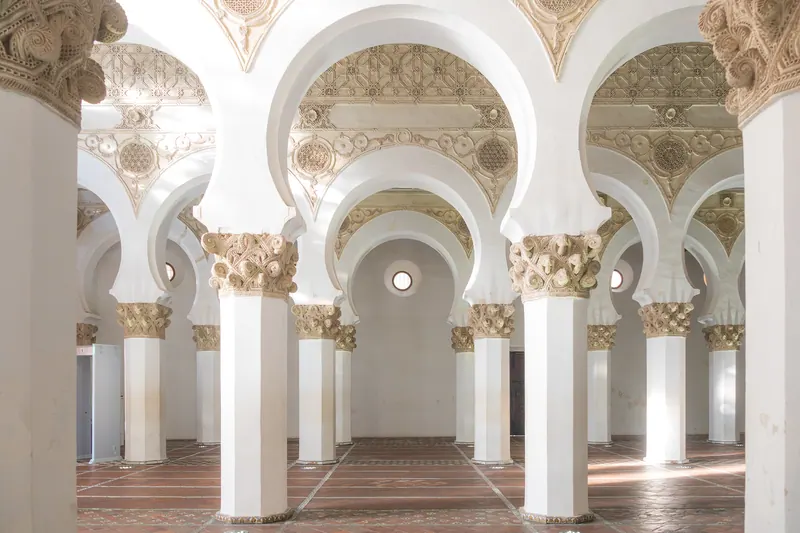
Samuel ha-Levi Abulafia was treasurer to Pedro I of Castile and one of the most powerful men in the kingdom. Around 1355–57 he built himself a synagogue beside his own house in the Jewish quarter. In 1360 Pedro had him arrested and tortured to death in Seville and seized his property, which is a fair summary of how far royal favour went.
The prayer hall is the finest fourteenth-century interior in the city. The east wall carries three tiers of carved plaster — arcading, sebka, palmettes — and running through it are inscriptions in three registers: psalms in Hebrew, a long panegyric to Samuel and to King Pedro, and Arabic-style epigraphy, with the arms of Castile and León worked into the plaster of a synagogue wall. Above it all is a coffered ceiling of cedar with inlaid stars. The women’s gallery runs along the south side.
After the expulsion of 1492 the building was granted to the Order of Calatrava and served as a church, then a hermitage — the Tránsito of the Virgin, which is where the name comes from — and later as a barracks. It was declared a national monument in 1877 and became the Museo Sefardí in 1964.
The museum is the reason this entry is here rather than a second synagogue entry. Its rooms take the history of Jews in Spain from Roman-era arrival through the medieval centuries to 1492 and the Sephardic diaspora that followed, with ritual objects, ketubot, manuscripts and — in the garden — a collection of medieval Hebrew tombstones lifted from Toledo’s Jewish cemetery, several of them legible. It is small, it is well labelled in Spanish and English, and it takes about an hour.
It is a state museum, so the pricing is generous: €3, free for under-18s, over-65s, students aged 18–25 and the unemployed, and free for everyone on Saturdays from 14:00 and all day Sunday. A €5 combined ticket adds the Museo del Greco five minutes away.