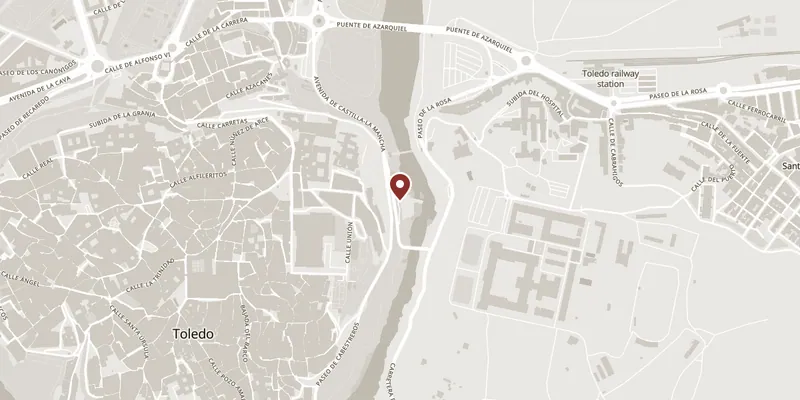
The Tagus wraps three sides of Toledo’s rock, and for most of the city’s history there were two ways over it. This is the eastern one, and the older. Its name is simply the Arabic al-qanṭara — the bridge.
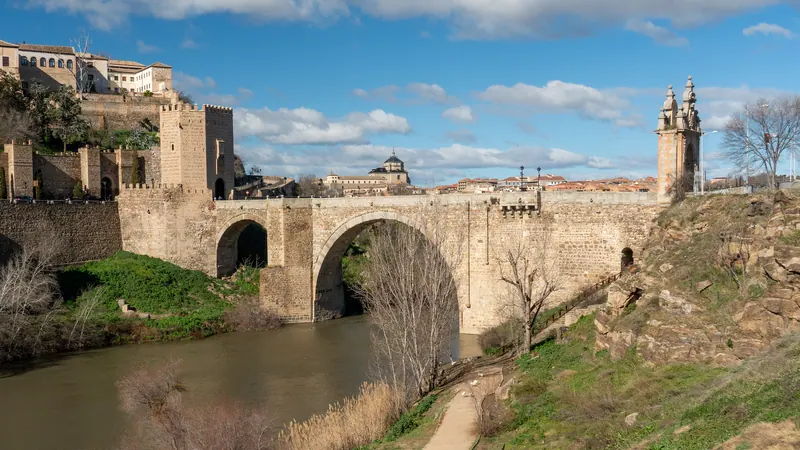
The crossing is Roman in origin. It was badly damaged and rebuilt in the tenth century, under Muslim rule, when the third arch was suppressed and replaced by a small gate with a horseshoe arch. It suffered again in a flood in the reign of Alfonso X (1252–84) and was rebuilt once more; the hexagonal western tower, with its two gateways, dates from that Alfonsine reconstruction. The Catholic Monarchs later modified and decorated it, and the Toledo tourism office points out the detail worth crossing town for: their coats of arms on the tower lack the pomegranate of Granada, because when they were carved the conquest was not yet finished. The eastern tower was in a bad state by the eighteenth century and was replaced in 1721 by the Baroque triumphal arch you now walk through. The bridge was declared a national monument in 1921.
This was the way in from the east — the road from Aragon and from Madrid — and it is still the best arrival on foot. From the far bank you get the whole south-east face of the city at once: the Alcázar above, the walls falling to the water, and the escarpment of the gorge. Above the far end stands the Castillo de San Servando, a fortress-monastery founded after 1085 and rebuilt in the fourteenth century by Archbishop Pedro Tenorio; it is now a youth hostel and cannot be toured, but the walk up to its walls is public and takes ten minutes.
It is free, open at every hour, and it is the single cheapest good decision in Toledo: come out here in the last half hour of daylight, when the low sun is on the east front and the bridge itself is empty because everybody is up in the old town looking for dinner.