Medieval Booker

Museum ◆ Toledo

Museo Taller del Moro

Part of a fourteenth-century Toledan noble house, built to an Andalusi palace plan and lined with carved plaster — officially the best surviving example of palace architecture of its date in the city. Entry is free, it is three minutes from the queue at Santo Tomé, and virtually nobody in that queue knows it exists.

Where and when

Where
Calle Taller del Moro s/n, 45002 Toledo, Toledo, Spain Open in Google Maps Walking directions
Era
Part of a 14th-century noble house on an Andalusi palace plan; museum since 1963, reopened 2017
Opening
Tuesday–Saturday 10:00–14:00 and 16:00–18:00; Sunday 09:00–15:00; closed Mondays and on 1, 6 and 23 January, 1 May and 24, 25 and 31 December (as of August 2026)
Price
Free, as listed by Toledo's tourism office (as of August 2026)
Best time
Before 14:00 on a weekday, or the 16:00 reopening. Combine it with Santo Tomé and El Salvador, all within four minutes' walk.
Good for
Free or cheapQuiet cornerWorks in the rain
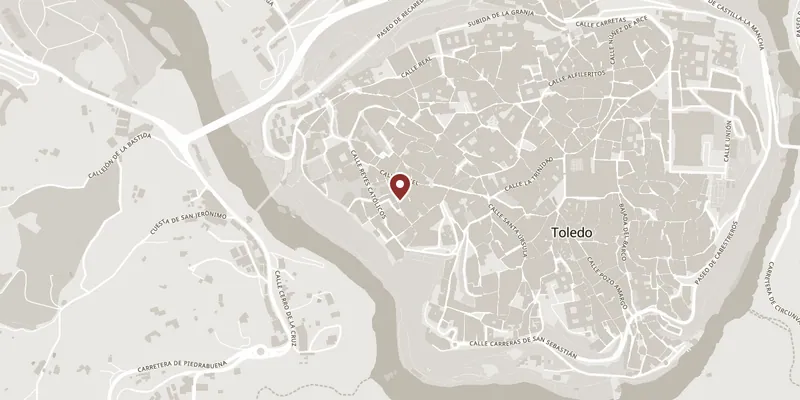
Map showing where Museo Taller del Moro is
Open in Google Maps Walking directions © MapTiler © OpenStreetMap contributors

Checked

What is Museo Taller del Moro?

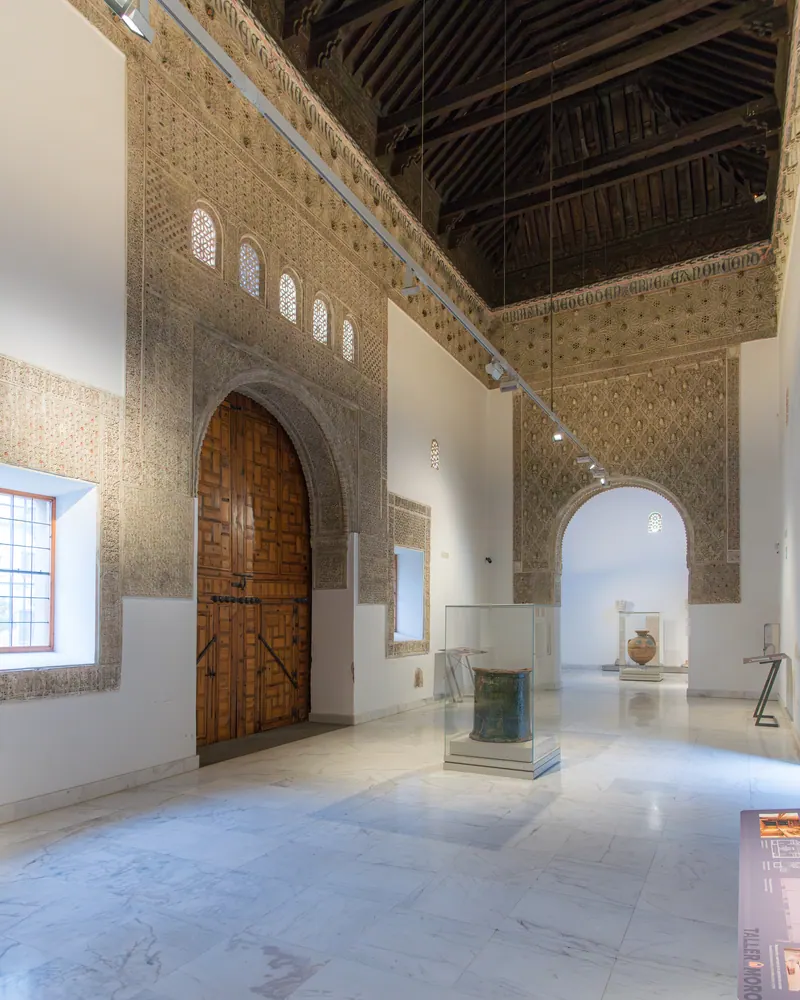
Toledo has plenty of medieval religious buildings and almost no medieval domestic ones you can walk into. This is the exception, and the official description does not hedge: the museum “occupies part of a principal house of the Toledan nobility of the fourteenth century and constitutes the best example of palace architecture of the period”.

The house was built for Lope González Palomeque and María Téllez de Meneses, and it follows an Andalusi palace plan — the layout a wealthy household in Muslim Spain would have used, put up for Christian nobles a couple of centuries after the conquest of the city. The surfaces are the point: carved plaster yeserías across the walls and a timber roof structure above them. Both have been conserved as state heritage work — the plasterwork by the Spanish Historical Heritage Institute in 2004, the plaster and framework cleaned again in 2012.

The name is a red herring worth knowing about. Taller del Moro means “the Moor’s workshop”, and it is traditionally explained by a much later use of the building as a masons’ yard for work on the cathedral, not by anybody who lived here.

It opened as a museum in 1963, closed in the early 2000s, and reopened in 2017 after some fifteen years of rehabilitation, now presented as an interpretation centre for Mudéjar art with a small, deliberately chosen selection of Andalusi decorative arts from Toledo. The pieces are there to explain the room rather than the other way round, which is the right decision in a building like this.

Practically: it is on Calle Taller del Moro beside the Palacio de Fuensalida, seat of the regional government, a couple of minutes from Santo Tomé and the Museo del Greco. Admission is currently free. The hours are split by a two-hour closure at lunch and it shuts on Mondays, which is how a free, first-rate fourteenth-century interior stays empty in one of the most visited small cities in Spain.
What visitors say

4.2 from 245 ratings

Ratings and reviews from Google. See all on Google Maps

Frequently asked questions

Is the Taller del Moro free?

Yes. Toledo's tourism office lists admission as free as of August 2026. It opens Tuesday to Saturday 10:00–14:00 and 16:00–18:00, and Sunday 09:00–15:00.

What is the Taller del Moro?

Part of a fourteenth-century house of the Toledan nobility, built on an Andalusi palace plan and described officially as the best example of palace architecture of its period in the city. It has held a museum since 1963 and reopened in 2017 after a long restoration.

Why is it called the Moor's workshop?

The name is traditionally explained by a later use of the building as a workshop for masons working on the cathedral. It does not refer to the people who built or lived in the house.

What is on display?

A small selection of Andalusi decorative arts from Toledo, chosen to interpret the building itself — carved plasterwork, the timber roof structure and the palace plan.

Where is it?

On Calle Taller del Moro beside the Palacio de Fuensalida, about three minutes' walk from Santo Tomé and the Museo del Greco.

Festivals in Toledo

Medieval festivals in Toledo
Featured
Historic City Celebrations

Corpus Christi in Toledo

Toledo, Spain

On Corpus Christi the 16th-century Custodia de Arfe, a three-metre Gothic tower of gilded silver, is carried out of Toledo Cathedral and through two kilometres of streets hung with awnings and tapestries and strewn with thyme, behind the banners of the city's old confraternities and guilds. Toledo keeps the feast on its traditional Thursday, sixty days after Easter: 4 June in 2026, and 27 May expected in 2027.

Expected 2027
Family

More places in Toledo

Places in Toledo
Church Start here

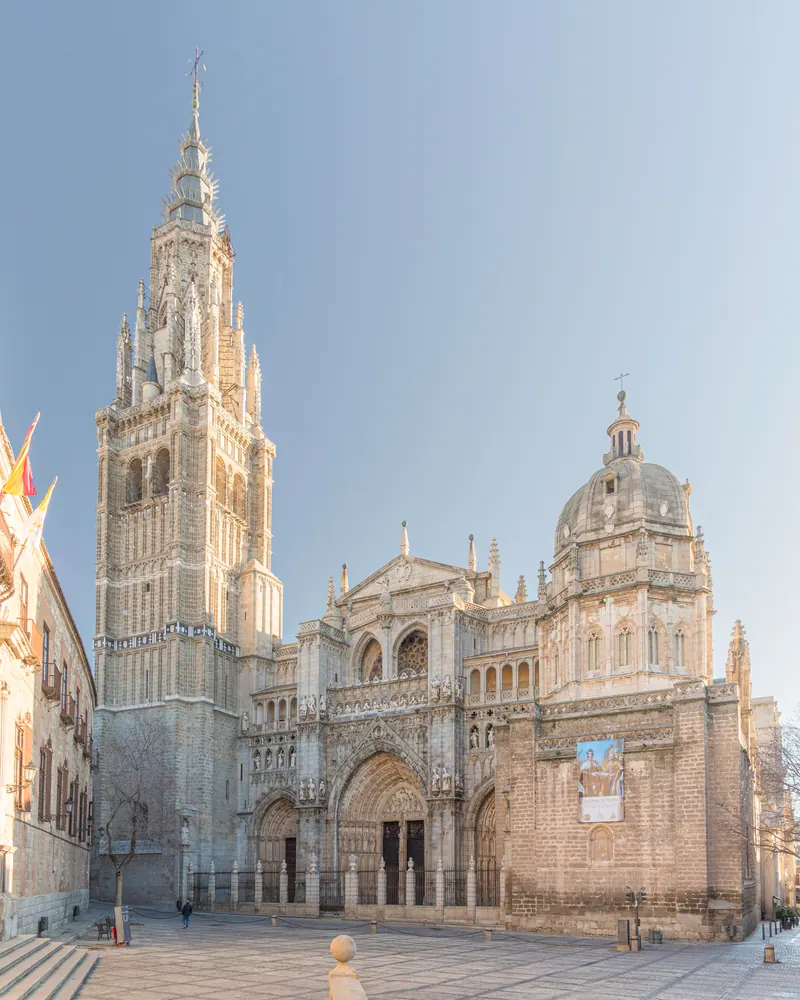
Toledo Cathedral

Begun 1226 under Ferdinand III and Archbishop Jiménez de Rada; completed 1493, on the site of the Friday mosque

Begun in 1226 on the site of the city's Friday mosque, which had itself replaced the Visigothic cathedral, and finished in 1493 — five naves, a double ambulatory and vaults 44 m up. Come for the 09:00 mass in the Mozarabic Chapel, the only daily liturgy left anywhere in the pre-1080 Hispanic rite, and stay for the choir stalls carved with the fall of Granada town by town.

Works in the rain
Walking directions
Church

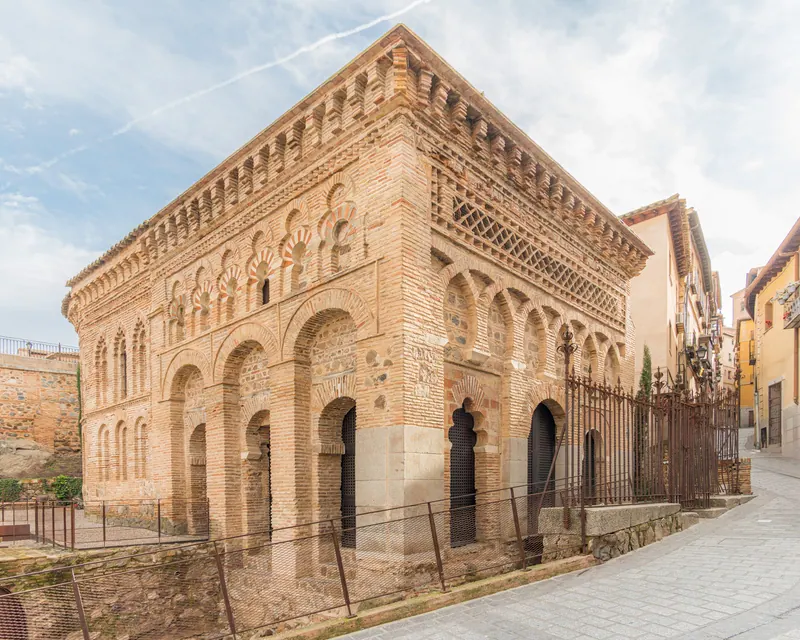
Mezquita del Cristo de la Luz

Built as the mosque of Bāb al-Mardūm in 999; Christian apse added c. 1182, the earliest known Mudéjar work

A mosque of the year 999, standing more or less intact on the north slope, with a Christian apse grafted onto it a century after Alfonso VI took the city. Go round to the outside wall and find the Kufic brick inscription that gives the date and the patron — it was hidden behind a later wall until 1899.

Free or cheap Quiet corner
Walking directions
Church

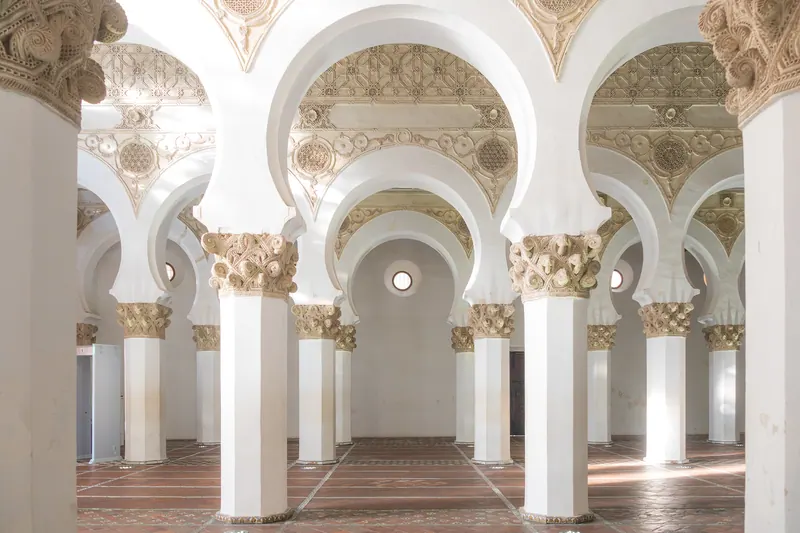
Sinagoga de Santa María la Blanca

Built as the Great Synagogue, late 12th century, in Almohad style; rebuilt after a fire of 1250; taken as a church c. 1411

Built as Toledo's Great Synagogue in the late 12th century, by Muslim craftsmen, for a Jewish congregation, under a Christian king — then taken as a church around 1411 and kept by the Catholic Church ever since. Stand at the west end and count the arcades: thirty-two horseshoe arches on brick octagons, whitewashed, with Almohad plasterwork above them.

Quiet corner Free or cheap
Walking directions