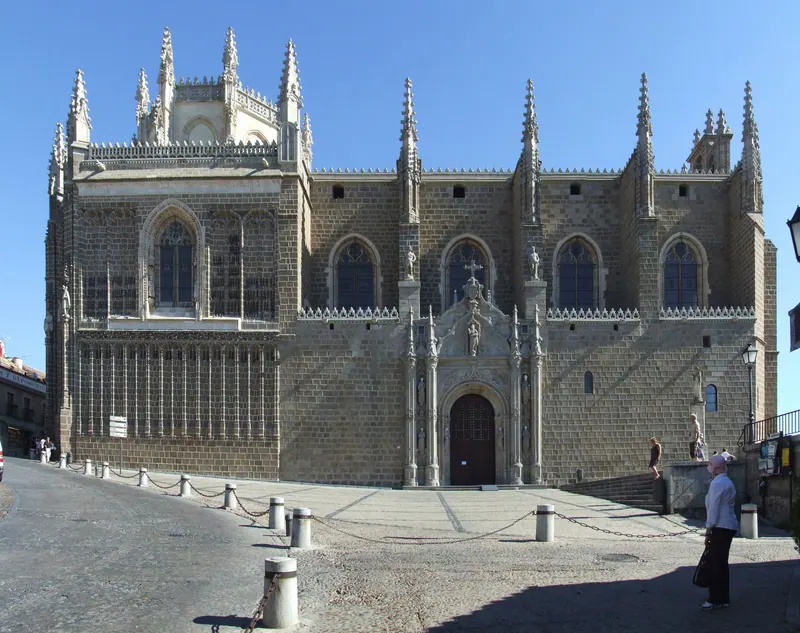
The Catholic Monarchs commissioned this monastery in 1477 to mark their victory at Toro the year before and, from 1478, the birth of their heir Prince Juan. It was meant to be their pantheon: they intended to be buried here. Then Granada fell in 1492, and they changed their minds and chose Granada instead — which is why the grandest royal mausoleum in Castile has no royal tomb in it.
The architect was Juan Guas, described by the monument’s own account as a Breton, with decorative carving by the Fleming Egas Cueman. What they produced is the definitive statement of Isabelline Gothic: a single tall nave, a star-vaulted crossing, and transept walls carrying coats of arms so large that the eagle of Saint John holding them spans the wall, with the yoke and the sheaf of arrows — Ferdinand’s and Isabella’s badges — repeated everywhere you look.
The cloister is the reason to go in. Two storeys: below, dense late-Gothic tracery and a garden of orange trees; above, a Mudéjar coffered ceiling running the whole way round, because even the Catholic Monarchs’ architect used Muslim carpenters. The gargoyles on the upper level are worth a slow circuit — they include animals doing distinctly unecclesiastical things.
On the outside, hanging along the north wall, are the iron chains and fetters. Toledo Monumental describes them as the shackles worn by Christian captives of the Nasrid kingdom of Granada, hung here after their release. They are the most direct object in the city: not a symbol of a war, but the ironmongery of one.
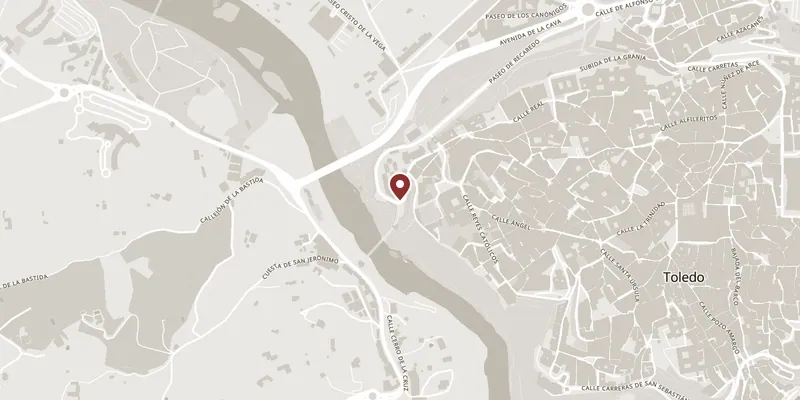
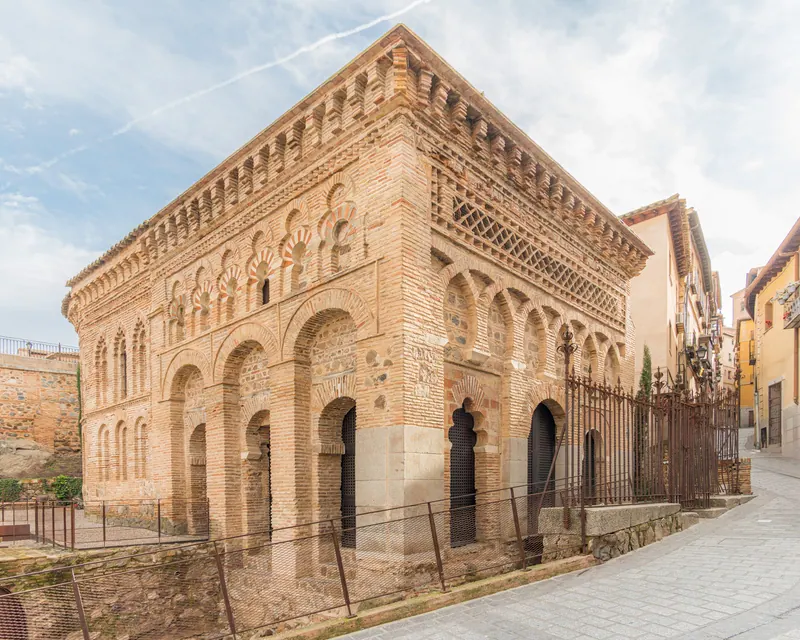
The French quartered troops in the monastery in 1808 and wrecked it; the cloister was rebuilt across the nineteenth and twentieth centuries, and the joins are visible if you look for changes in the stone. Franciscans are still resident. It stands at the western end of the old Jewish quarter, on the same street as Santa María la Blanca — three minutes apart, which is a fact worth sitting with.