Medieval Booker

Museum ◆ Toledo

Iglesia de San Román and the Museum of the Councils

A church consecrated in 1221 by the same archbishop who began the cathedral five years later — built in Islamic technique, on horseshoe arches carried by looted Roman and Visigothic capitals, and painted right round with a Last Judgement of the 1270s. It holds the city's Visigothic collection, admission is currently free, and hardly anyone finds it.

Where and when

Where
Calle San Román s/n, 45002 Toledo, Toledo, Spain Open in Google Maps Walking directions
Era
Consecrated 1221 by Archbishop Rodrigo Jiménez de Rada; wall paintings of the 1270s; museum since 1968
Opening
Tuesday–Saturday 10:00–14:00 and 16:00–18:00; Sunday 09:00–15:00; closed Mondays and on 6 and 23 January, 1 May and 24, 25 and 31 December (as of August 2026)
Price
Listed by Toledo's tourism office as "Gratuito (temporalmente)" — free, temporarily. Treat the free entry as provisional and expect a small charge to return one day (as of August 2026)
Best time
Late morning on a weekday, before it shuts at 14:00. The paintings need what daylight the small windows give, so avoid the last hour of a winter afternoon.
Good for
Free or cheapQuiet cornerWorks in the rain
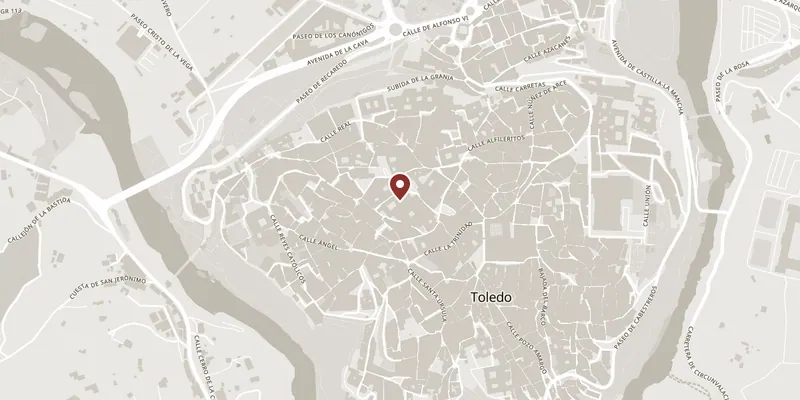
Map showing where Iglesia de San Román and the Museum of the Councils is
Open in Google Maps Walking directions © MapTiler © OpenStreetMap contributors

Checked

What is Iglesia de San Román and the Museum of the Councils?

San Román is the building that carries the first third of Toledo’s story, the part most visitors miss entirely because they arrive looking for synagogues and cathedrals.

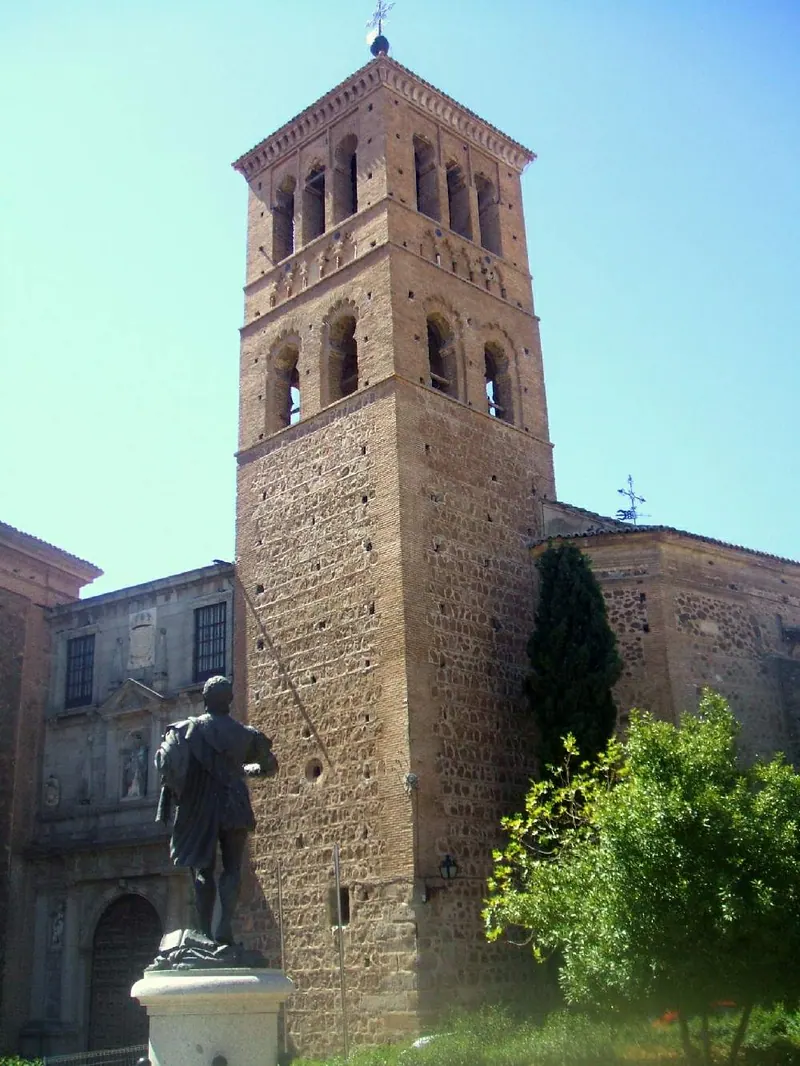
The church was consecrated in 1221 by Rodrigo Jiménez de Rada — the archbishop who laid out the Gothic cathedral five years later, and who wrote the chronicle most of what we know about thirteenth-century Castile comes from. What he consecrated was not Gothic at all: it is the standard example of the first Toledan Mudéjar, brick and horseshoe arches, and the arcades stand on capitals reused from earlier buildings, some of them Corinthian in inspiration, robbed from the Roman and Visigothic city. The free-standing tower at the west end was built at the end of the thirteenth century and is modelled directly on caliphal minarets.

The wall paintings date from the last quarter of the thirteenth century and cover the nave: saints, scenes of death and resurrection, the Last Judgement and Paradise. They are painted in a manner that was already old-fashioned when they were made, in a church of Islamic construction, for a Castilian congregation. Stand at the west end and take them as a single sweep before you look at anything in a case.

Since 1968 the building has housed the Museo de los Concilios y la Cultura Visigoda — the Museum of the Councils and Visigothic Culture, named for the church councils held at Toledo when it was the capital of Visigothic Spain, among them the third council of 589 at which King Reccared abandoned Arianism. The collection is architectural and epigraphic: carved capitals, reliefs, inscriptions and other material from the Visigothic city.

Manage one expectation. The votive crowns of Guarrazar, the great Visigothic gold treasure dug up a few kilometres from here in 1858, are not in this museum: they are in the Museo Arqueológico Nacional in Madrid and the Musée de Cluny in Paris. What is here is the stone city, not the gold.

Admission is listed by Toledo’s tourism office as free, temporarily. The hours are split by a long lunch — check them before you walk up.
What visitors say

4.7 from 274 ratings

  • Alanna Albert

    5 out of 5 10 months ago

    Churches are a must visit while in Madrid. This one is hard to find but well worth the search. Seniors are free and adults are 3€. How inexpensive to get a feel for the past. The architecture is beautiful and different than what we see in North America. Unfortunately, for English speakers because the antiquities descriptions are all in Spanish.

    Read this review on Google
  • J. A.

    4 out of 5 11 months ago

    The Visigothic Museum and the Church of San Roman are the same. There is a nice mixture of religion styles. The church has Arabic and Visigothic artifacts on display. Some frescos were restored. Unfortunately explanations are only in Spanish. From a Unesco World Heritage City I would expect at least explanations in English. This remark applies for other Toledo sites like the Roman Baths as well. Entrance was free. When I was there it was almost empty, so it was very quiet. Not a must see if you have little time but worth it if you are in the area.

    Read this review on Google
  • MICHAEL LEE

    5 out of 5 4 years ago

    The Visigothic Museum and the Church of San Roman are one and the same. The church has Visigothic features, Mozarabic, and numerous Visigothic artifacts, very well curated in Spanish, but you can use Google Translate and import images of the written text posted into any language. The frescos (muralles) were restored in the 20th Century. You can see some fragments that were too deteriorated to be restored.

    Read this review on Google

Ratings and reviews from Google. See all on Google Maps

Frequently asked questions

How much does the Museo de los Concilios cost?

Toledo's tourism office lists admission as free on a temporary basis as of August 2026. Check before travelling, as that wording implies it may change.

What is the Museum of the Councils and Visigothic Culture?

The city's collection of Visigothic-era material — capitals, reliefs and inscriptions from the time when Toledo was the capital of Visigothic Spain — installed since 1968 in the church of San Román. It is named for the church councils held in the city, including the third, in 589.

Are the Guarrazar crowns in Toledo?

No. The Visigothic votive crowns found at Guarrazar near Toledo in 1858 are held by the Museo Arqueológico Nacional in Madrid and the Musée de Cluny in Paris, not by this museum.

How old is the church of San Román?

It was consecrated in 1221 by Archbishop Rodrigo Jiménez de Rada and is the standard example of the earliest Toledan Mudéjar. The free-standing tower was built at the end of the thirteenth century, modelled on caliphal minarets.

When is San Román open?

Tuesday to Saturday 10:00–14:00 and 16:00–18:00, and Sunday 09:00–15:00, as of August 2026. It closes on Mondays and shuts for two hours in the middle of the day.

Festivals in Toledo

Medieval festivals in Toledo
Featured
Historic City Celebrations

Corpus Christi in Toledo

Toledo, Spain

On Corpus Christi the 16th-century Custodia de Arfe, a three-metre Gothic tower of gilded silver, is carried out of Toledo Cathedral and through two kilometres of streets hung with awnings and tapestries and strewn with thyme, behind the banners of the city's old confraternities and guilds. Toledo keeps the feast on its traditional Thursday, sixty days after Easter: 4 June in 2026, and 27 May expected in 2027.

Expected 2027
Family

More places in Toledo

Places in Toledo
Church Start here

Toledo Cathedral

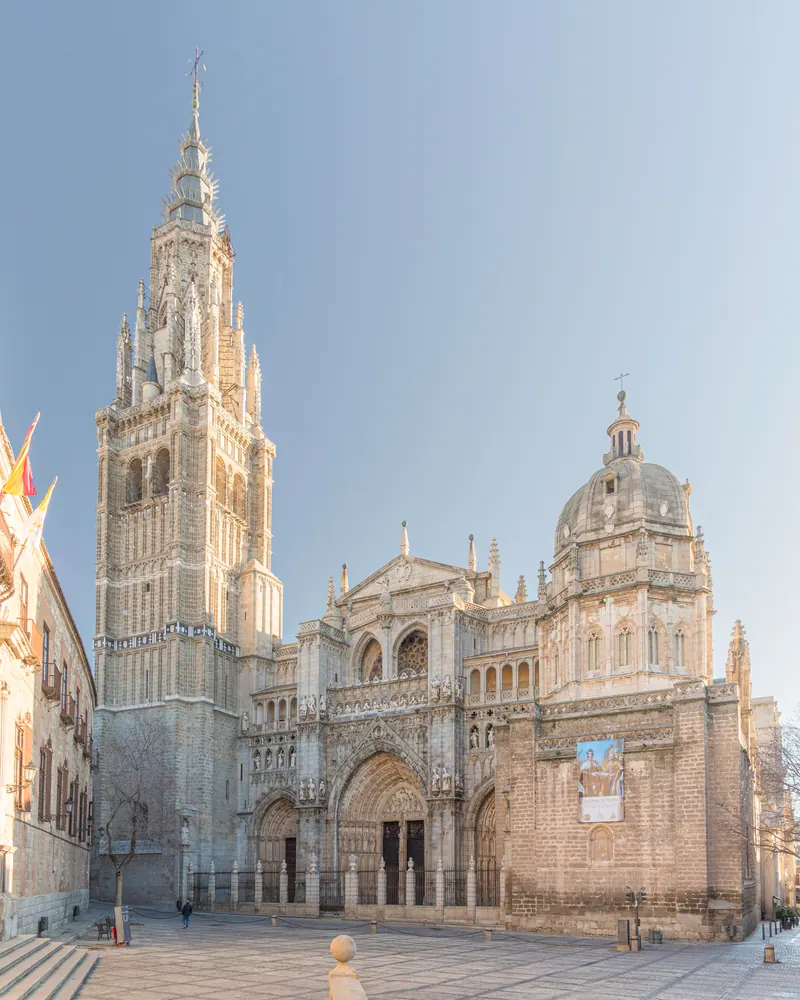
Begun 1226 under Ferdinand III and Archbishop Jiménez de Rada; completed 1493, on the site of the Friday mosque

Begun in 1226 on the site of the city's Friday mosque, which had itself replaced the Visigothic cathedral, and finished in 1493 — five naves, a double ambulatory and vaults 44 m up. Come for the 09:00 mass in the Mozarabic Chapel, the only daily liturgy left anywhere in the pre-1080 Hispanic rite, and stay for the choir stalls carved with the fall of Granada town by town.

Works in the rain
Walking directions
Church

Mezquita del Cristo de la Luz

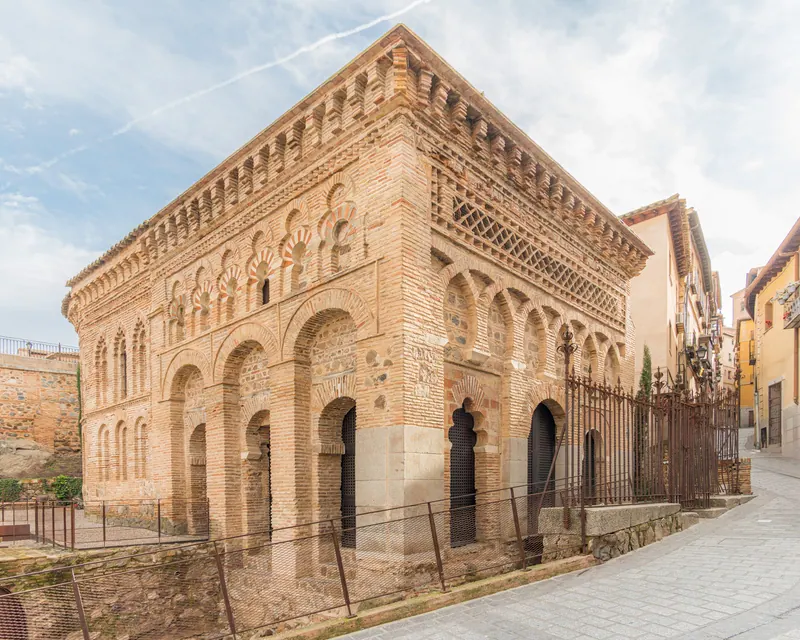
Built as the mosque of Bāb al-Mardūm in 999; Christian apse added c. 1182, the earliest known Mudéjar work

A mosque of the year 999, standing more or less intact on the north slope, with a Christian apse grafted onto it a century after Alfonso VI took the city. Go round to the outside wall and find the Kufic brick inscription that gives the date and the patron — it was hidden behind a later wall until 1899.

Free or cheap Quiet corner
Walking directions
Church

Sinagoga de Santa María la Blanca

Built as the Great Synagogue, late 12th century, in Almohad style; rebuilt after a fire of 1250; taken as a church c. 1411

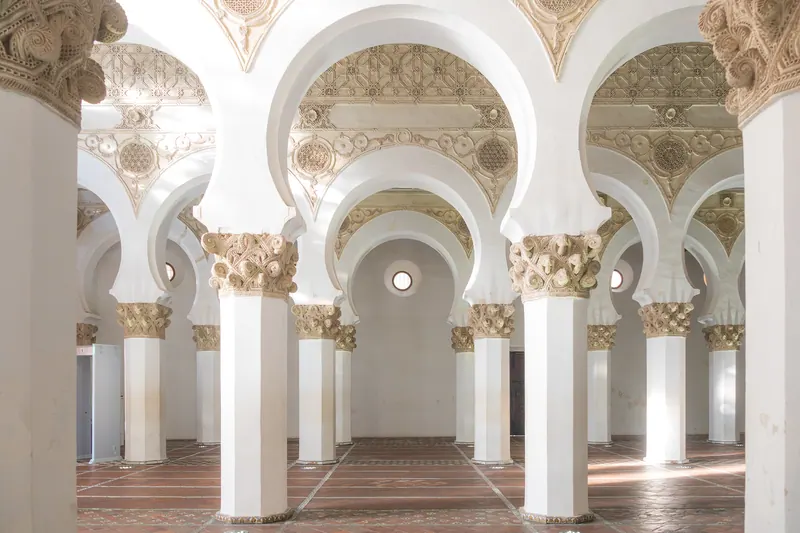
Built as Toledo's Great Synagogue in the late 12th century, by Muslim craftsmen, for a Jewish congregation, under a Christian king — then taken as a church around 1411 and kept by the Catholic Church ever since. Stand at the west end and count the arcades: thirty-two horseshoe arches on brick octagons, whitewashed, with Almohad plasterwork above them.

Quiet corner Free or cheap
Walking directions