Medieval Booker

Museum ◆ Toledo

Alcázar de Toledo and the Museo del Ejército

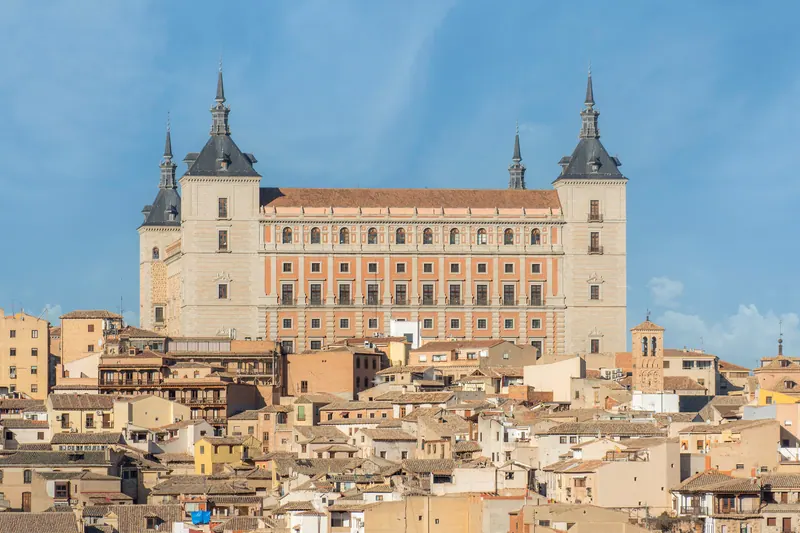
The square fortress on the highest point of the city is almost entirely a post-1936 rebuild — but underneath it lie Roman, Visigothic and Islamic foundations and a rock-cut cistern, and inside it sits Spain's national army museum. The archaeological level and the room on armies before the modern army are free to walk into on any day, without a ticket.

Where and when

Where
Calle Unión s/n, Alcázar de Toledo, 45001 Toledo, Toledo, Spain Open in Google Maps Walking directions
Era
Fortified since Roman times, rebuilt after 1085 and again under Charles V; destroyed in 1936 and rebuilt; museum since 2010
Opening
Tuesday–Sunday 10:00–17:00 according to the museum's own site; closed Mondays and on 1 and 6 January, 1 May and 24, 25 and 31 December. Toledo's tourism office lists a 16:30 close, so do not arrive after about 15:30 (as of August 2026)
Price
Permanent exhibition €5; free every Wednesday, and on 29 March, 18 April, 18 May, 12 October and 6 December. Free at all times for under-18s, EU citizens over 65, the unemployed, large families and youth-card holders. The archaeological remains, the gardens, the temporary exhibitions and the room "Los ejércitos antes del Ejército" are free to visit on any day (as of August 2026)
Best time
A Wednesday, when the whole permanent exhibition is free, or the first hour after 10:00 on any day. Allow two hours for the pre-1700 material and the archaeology; four if you intend to do the lot.
Good for
Works in the rainGood with childrenFree or cheap
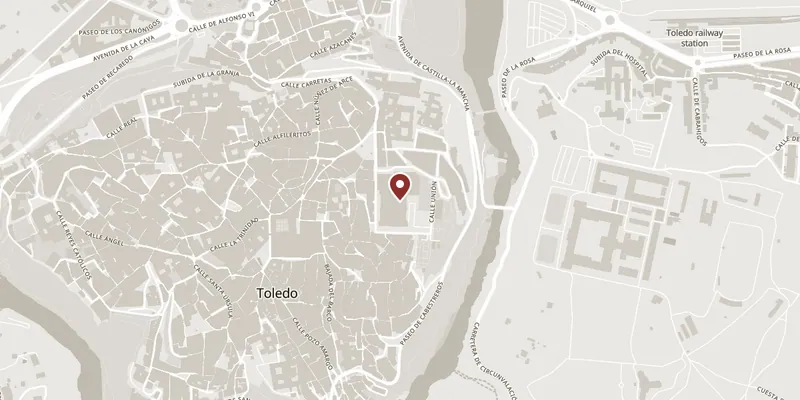
Map showing where Alcázar de Toledo and the Museo del Ejército is
Open in Google Maps Walking directions © MapTiler © OpenStreetMap contributors

Checked

What is Alcázar de Toledo and the Museo del Ejército?

Be clear about what this building is before you climb up to it. There has been a stronghold on this rock since Roman times; the Muslim governors held their al-qaṣr here, Alfonso VI and Alfonso X rebuilt it after 1085, and Charles V turned it into a Renaissance palace in the sixteenth century. Then it burned in 1710, burned again under the French in 1810, burned once more in 1887, and in 1936 was besieged for ten weeks and reduced to rubble. What stands today is a reconstruction of the mid-twentieth century, put up by the Franco regime as a monument to that siege. There is essentially no medieval fabric above ground.

The medieval city is underneath. When the museum was extended from 2003 the excavations were kept and incorporated, and the archaeological remains below the building run from the Bronze Age through Roman, Visigothic and Islamic levels — including a Roman cistern about nine metres deep cut into the rock. That is the oldest thing you can stand next to in Toledo, and the museum’s own visitor page lists the archaeological remains among the areas that are free to visit on any day, along with the gardens, the temporary exhibitions and the room “Los ejércitos antes del Ejército” — armies before the Army, which is the pre-modern one.

The ticketed part is the Museo del Ejército, moved here from Madrid in 2010: twenty rooms, a collection above 35,000 objects, arranged both chronologically and by theme. For our purposes the thematic rooms are the point — artillery, flags and standards, firearms, and the arma blanca room of edged weapons. The museum’s own collection page for edged weapons is headed by a Nasrid jineta sword attributed to Boabdil, the last emir of Granada. It does not publish which gallery any given piece is in, so ask at the desk if that is what you came for.

The honest caveats: the great majority of the museum is eighteenth to twentieth century, and the 1936 siege — a founding myth of the Franco regime — is still politically live in Spain and is handled here at length.
What visitors say

4.5 from 6,509 ratings

  • Christine Smith

    4 out of 5 a month ago

    Very interesting and extensive museum. There was also an exhibit on show of the part that Spain played in creating the USA. Added bonus, although we are English we are Spanish residents and got in for free.

    Read this review on Google
  • Tolga

    4 out of 5 2 months ago

    This towering fortress is a masterclass in how a building's exterior can completely misrepresent what is waiting inside. If you’re picturing a romantic stroll through the intact, medieval chambers of Emperor Charles V, let’s burst that bubble right now. The Alcázar of Toledo has been entirely gutted and transformed into Spain's National Army Museum—which, practically speaking, is an inescapable, heavily modernized labyrinth of sterile glass display boxes. Make no mistake, the sheer volume of military history is staggering. You’ll find everything from ancient Roman foundations in the basement to the chilling, bullet-shredded office of General Moscardó from the 1936 siege. But the layout is a notoriously rigid, one-way conveyor belt. Once you commit to a wing, you are locked into a multi-hour march past thousands of swords, medals, and mannequins in uniforms. If you aren't a hardcore military history buff, museum fatigue will hit you like a physical wall about forty-five minutes in. Here is how you actually survive it, because a little strategy goes a long way: First, respect the geography. The Alcázar sits at the absolute highest point of Toledo. Do not try to heroically hike up from the train station in the blazing summer heat. Save your sanity—take the city's hidden mechanical escalators or a local bus straight to Plaza de Zocodover, leaving you with a short, flat walk to the entrance. Logistically, the rules are aggressively strict. You will be forced to surrender any large bags or backpacks to the mandatory cloakroom, and security is airport-level tight. However, that heavy modernization brings one massive, unexpected victory: the entire complex is flawlessly equipped with spacious elevators and ramps, making it fully wheelchair accessible—an absolute rarity in a steep, ancient, cobblestone city like Toledo. Timing is everything. Because the doors are firmly locked on Mondays, Tuesday mornings become a chaotic, shoulder-to-shoulder bottleneck of massive tour groups. To preserve your peace, aim for a Wednesday afternoon, or go on a Sunday when admission is actually free (though expect a denser crowd). Keep in mind the doors close at 5:00 PM, and they start clearing the rooms aggressively 30 minutes prior. The real secret? The absolute best parts of the building aren't the relics behind the glass. Push through the military displays, step out into the grand central courtyard, and find the upper terraces. That is where you get the sweeping, panoramic views of the Tagus River and the sprawling plains below. Come for the views, tolerate the endless swords, and whatever you do, wear comfortable walking shoes.

    Read this review on Google
  • Julio N

    5 out of 5 6 months ago

    The museum is big, so go with at least 2 hours to see everything. It is very good, not only to understand the history of the Spanish Army, but also to learn about the history of Toledo and the formation of Spain as a country.

    Read this review on Google

Ratings and reviews from Google. See all on Google Maps

Frequently asked questions

Is the Alcázar de Toledo an original medieval castle?

No. The site has been fortified since antiquity, but the present building is a reconstruction of the mid-twentieth century after the fortress was destroyed in the siege of 1936. The medieval and older remains survive below it, at the archaeological level.

How much is the Museo del Ejército in Toledo?

€5 for the permanent exhibition as of August 2026, free every Wednesday and free at all times for under-18s, EU over-65s, the unemployed and large families.

What can you see at the Alcázar without paying?

The museum lists the archaeological remains, the gardens, the temporary exhibitions, the room "Los ejércitos antes del Ejército", the library, the shop and the café as free to visit on any day.

Are there medieval weapons in the Museo del Ejército?

Yes, in the thematic rooms — artillery, edged weapons, flags and firearms. The edged-weapons collection is headed by a Nasrid jineta sword attributed to Boabdil, the last emir of Granada, though the museum does not publish which gallery individual pieces are shown in.

What are the archaeological remains under the Alcázar?

Levels running from the Bronze Age through Roman, Visigothic and Islamic Toledo, uncovered during the museum's extension from 2003 and kept in place, including a Roman cistern about nine metres deep cut into the rock.

Festivals in Toledo

Medieval festivals in Toledo
Featured
Historic City Celebrations

Corpus Christi in Toledo

Toledo, Spain

On Corpus Christi the 16th-century Custodia de Arfe, a three-metre Gothic tower of gilded silver, is carried out of Toledo Cathedral and through two kilometres of streets hung with awnings and tapestries and strewn with thyme, behind the banners of the city's old confraternities and guilds. Toledo keeps the feast on its traditional Thursday, sixty days after Easter: 4 June in 2026, and 27 May expected in 2027.

Expected 2027
Family

More places in Toledo

Places in Toledo
Church Start here

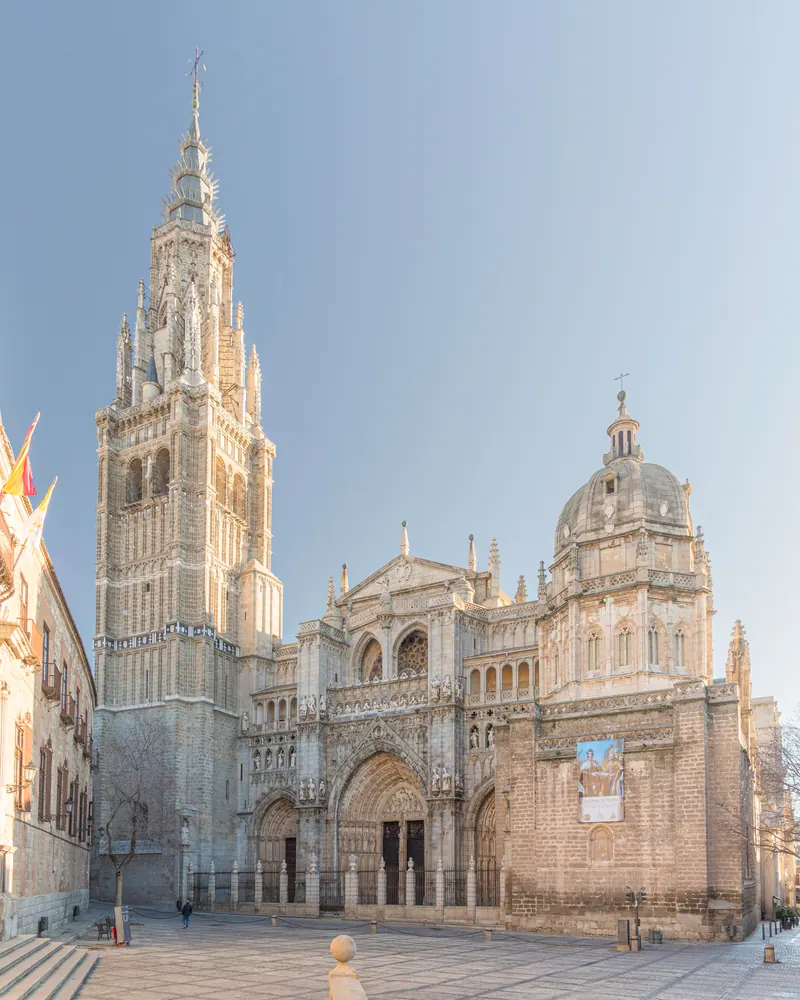
Toledo Cathedral

Begun 1226 under Ferdinand III and Archbishop Jiménez de Rada; completed 1493, on the site of the Friday mosque

Begun in 1226 on the site of the city's Friday mosque, which had itself replaced the Visigothic cathedral, and finished in 1493 — five naves, a double ambulatory and vaults 44 m up. Come for the 09:00 mass in the Mozarabic Chapel, the only daily liturgy left anywhere in the pre-1080 Hispanic rite, and stay for the choir stalls carved with the fall of Granada town by town.

Works in the rain
Walking directions
Church

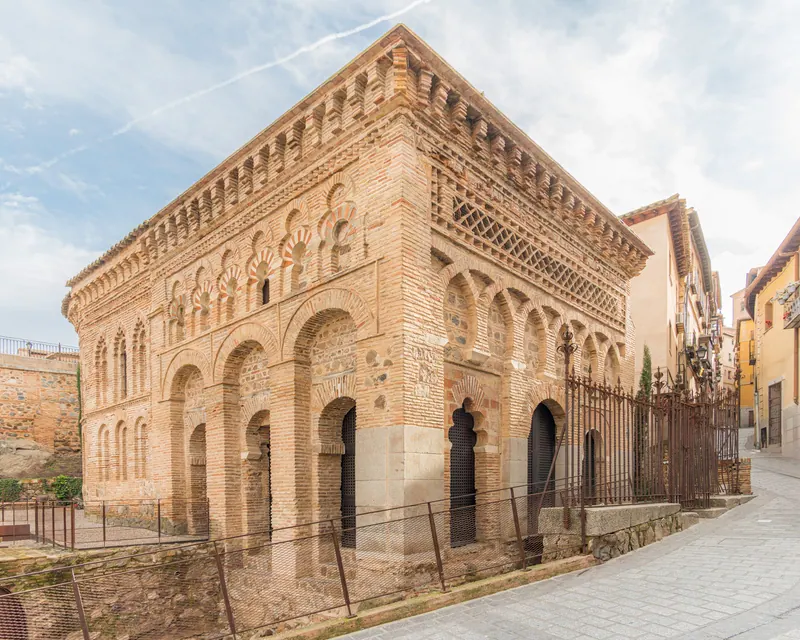
Mezquita del Cristo de la Luz

Built as the mosque of Bāb al-Mardūm in 999; Christian apse added c. 1182, the earliest known Mudéjar work

A mosque of the year 999, standing more or less intact on the north slope, with a Christian apse grafted onto it a century after Alfonso VI took the city. Go round to the outside wall and find the Kufic brick inscription that gives the date and the patron — it was hidden behind a later wall until 1899.

Free or cheap Quiet corner
Walking directions
Church

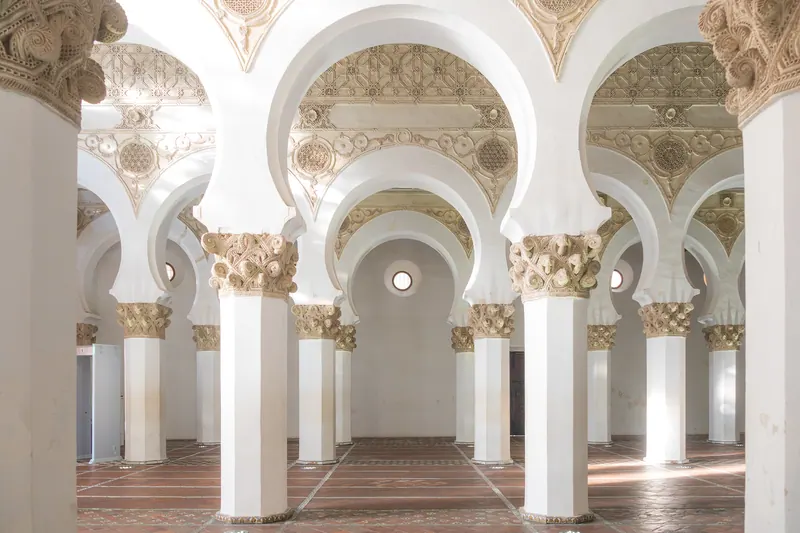
Sinagoga de Santa María la Blanca

Built as the Great Synagogue, late 12th century, in Almohad style; rebuilt after a fire of 1250; taken as a church c. 1411

Built as Toledo's Great Synagogue in the late 12th century, by Muslim craftsmen, for a Jewish congregation, under a Christian king — then taken as a church around 1411 and kept by the Catholic Church ever since. Stand at the west end and count the arcades: thirty-two horseshoe arches on brick octagons, whitewashed, with Almohad plasterwork above them.

Quiet corner Free or cheap
Walking directions