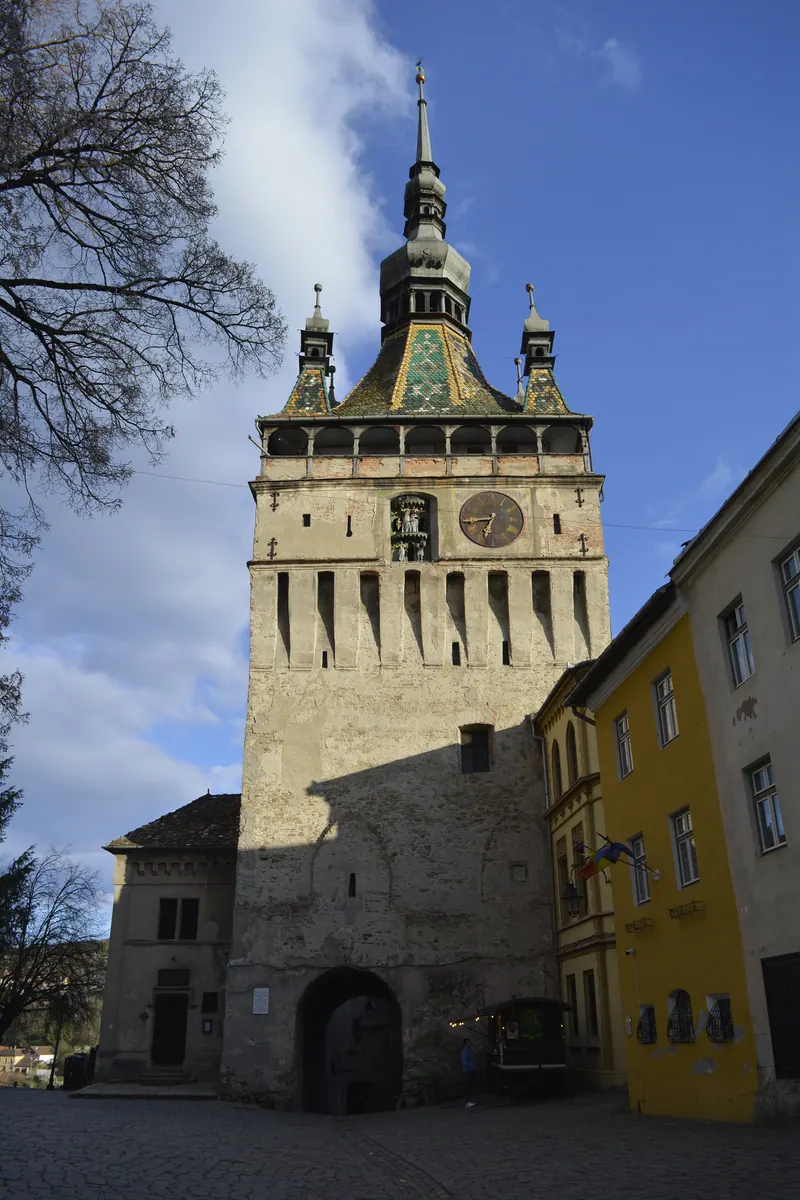
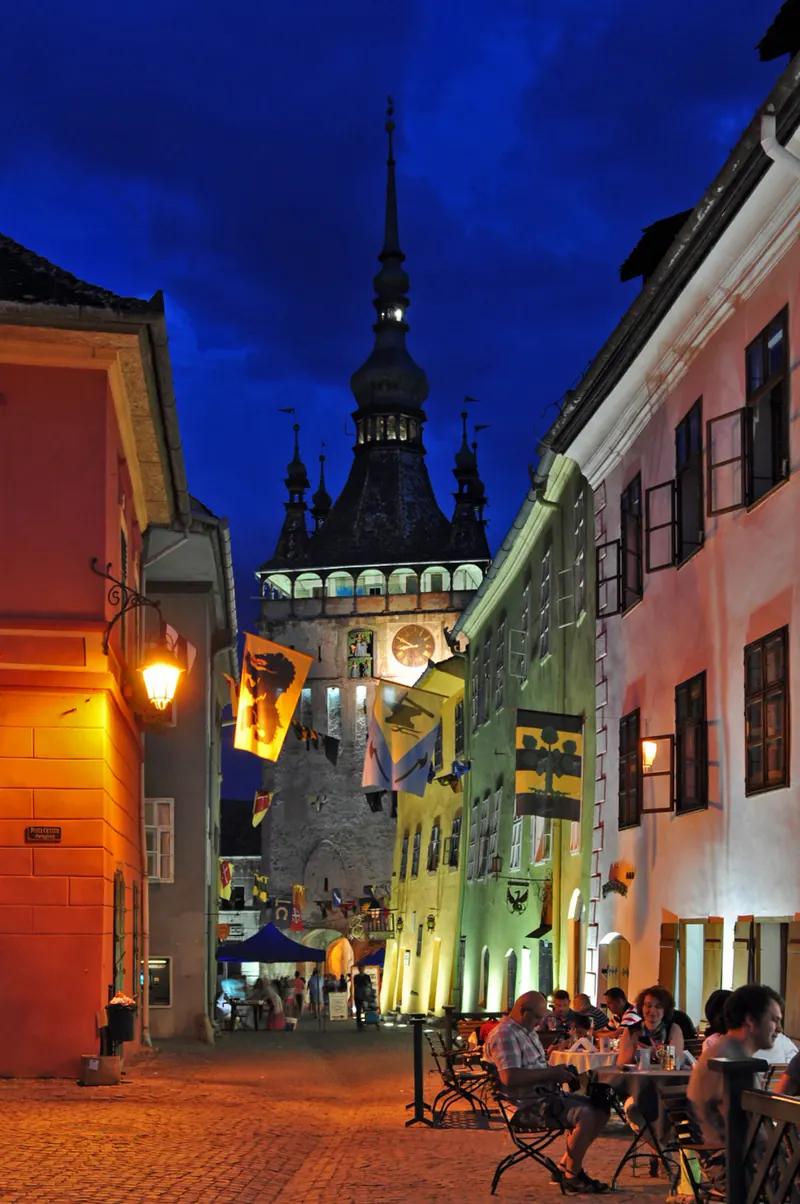
This is the main gate of the citadel and always was: everything else in Sighișoara is reached by walking under it. The tower went up in the second half of the 14th century, burned with the rest of the town on 30 April 1676 and was re-roofed in 1677 in the Baroque shape it still has, with four small turrets at the corners. The town’s own museum service is explicit about why those turrets are there — they signalled the town’s judicial autonomy, its right to try and hang its own people. Coloured glazed tiles were laid on the roof in 1894. Until 1556 the council of Sighișoara met on the first floor.
The clock has two faces, 2.40 m across, one turned into the citadel and one down at the lower town. In 1648 the clockmaker Johann Kirchel fitted carved and painted linden-wood figures about 0.80 m tall into niches beside them. On the lower-town side stand the seven gods of the days of the week, each with the metal that alchemy assigned to its planet: Diana for Monday and silver, Mars for Tuesday and iron, Mercury for Wednesday, Jupiter for Thursday and tin, Venus for Friday and copper, Saturn for Saturday and lead, and a crowned Sun for Sunday and gold. They advance once in twenty-four hours, at midnight. On the citadel side are Peace with an olive branch, a drummer, Justice and Law, and two angels — the day angel comes out at 06:00, the night angel with her candles at 18:00. The movement that drives all of it was installed in 1906.
Inside, the History Museum has been in the tower since 24 June 1899, founded by the physician Josef Bacon. Six levels and 110 steep steps take you past archaeology, an apothecary’s shop, guild chests, signs and tools, furniture, clocks, coins, and painted icons on wood and glass from the Târnava Mare villages. The guild material is the part that repays slow looking: this was a town run by its crafts, and each craft held a tower on the wall.
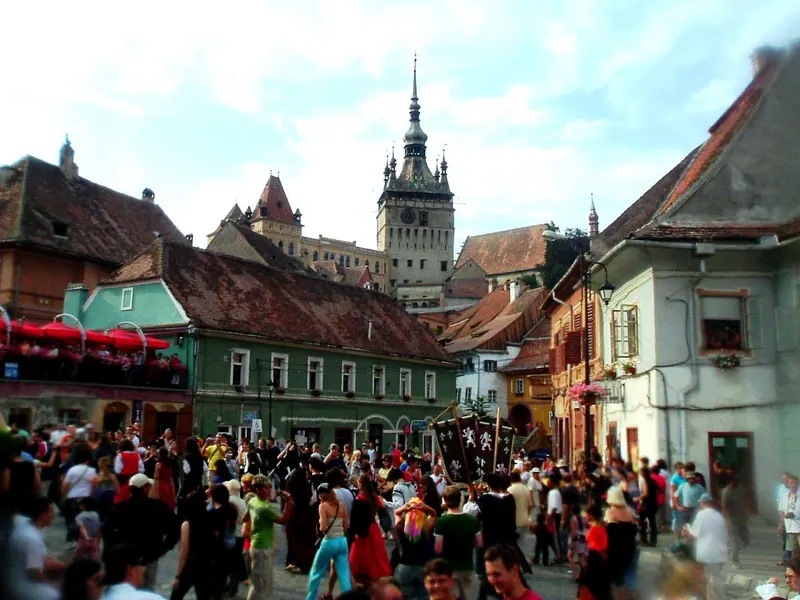
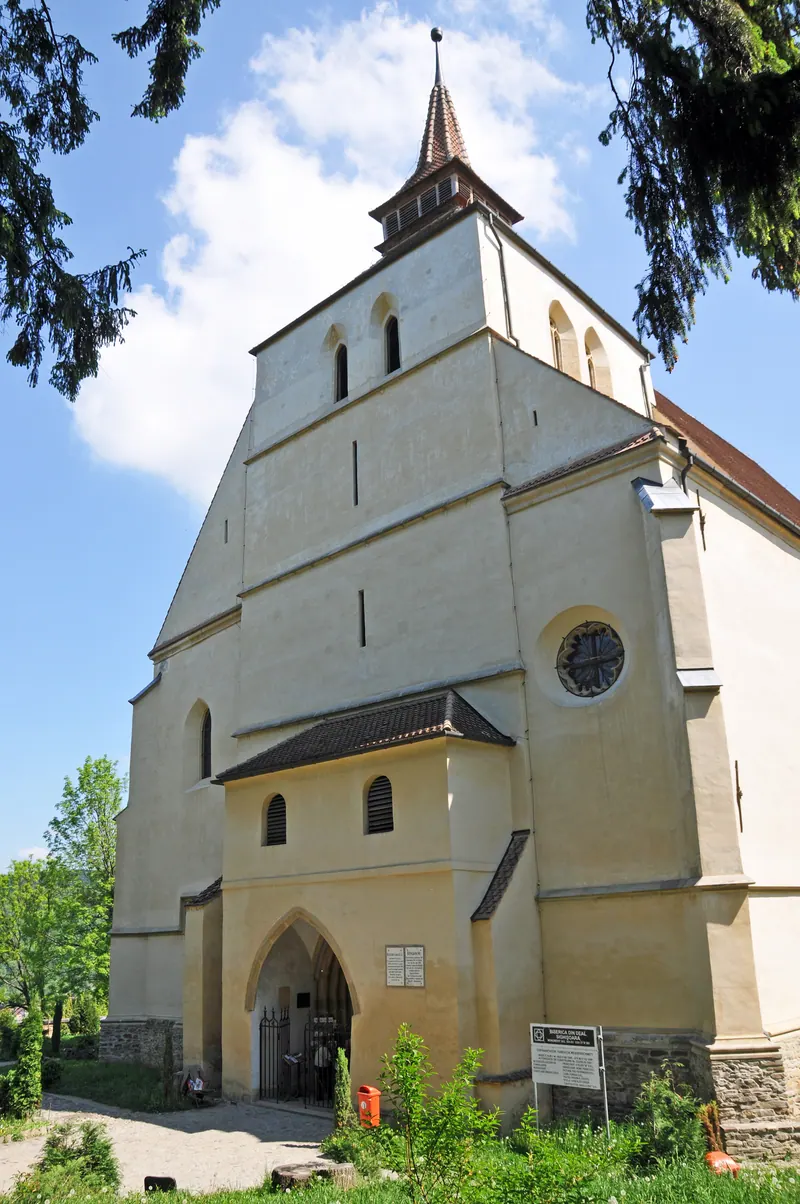
The top level opens onto the wooden gallery that runs right round the tower. From it you get the whole citadel roofscape, the Church on the Hill above the town, the lower town below and the Târnava Mare valley beyond — the single best orientation you can buy here, and worth doing first rather than last.