Start at the bottom, on Strada Școlii, and go up the Scara Școlarilor — the Scholars’ Stair, built in 1642 so that children walking to the school on the hill and the congregation walking to church could do it in snow without breaking a leg. It is a wooden tunnel with a tiled roof, climbing the hillside in one straight flight. It had about 300 steps until 1849, when the top section was removed; today the count is 175, or 176 depending on who is counting.
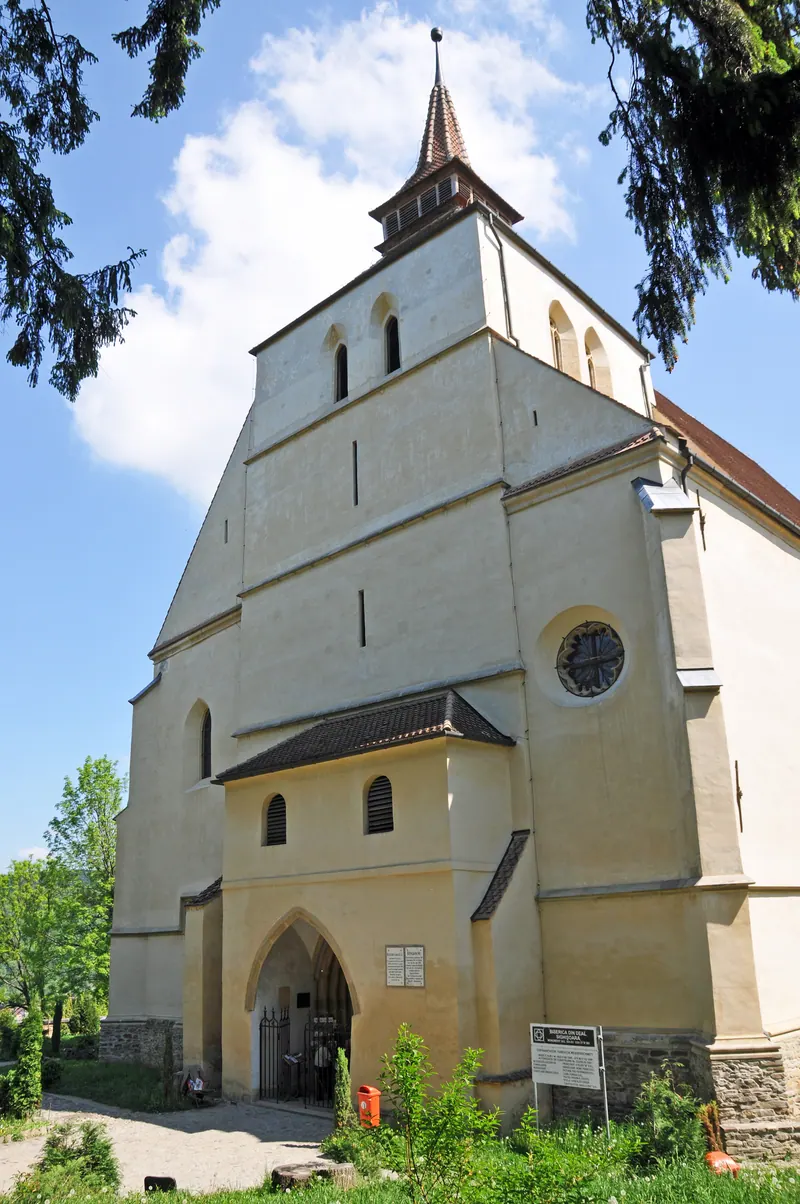
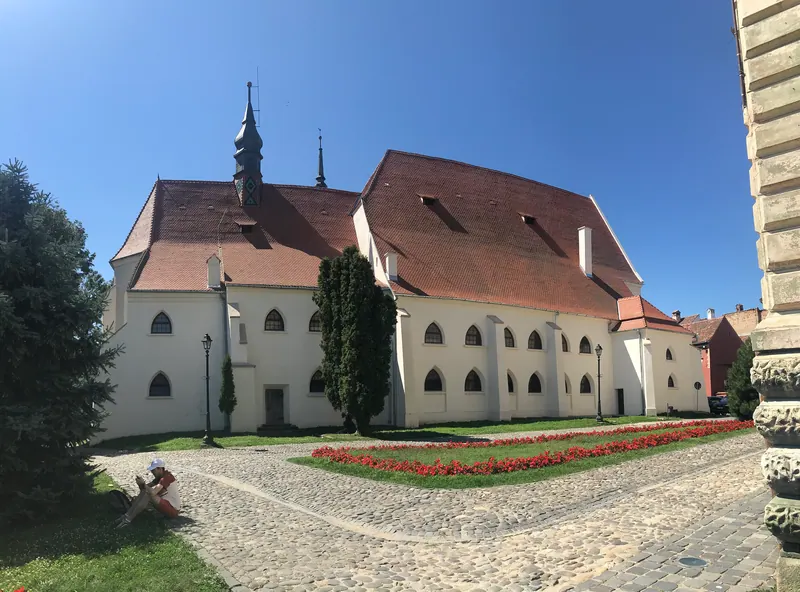
The church at the top was first mentioned in a document of 1345. An inscription in the building dates the great rebuilding to 1429–1488, when a basilica was reworked into a hall church: three aisles of nearly equal height, 53 m long, with a tower of 42 m on a square base 11 m a side. It was dedicated to St Nicholas. The Hungarian siege of 1704 wrecked the roof and brought the bells down, and the earthquake of 1838 destroyed the choir vaults — what you look up at over the choir is a wooden imitation of stone ribs.
The frescoes are the reason to pay. The choir and chancel arch were painted in 1483, attributed to Valentinus Pictor, who went on to become mayor of the town in 1490; the aisles followed in 1488, attributed to Jakobus Kendlinger. They were limewashed over in the 1770s, found again in 1934 and properly uncovered in the restoration campaign of the 1990s and early 2000s, paid for by the Messerschmitt Foundation and the Romanian Ministry of Culture. They survive as fragments rather than as a complete cycle. Look for St George and the dragon, told in three scenes, and the Archangel Michael weighing a soul.
Also here: a carved stone font dated 1480 under the chancel arch, a sacrament niche on the north side of the choir that Romanian art historians rank as a first-order piece of 15th-century Transylvanian carving, and an altarpiece of St Martin of 1520 attributed to Johannes Stoss, son of the Nuremberg sculptor Veit Stoss.
Under the choir is the crypt, the only medieval one known in Transylvania, holding burials of the town’s leading families from the 16th to the 18th century. It has been broken into repeatedly over the centuries by people hunting for grave goods.