Medieval Booker

Landmark ◆ Kraków

Wieliczka Salt Mine

Rock salt has been cut out of this hill since the 13th century, and the royal saltworks that ran it were one of the largest single sources of income the Polish crown had. It is 14 km from the Old Town and 27 minutes on the train — but it is guided-only, timed, over 800 steps down and two to three hours underground, so treat it as a half-day and book days ahead.

Where and when

Where
ul. Daniłowicza 10, 32-020 Wieliczka (14 km south-east of Kraków Old Town), Kraków, Poland Open in Google Maps Walking directions
Era
Rock salt mined here since the 13th century as the royal Kraków Saltworks; inscribed on the first UNESCO World Heritage list in 1978
Opening
Guided groups only, in timed slots booked by language. The Tourist Route runs through the day with English-language departures roughly every half hour in the middle of the day, but the timetable changes month by month and the mine publishes it per date inside its booking system. Allow two to three hours underground plus travel from Kraków (as of August 2026)
Price
We are not naming a figure. The mine's official price page is a booking widget rather than a printed tariff and would not yield a number to us in August 2026. What is clear about the structure: prices are seasonal (low 1 January–30 April and 1 October–31 December, mid 1 May–30 June and all September, high 1 July–31 August), English-language departures cost more than Polish ones, children under 4 go free, and reduced rates cover ages 4–19, students to 26 and over-65s. Secondary Polish sources read in August 2026 put a Tourist Route ticket somewhere between roughly 93 zł and roughly 143 zł a head depending on season and language. Get the real number from bilety.kopalnia.pl before you budget
Best time
The first English departure of the day, booked several days ahead in summer. It is 17–18 °C down there in every season, which makes a cold or wet Kraków day the right day to go.
Good for
Good with childrenWorks in the rain
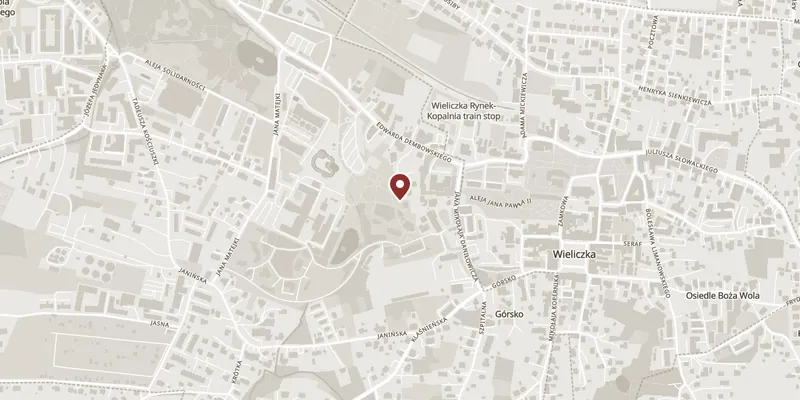
Map showing where Wieliczka Salt Mine is
Open in Google Maps Walking directions © MapTiler © OpenStreetMap contributors

Checked

What is Wieliczka Salt Mine?

Wieliczka and Bochnia have been mined for rock salt since the 13th century and were worked in parallel, continuously, into the late 20th. The żupy krakowskie — the Kraków Saltworks — were a royal monopoly, and Casimir III the Great gave them their own written statute. Salt is a large part of the answer to how a 14th-century Polish king paid for Wawel, the walls and a university. UNESCO put the mine on the very first World Heritage list in 1978, the same year as Kraków’s Old Town. The property today spreads over nine levels with about 300 km of galleries.

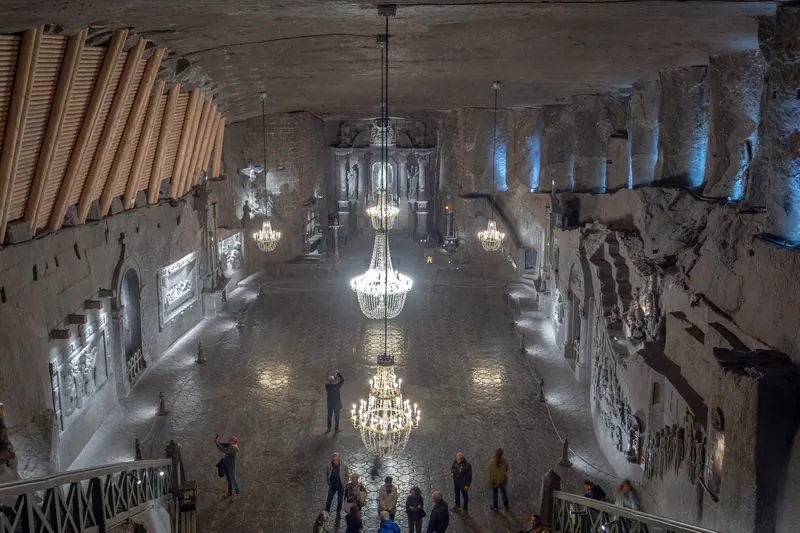
The Tourist Route is what almost everyone walks: about 3.5 km of that, down to 135 metres, over 800 steps, two to three hours, at a steady 17–18 °C all year. You return to the surface by lift. It passes worked-out chambers, brine lakes and a great deal of historic timbering.

Be clear about the period before you go. The salt-carved chapels and statues that fill every photograph of Wieliczka — St Kinga’s Chapel above all — are the work of miner-sculptors from the late 19th century onwards. They are extraordinary and they are not medieval. What is medieval here is the workings themselves: the shape of the chambers, the timbering, and the wooden extraction machinery — horse-powered hoists and haulage gear recovered from the pits — shown in the Cracow Saltworks Museum’s underground exhibition, roughly 7,500 m² on the same third level at 135 m. Whether that exhibition is covered by the mine ticket or sold separately is not stated plainly on the museum’s own pages; ask when you book.

The part the coach tours skip is above ground and five minutes’ walk away: the Saltworks Castle at ul. Zamkowa 8, the medieval administrative seat of the mine, now the other half of the same museum. The museum states that it contains the oldest exploratory shaft in Wieliczka, from the middle of the 13th century. If you came to Poland for the Middle Ages rather than for the salt chandeliers, that shaft is the most genuinely medieval thing on the whole site.

Getting there is easy and does not need a tour: a direct train from Kraków Główny to Wieliczka Rynek-Kopalnia takes about 27 minutes and runs roughly every half hour, and city bus 304 also serves the mine.
What visitors say

4.6 from 37,894 ratings

  • Holly T

    5 out of 5 a month ago

    Would definitely recommend visiting the salt mines, it's a really interesting trip. We did a guided tour and learnt so much! It was busy outside in the queues on a Saturday afternoon but we go in fairly quickly with the guided tour. There's around 800 steps to get down into the mine but a lift to get back to the top. Lots of walking so wear comfortable shoes. We took jackets as we thought it might be cold down there but it was actually very comfortable in shorts and a tshirt. You can buy food and refreshments at different intervals.

    Read this review on Google
  • Alexei Nikonovich-Kahn

    5 out of 5 a month ago

    A truly unique experience worth the time! At the end they will offer you an additional museum exhibit. You don’t see much that is unique, but you do often get a different guide which can really impact your experience! Overall a great experience and would recommend the additional exhibit if you have time and are curious to explore more, but rest assured the grandest sites are on the main route.

    Read this review on Google
  • Denis

    5 out of 5 2 months ago

    An incredible place that exceeded all expectations. It is hard to believe that such beauty exists deep underground. The enormous chambers, salt sculptures, chapels, and the scale of the entire mine are truly impressive. Every section reveals something new and fascinating. The tour is very engaging and well organized, and the history of this place is remarkable. It is one of Poland’s most unique attractions and definitely worth visiting at least once in a lifetime.

    Read this review on Google

Ratings and reviews from Google. See all on Google Maps

Frequently asked questions

Is Wieliczka worth it if you came for the Middle Ages?

Yes, with a caveat. The mine has been worked since the 13th century, it was the royal saltworks that funded a large share of the crown's income, and the underground museum holds wooden extraction machinery recovered from the old pits. But the famous salt chapels and sculptures are the work of miner-sculptors from the late 19th century onwards, not medieval carving.

How do you get to Wieliczka from Kraków?

It is about 14 km. A direct train from Kraków Główny to Wieliczka Rynek-Kopalnia takes around 27 minutes and runs roughly every half hour, and city bus 304 also goes to the mine. You do not need to buy an organised day tour to get there.

How long does the Wieliczka tour take?

Two to three hours underground on the Tourist Route, which covers about 3.5 km of galleries and descends to 135 metres, plus travel each way. Budget half a day from Kraków.

How many steps are there in the Wieliczka Salt Mine?

Over 800 on the way down, per the mine's own description of the Tourist Route. You come back up by lift rather than on foot. The mine says the route does not need above-average fitness, but the step count is the thing to weigh.

Can you visit Wieliczka without a guide?

No. The Tourist Route is walked in guided groups on timed slots, booked by language, through bilety.kopalnia.pl. Summer slots go several days in advance, so this is not a same-day decision in July or August.

What is the Saltworks Castle in Wieliczka?

The medieval administrative seat of the mine, at ul. Zamkowa 8 in the town, now the above-ground half of the Cracow Saltworks Museum. The museum says it holds the oldest exploratory shaft in Wieliczka, dating from the middle of the 13th century. Coach tours do not include it.

Festivals in Kraków

Medieval festivals in Kraków
Historic City Celebrations

Lajkonik Procession

Kraków, Poland

Once a year a bearded rider in Tatar dress on a white hobby-horse — the Lajkonik, or Konik Zwierzyniecki — parades across Kraków with a band and a costumed retinue, from Zwierzyniec to the Main Market Square, tapping bystanders with his mace for luck. The pageant is held on the octave of Corpus Christi, the Thursday eight days after Corpus Christi, and is organised by the Museum of Kraków; the 2026 edition was on 11 June and 3 June 2027 is expected.

Expected 2027
Family

More places in Kraków

Places in Kraków
Church Start here

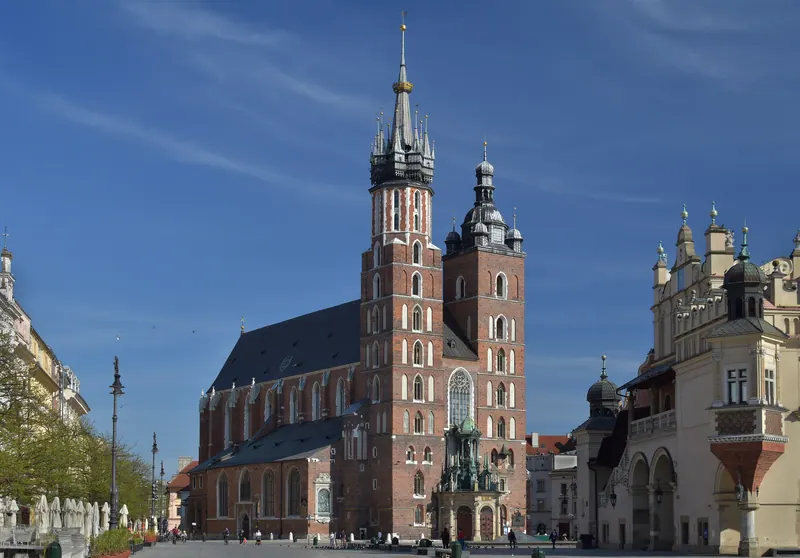
St Mary's Basilica

Chancel from the 1350s, nave completed late 14th century; Veit Stoss altarpiece 1477–89

Veit Stoss spent twelve years, from 1477 to 1489, carving the largest Gothic altarpiece in the world for the burghers of Kraków, and it still stands in the chancel it was made for. Be inside before 11:50, when the wings are opened by hand; the hejnał is played from the taller tower on the hour and breaks off mid-phrase.

Works in the rain Good with children
Walking directions
Castle

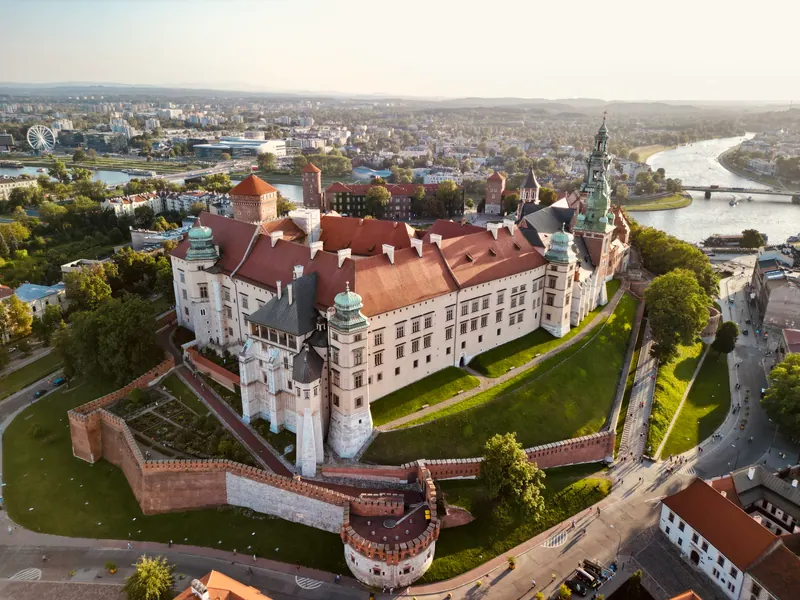
Wawel Royal Castle

Royal seat from the 11th century; Gothic castle of Casimir the Great, 14th century; Renaissance rebuilding 1507–1536

The seat of the Polish kings on the limestone hill above the Vistula — a Gothic castle of Casimir the Great rebuilt from 1507 around a three-tier arcaded courtyard. Nothing here is a single ticket: the two castle floors, the Crown Treasury and Armoury, the Castle Dungeons and the Dragon's Den are sold separately in timed slots with daily caps, so buy online before you walk up the hill.

Good with children Works in the rain
Walking directions
Church

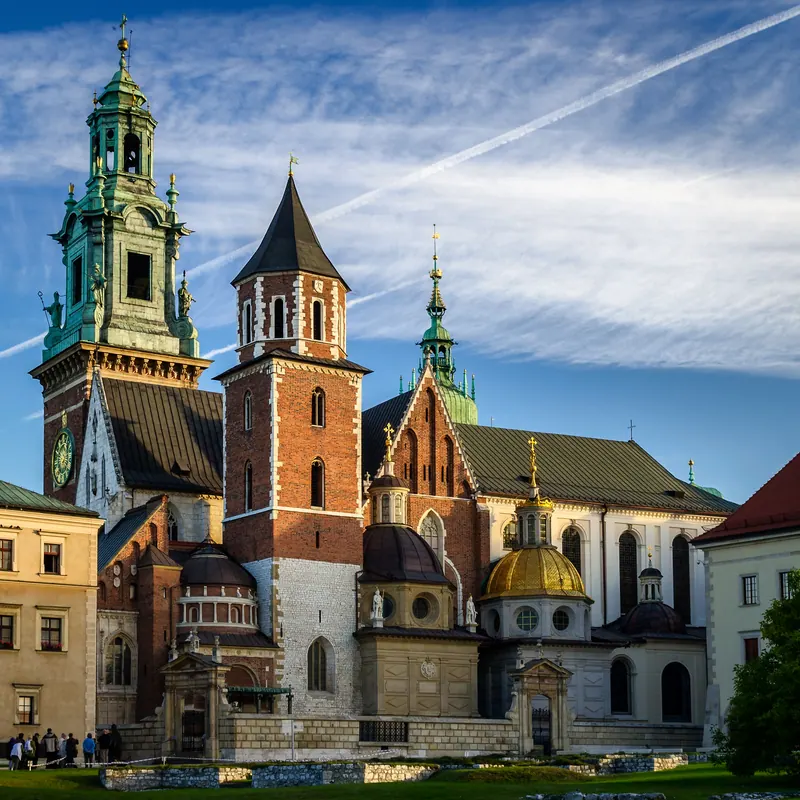
Wawel Cathedral

Gothic cathedral begun 1320, consecrated 1364; St Leonard's Crypt c. 1090–1118; Sigismund Bell cast 1520

The coronation and burial church of the Polish monarchy — kings crowned here from 1320 to 1734, and most of them buried under the floor. It is ticketed separately from the castle and the castle box office will not sell it to you: one ticket of 26 zł covers the cathedral, the royal crypts, the Cathedral Museum and the wooden climb to the Sigismund Bell of 1520.

Works in the rain
Walking directions