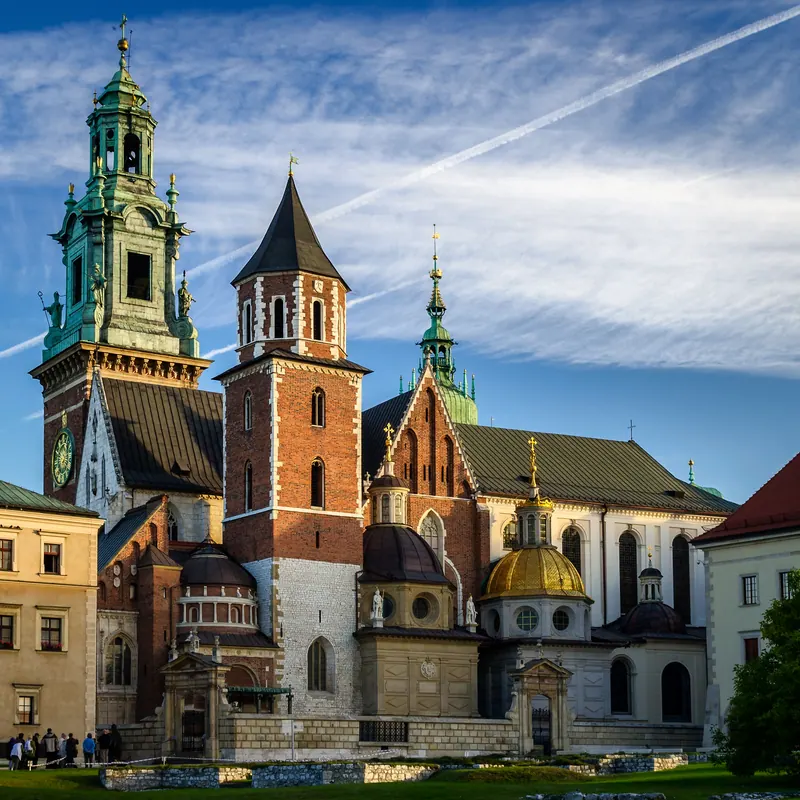
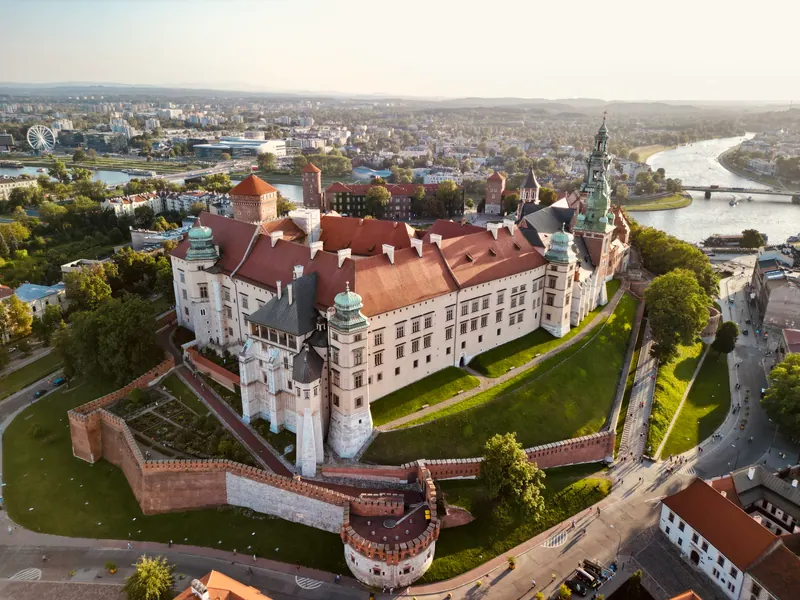
This is the third cathedral on the hill. The first went up around 1020; the Romanesque second was begun in the 1090s and consecrated in 1142, and burned in 1305. The Gothic building you walk into was started in 1320 under Władysław Łokietek — the king who had just been crowned here, breaking two centuries of division — and consecrated in 1364. Coronations continued in it until Augustus III in 1734.
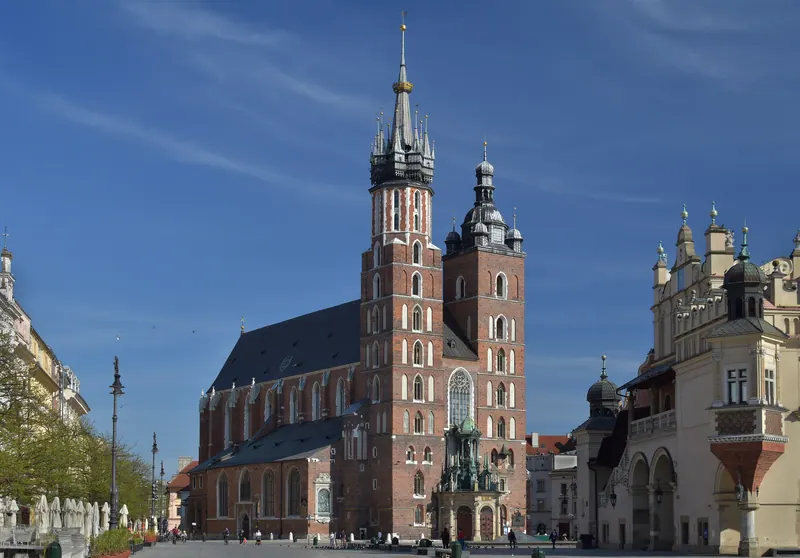
The royal tombs are the reason to come, and they are not in a crypt but around you. Władysław Łokietek‘s tomb of about 1341 is the first Gothic royal tomb in Poland. Casimir III the Great (d. 1370) lies under a red marble canopy in the ambulatory; Władysław Jagiełło (d. 1434) has the grandest of them, a red marble effigy under a canopy on twisted columns. In the Holy Cross Chapel, the tomb of Casimir IV Jagiellon was carved in 1492 by Veit Stoss — the same man who was, at that moment, finishing his altarpiece in St Mary’s on the square below.
Under the floor, St Leonard’s Crypt is what is left of the Romanesque cathedral of about 1090–1118: a low, square, plain-vaulted room on eight columns. The royal crypts beyond it run from the Piasts and Jagiellons to Jan III Sobieski, and on to Kościuszko, Poniatowski and Piłsudski. In the middle of the nave, the silver shrine of St Stanisław — the bishop killed in 1079 and canonised in 1253 — sits where kings laid captured standards after a victory.
The ticket includes the climb up the Sigismund Tower on wooden stairs to the Sigismund Bell, cast in 1520 by Hans Behem of Nuremberg, about two metres across, and rung by hand by a dozen ringers only on great feasts and national occasions. Visitors touch the clapper for luck.
On the way in, look up at the chained bones above the west door: they are a whale, a mammoth and a woolly rhinoceros, hung there for centuries as the bones of the Wawel dragon. Tradition says the world ends when they fall.