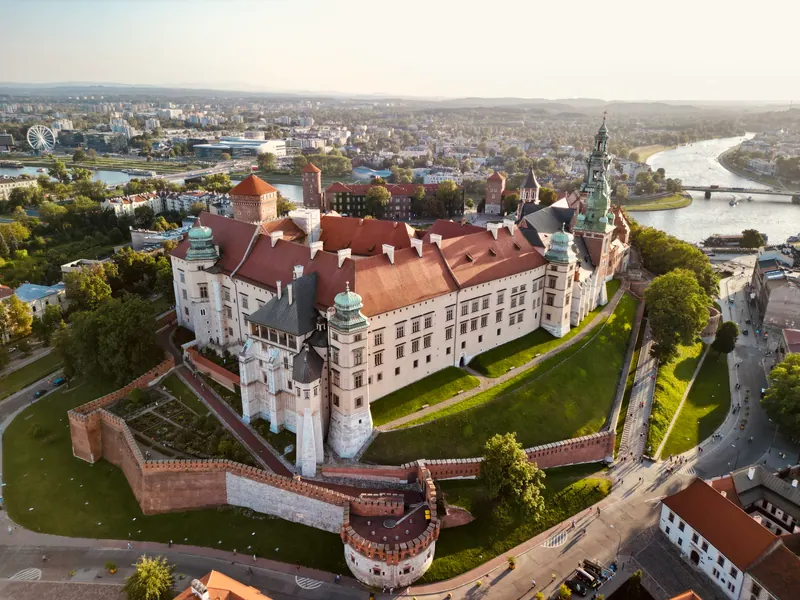
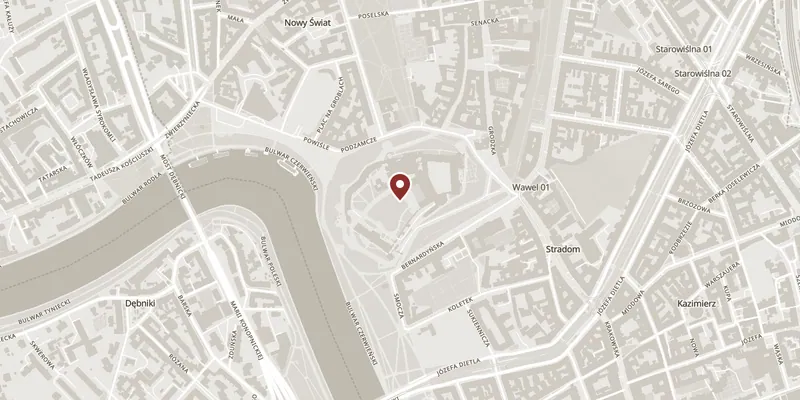
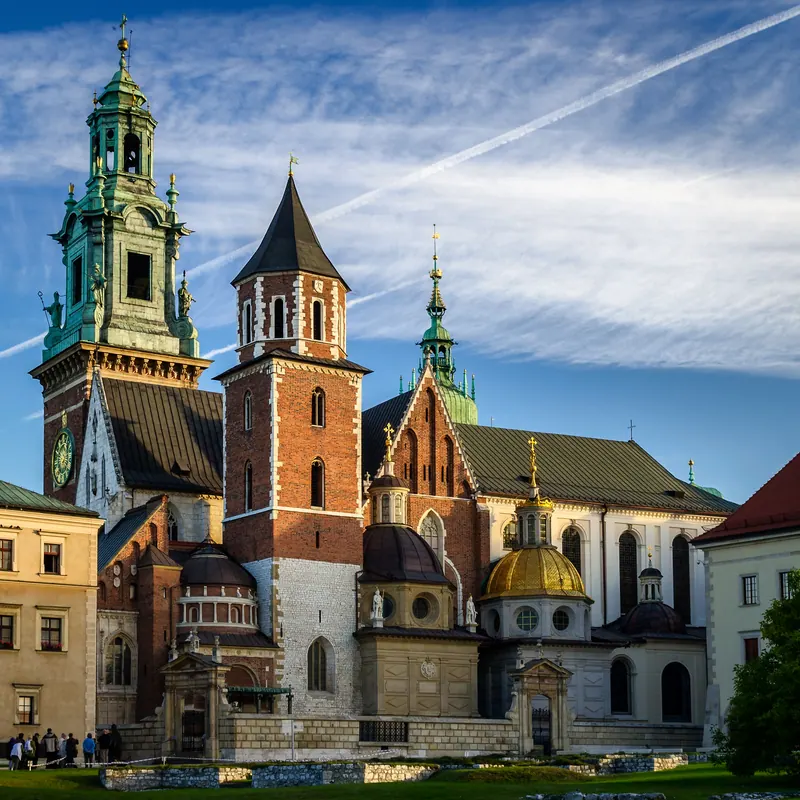
Wawel has been the ruling seat of Poland since the 11th century, and every century since has left something on the hill. The Gothic castle was built by Władysław Łokietek and his son Casimir III the Great in the 14th century, after the fire of 1305; between 1507 and 1536 Sigismund I the Old had it rebuilt as a Renaissance residence, first by Francesco the Florentine and then by Bartolomeo Berrecci, around the arcaded courtyard that is the building’s signature. The court moved to Warsaw in 1596. The Austrian army used the castle as barracks from 1846 to 1911, and the restoration that followed is why you can walk into it at all.
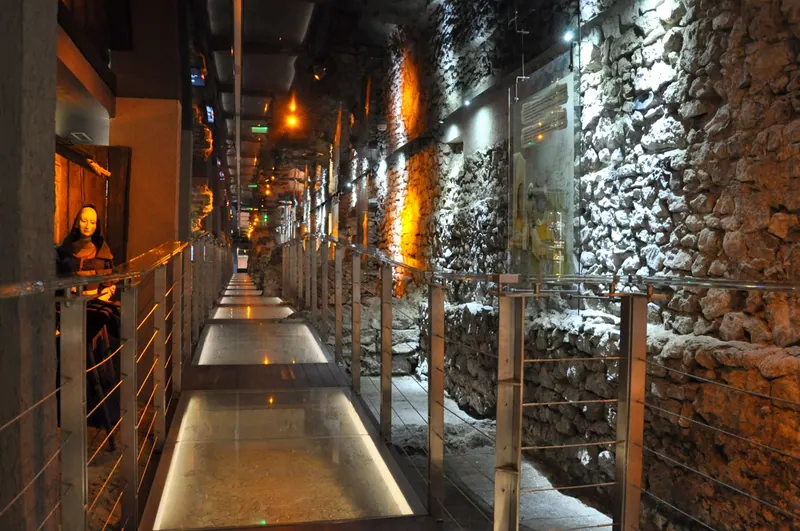
The medieval fabric is easiest to find on the outside and underneath. On the east side, the Hen’s Foot Tower and the Danish Tower are Gothic survivals from Casimir’s castle. The late-14th-century Gothic chambers now called the Jadwiga and Jagiełło Rooms hold the Crown Treasury. And the Castle Dungeons ticket — sold as Wawel Zaginiony, “Lost Wawel” — is an archaeological reserve built over the excavated hill: the stone rotunda of SS Felix and Adauctus of the 10th–11th century, four apses standing three to seven metres high, plus foundations, medieval kitchen pottery and a lapidarium.
On the second floor, the State Rooms are Renaissance. Look up in the Hall of Deputies at the coffered ceiling of about 1540, which once held nearly two hundred carved wooden heads and still has thirty; and in the Hall under the Eagle at the painting of the Battle of Orsza of 1514. The Brussels tapestries commissioned by Sigismund Augustus hang throughout.
The ticketing is the thing people get wrong. As of August 2026 the castle’s own FAQ prices the two castle floors together at 95/71 zł, the Crown Treasury and Armoury at 47/35 zł, the Castle Dungeons at 47/35 zł, the Dragon’s Den at 15/10 zł and the Royal Gardens at 11/9 zł, with an all-exhibitions pass at 199/149 zł. Mondays are free for selected exhibitions, but only on tickets handed out at the box office that morning, in limited numbers.
The Dragon’s Den is a real cave: 270 m long, 81 m of it open, entered down a shaft inside a brick wellhead and exiting by the river at Bronisław Chromy’s fire-breathing dragon of 1972. It runs in the warm season only.