Medieval Booker

Historic City Celebrations ◆ Poland

Lajkonik Procession

Once a year a bearded rider in Tatar dress on a white hobby-horse — the Lajkonik, or Konik Zwierzyniecki — parades across Kraków with a band and a costumed retinue, from Zwierzyniec to the Main Market Square, tapping bystanders with his mace for luck. The pageant is held on the octave of Corpus Christi, the Thursday eight days after Corpus Christi, and is organised by the Museum of Kraków; the 2026 edition was on 11 June and 3 June 2027 is expected.

When is Lajkonik Procession 2027?

Next edition
Expected 2027 Lajkonik Procession 2027 See all editions
Where
Kraków, Poland
How often
Every year
Entry
Free. It takes place in the open street with no tickets; bring small change, as the retinue traditionally collects a tribute along the route.
Family-friendly
Yes — bring the kids
Official site
pik.krakow.pl

Checked · we re-check every festival twice a year.

Past and upcoming editions

Editions of Lajkonik Procession
EditionDatesStatusCalendar
2027 edition Expected 2027 Google Calendar · .ics

Expected means the organiser hasn't announced yet; we show the usual window.

Past editions (1)
  • 2026 edition — 11 June 2026

What happens at Lajkonik Procession?

The Lajkonik is Kraków’s own hobby-horse pageant, and it takes over the city for one afternoon and evening every summer. A rider in a bearded mask and Tatar costume, mounted on a small white wooden horse fixed at his waist, crosses the city from the riverside district of Zwierzyniec to the Main Market Square, followed by a band playing Kraków melodies and a retinue in Tatar and raftsmen’s dress. The date is fixed to the church calendar rather than the diary: it is held on the octave of Corpus Christi, meaning the Thursday eight days after Corpus Christi itself, which in turn moves with Easter. That put it on 11 June in 2026 and on 3 June in 2027.

The story behind it is a medieval one. According to the legend, Tatars raiding Poland in 1287 camped in the reeds by the Vistula near Zwierzyniec, were surprised there by the local raftsmen — the włóczkowie — and the boldest of the raftsmen rode into Kraków wearing the khan’s clothes. The custom itself is documented rather later: the earliest firm record is a fine imposed by the Kraków city court in 1738 on the raftsmen for their disorderly performance during the Corpus Christi celebrations. The costume and horse-cloth worn today follow the design Stanisław Wyspiański made for the Lajkonik in 1904, and the tradition was entered on Poland’s National List of Intangible Cultural Heritage in 2014.

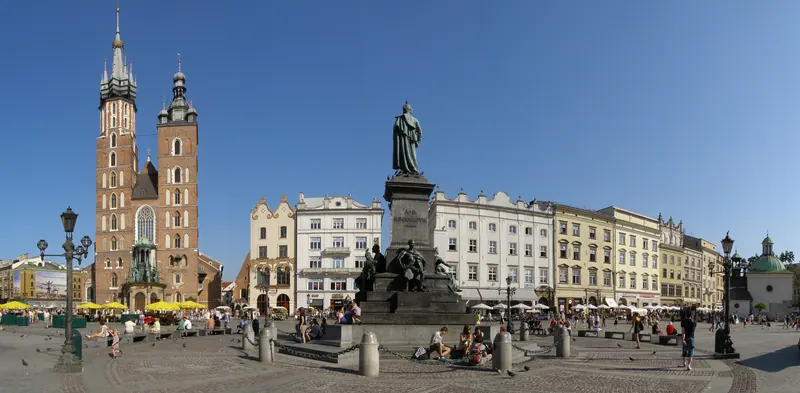
The procession sets out in the early afternoon — 12:30 in 2026, from the Kraków Waterworks building on Senatorska Street, where several of the retinue work — and calls at the Norbertine convent in Zwierzyniec before working its way along Kościuszki Street, past the Vistula embankment where the raftsmen are greeted, over the crossing by the Philharmonic and down Franciszkańska and Grodzka to the Main Market Square. The whole route takes about seven and a half hours, because the Lajkonik stops constantly at shops, offices and courtyards to dance, and touching people with his mace, which is said to bring a year’s luck, is the point of the crowds pressing in.

The finale is on the Rynek in the evening, at about 20:15 in 2026: the Mayor of Kraków pays the traditional tribute, the haracz, the two drink to the city’s prosperity, and the Lajkonik performs his closing banner dance in front of the Cloth Hall. Everything happens in the open street and nothing is ticketed; small change is useful, since by tradition the retinue collects money along the way. The Museum of Kraków publishes the route and the timings a few weeks in advance. This is a one-day street pageant, not a weekend festival with a market attached — plan around the moment you want to see, either the quieter start in Zwierzyniec or the crowded finish on the square.
Frequently asked questions

When is the Lajkonik procession in Kraków in 2027?

Thursday 3 June 2027 is expected. The pageant always falls on the octave of Corpus Christi — the Thursday eight days after Corpus Christi — which moves with Easter. The Museum of Kraków publishes the route and times a few weeks beforehand.

Is the Lajkonik procession free?

Yes. It runs through public streets and nothing is ticketed. Take small change: by tradition the retinue collects money along the route.

Where does the Lajkonik procession start and finish?

It starts in Zwierzyniec in the early afternoon (12:30 in 2026, from the Waterworks building on Senatorska Street, with a stop at the Norbertine convent) and finishes on the Main Market Square in the evening, at about 20:15 in 2026.

What does the Lajkonik commemorate?

A legend of the Tatar raid of 1287, in which raftsmen from Zwierzyniec surprised a Tatar camp by the Vistula and one of them rode into the city in the khan's clothes. The procession itself is first recorded in 1738.

Why does the Lajkonik hit people with his mace?

A tap from his mace is said to bring luck for the coming year, which is why spectators crowd towards him as he passes.

How long does the Lajkonik procession last?

About seven and a half hours end to end, because it stops constantly along the way. Most people watch one section rather than following the whole route.

More medieval festivals in Poland

Same country, upcoming first.

All festivals in Poland
Featured
Reenactment & Battles Living History & Museums

Battle of Grunwald Reenactment

Grunwald, Poland

Every July around 1,400 armoured re-enactors restage the 1410 Battle of Grunwald on the original battlefield in Warmia-Masuria, watched by crowds quoted at around 100,000. The free event, held since 1998, anchors the multi-day Dni Grunwaldu with knights' camps, tournaments and a medieval fair.

2027
Free Family
Featured
Medieval Markets & Fairs Historic City Celebrations

St. Dominic's Fair (Jarmark św. Dominika)

Gdańsk, Poland

St. Dominic's Fair is a three-week street fair in the centre of Gdańsk that traces its origins to a papal privilege of 1260, making it one of the oldest trading fairs in Europe. Around 700 stalls of craftspeople, antique dealers, artists and food sellers fill the Main Town from late July to mid-August, with some 200 concerts and events alongside.

Expected 2027
Family
Featured
Reenactment & Battles Living History & Museums +1

Festival of Slavs and Vikings, Wolin

Wolin, Poland

The Festival of Slavs and Vikings on Ostrów island at Wolin is one of Europe's largest early-medieval gatherings, with around 2,000 re-enactors from some 30 countries camping in a reconstructed 9th–11th-century port settlement. Four days of crafts, battles with hundreds of warriors, boat regattas, rituals and music recall the town that medieval chroniclers knew as Jomsborg or Vineta.

Expected 2027
Family

Other historic city celebrations

All historic city celebrations
Featured
Medieval Markets & Fairs Jousting & Tournaments +1

Jornadas Medievales de Ávila (Mercado de las Tres Culturas)

Ávila, Spain

Ávila's Jornadas Medievales turn the walled UNESCO city into the 'Market of the Three Cultures' for four days on the first weekend of September, with more than 300 stalls, around 150 free shows, nine mounted tournaments and a grand parade recalling the town's Christian, Jewish and Muslim past. Held since 1997 and declared a Festival of National Tourist Interest, it drew about 130,000 visitors in 2025.

2026
Family
Featured
Living History & Museums Historic City Celebrations

Der Meistertrunk (Rothenburg Whitsun Festival)

Rothenburg ob der Tauber, Germany

Rothenburg ob der Tauber's Whitsun festival re-enacts the legend of 1631, when former mayor Nusch supposedly saved the town from General Tilly's army by emptying a tankard holding more than three litres of wine in one draught. Citizens have performed the play 'Der Meistertrunk' since 1881, framed by a four-day festival with a costumed procession, military camp, shepherds' dance and crafts market.

2026
Family
Reenactment & Battles Medieval Markets & Fairs +1

Sajam u srednjovjekovnom Šibeniku (Medieval Fair in Šibenik)

Šibenik, Croatia

The Medieval Fair in Šibenik turns the Dalmatian port's waterfront below the UNESCO-listed Cathedral of St James and the lanes of the old town into a three-day market of costumed craftspeople, with knights' combat, cannon fire, period music and an evening re-enactment of a 1378 naval battle along the riva. Revived in 2025 after a five-year pause, the 17th edition is scheduled for 4–6 September 2026 and the programme is free.

2026
Free Family

Read more about Kraków

Stories and guides from medieval Kraków.

Medieval Kraków — the city guide

Kraków was the seat of the Polish monarchy for over five centuries: kings were crowned and buried in Wawel Cathedral from 1320, and the Old Town still follows the street grid set out by the location charter of 1257. It came through the Second World War without the systematic destruction that flattened Warsaw and Gdańsk, and was on the first UNESCO World Heritage list in 1978.