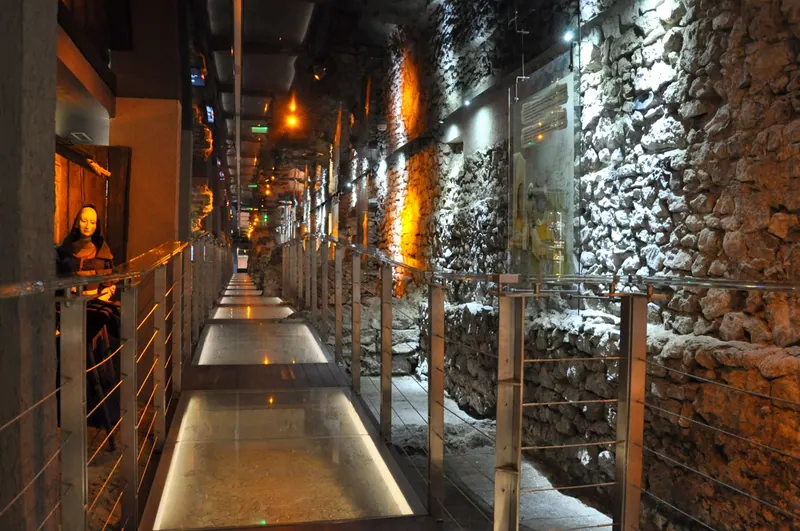
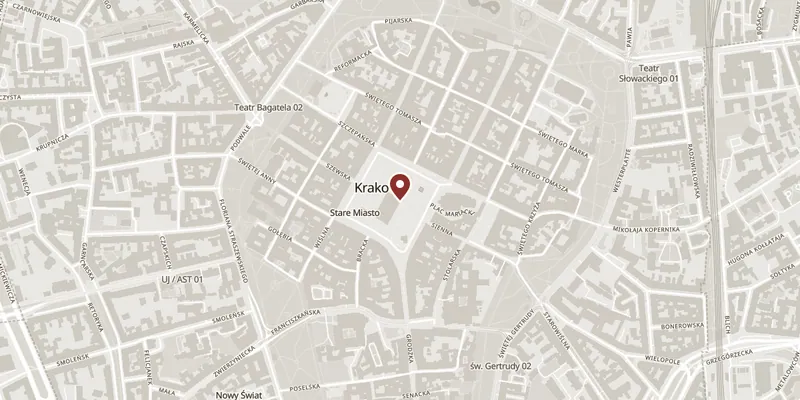
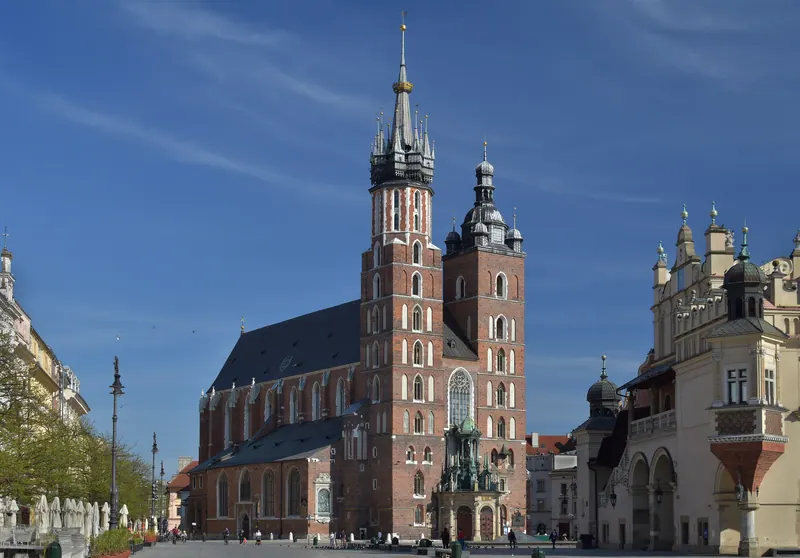
When the Main Market Square was relaid, archaeologists worked the eastern side of it continuously from 2005 to 2010. Rather than backfill, the city roofed the trench and opened it on 24 September 2010 as a branch of the Museum of Kraków. The permanent exhibition is called Following the Traces of European Identity of Kraków, and you walk through the excavation at the level the square stood at in the Middle Ages.
What survives is the commercial machinery of the square. The stone and brick cellar walls of the Kramy Bolesławowe and the Kramy Bogate — the ranges of trading stalls that stood on the square before and beside the Cloth Hall — the footings of the Great Scales, the public weigh-house where goods were checked, and stretches of the roads themselves, cut through to show how a medieval street was built up in layers of timber, brushwood and gravel.
The objects are the other half. Fourteenth-century coins, pottery, tools, dice, clay figures and personal oddments; a goldsmith’s and a blacksmith’s workshop of the late 12th and 13th centuries; reconstructed 11th-century burials from the cemetery that lay here before the town was laid out in 1257. The centrepiece is a lead ingot weighing 693 kg, which the museum describes as the only object of its kind in the world — lead from the Olkusz mines was one of the goods that made Kraków rich.
The display is heavily multimedia: holograms, projections onto steam, touchscreen models of the square’s development. Some of it has aged, and it competes for attention with the archaeology, which is the point of the place.
As of August 2026 admission is 45 zł normal, 35 zł reduced, 90 zł for a family of up to four. Tuesday is free, but only on a limited number of tickets collected from the box office on the day — you cannot book a free ticket online. Last entry is 75 minutes before closing, and the exhibition is closed on the second Monday of each month. Allow at least 90 minutes.