Medieval Booker

Landmark ◆ Kraków

Rynek Główny and the Cloth Hall

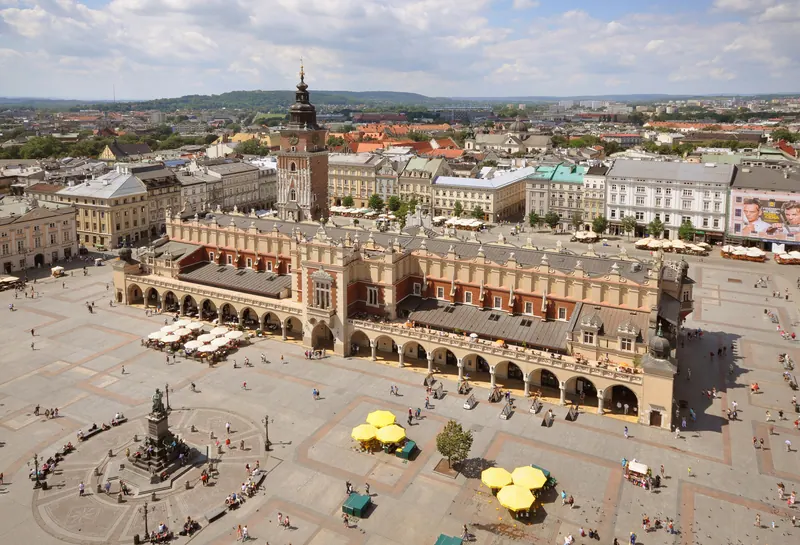
A square staked out in one survey in 1257 and never re-planned since: roughly 200 metres each way, about four hectares, with the market hall still standing in the middle of it and still trading. Kraków's own tourism board calls it "the most expansive Market Square of medieval Europe" and "one of the largest" today — which is the honest version of the claim you will see everywhere.

Where and when

Where
Rynek Główny, 31-042 Kraków, Kraków, Poland Open in Google Maps Walking directions
Era
Square laid out under the location charter of 1257; Cloth Hall built in brick c. 1358 under Casimir III the Great, rebuilt after the fire of 1555
Opening
The square is open ground, day and night, all year. The Cloth Hall's central arcade is a public passage; the stalls inside it are independently run and neither the city nor the museum publishes a timetable for them. The paid attractions on the square each keep their own hours (as of August 2026)
Price
The square and the Cloth Hall's central arcade are free. Everything ticketed on and under the Rynek is sold separately: Rynek Underground 45/35 zł, the Town Hall Tower 22/16 zł, and the National Museum's Gallery of 19th-Century Polish Art on the Cloth Hall's upper floor, whose current price is on mnk.pl — we have not verified a figure for it (as of August 2026)
Best time
Before 08:00, when the stalls are shuttered and the square belongs to delivery vans and pigeons, or after 22:00 in summer once the café terraces thin out and the Cloth Hall is lit. The hejnał sounds from St Mary's tower on every hour in between.
Good for
Good with childrenFree or cheapBest in the evening
Official site
krakow.travel
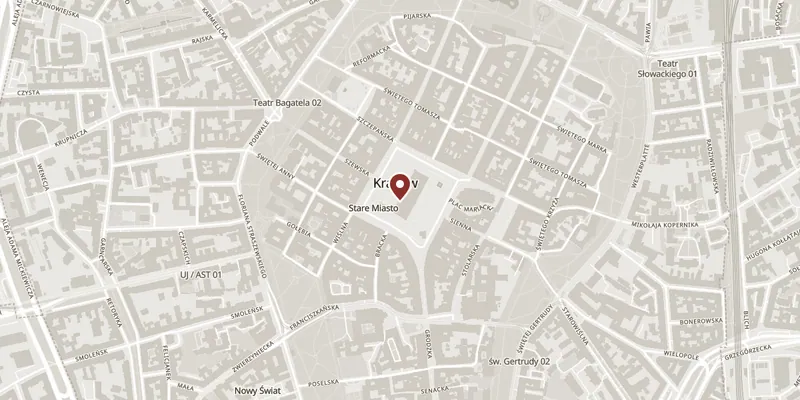
Map showing where Rynek Główny and the Cloth Hall is
Open in Google Maps Walking directions © MapTiler © OpenStreetMap contributors

Checked

What is Rynek Główny and the Cloth Hall?

On 5 June 1257 Duke Bolesław V the Chaste granted Kraków a location charter under Magdeburg law, and surveyors laid out a chessboard of streets around a square of roughly 200 by 200 metres. The plan has not been altered since. Note how the claim is usually worded before you repeat it: the city’s tourism board says this was the largest square in medieval Europe, and is one of the largest now. Those are two different statements, and only the first one is a superlative.

The square was never meant to be empty. Its middle block carried the town hall, the Cloth Hall, the Great Scales and the Small Scales where goods were weighed for tax, and the ranges of rich stalls called the Kramy Bogate. The Austrians took the town hall down in 1820 and left only its tower. The weigh-houses and the stalls came down too — their footings are what you walk over in Rynek Underground, four metres below your feet.

The Cloth Hall is the survivor. The 1257 charter gave the town the right to trade in cloth; by the later 13th century two rows of stalls stood here under a wooden roof. Around 1358 Casimir III the Great paid for a brick building — a roofed central hall 108 metres long and 10 metres wide, with vaulted stalls opening off it through pointed arcades. Fire destroyed it in 1555. It was rebuilt in Renaissance form between 1556 and 1559 under Master Pankracy, with Giovanni Maria Padovano’s loggias and the crested attic parapet associated with Santi Gucci. The arcaded aisles you actually walk through are much later: Tomasz Pryliński’s remodelling of 1875–79.

So the building is medieval in plan and function and Renaissance-to-Victorian in what you see. The central passage is free, always a public right of way, and lined with souvenir and amber stalls. Above it, the National Museum’s Gallery of 19th-Century Polish Art is a separate ticket and a separate century.

Two free things to find. At the south-east corner, wedged where the square meets Grodzka, St Adalbert’s is one of the oldest stone churches in Poland, with 11th-century Romanesque masonry in its lower walls; its floor sits about two metres below the pavement because the square’s surface has risen by two to two and a half metres since it was built. And at the south-west corner, the Town Hall Tower is all that is left of the building that ran this square for five hundred years.
What visitors say

4.7 from 16,173 ratings

  • Emilian TravelZone

    5 out of 5 2 weeks ago

    The Ground Floor Marketplace: While the upper floor of the Cloth Hall runs the 19th-century fine art gallery, the historic arcade stalls on the ground floor function as a bustling marketplace heavily dedicated to Baltic amber jewelry and raw specimens. The Baltic Gold Connection: Most amber sold in Kraków originates from the southern coast of the Baltic Sea (Poland's "Amber Coast"). It is prized for its high succinic acid content, earning it the scientific name succinite.

    Read this review on Google
  • Johannes Krause

    5 out of 5 2 months ago

    The market hall looks magnificent and is well maintained. It blends in nicely with the surrounding square. Even though the square is very touristy, its spaciousness makes you feel at ease. You can buy various tourist souvenirs in the market hall—I can’t comment on the prices.

    Read this review on Google
  • I. T.

    5 out of 5 4 months ago

    Great marketplace in the heart of Krakow. I didn’t realise this was a museum until I started writing this review. Most people would just stroll through it and look at the shop stalls, which is also what we did.

    Read this review on Google

Ratings and reviews from Google. See all on Google Maps

Frequently asked questions

Is Kraków's Main Market Square the largest medieval square in Europe?

That is how the city's own tourism board phrases it — the most expansive market square of medieval Europe, and one of the largest today. It measures roughly 200 by 200 metres, about four hectares, and was staked out in 1257 when Kraków received its charter under Magdeburg law.

Is the Cloth Hall free to enter?

Yes. The central arcade running through the middle of the building is a public passage and costs nothing. The Gallery of 19th-Century Polish Art on the upper floor and the Rynek Underground excavation below the square are separate paid tickets.

How old is the Cloth Hall in Kraków?

The right to trade cloth here came with the charter of 1257 and stalls stood under a roof by the later 13th century. Casimir III the Great paid for a brick hall around 1358, 108 metres long and 10 metres wide. It burned in 1555, was rebuilt in Renaissance form in 1556–59, and the arcaded aisles were added by Tomasz Pryliński in 1875–79.

What is the small church in the corner of the Main Market Square?

St Adalbert's, one of the oldest stone churches in Poland, with 11th-century Romanesque masonry surviving in the lower walls. Its floor lies about two metres below the modern pavement because the square has risen roughly two to two and a half metres since. Its crypt holds a small Archaeological Museum display on the square, which keeps irregular hours.

What happened to Kraków's medieval town hall?

It was pulled down in 1820, under Austrian rule, leaving only its tower standing at the south-west corner of the square. The tower is now a branch of the Museum of Kraków and you can climb it.

What is under the Main Market Square?

Nearly 4,000 m² of excavated medieval market level, opened in 2010 as Rynek Underground: the cellars of the trading stalls, the footings of the public weigh-house, road surfaces and burials from before the town was chartered. The entrance is in the square between the Cloth Hall and St Mary's.

Festivals in Kraków

Medieval festivals in Kraków
Historic City Celebrations

Lajkonik Procession

Kraków, Poland

Once a year a bearded rider in Tatar dress on a white hobby-horse — the Lajkonik, or Konik Zwierzyniecki — parades across Kraków with a band and a costumed retinue, from Zwierzyniec to the Main Market Square, tapping bystanders with his mace for luck. The pageant is held on the octave of Corpus Christi, the Thursday eight days after Corpus Christi, and is organised by the Museum of Kraków; the 2026 edition was on 11 June and 3 June 2027 is expected.

Expected 2027
Family

More places in Kraków

Places in Kraków
Church Start here

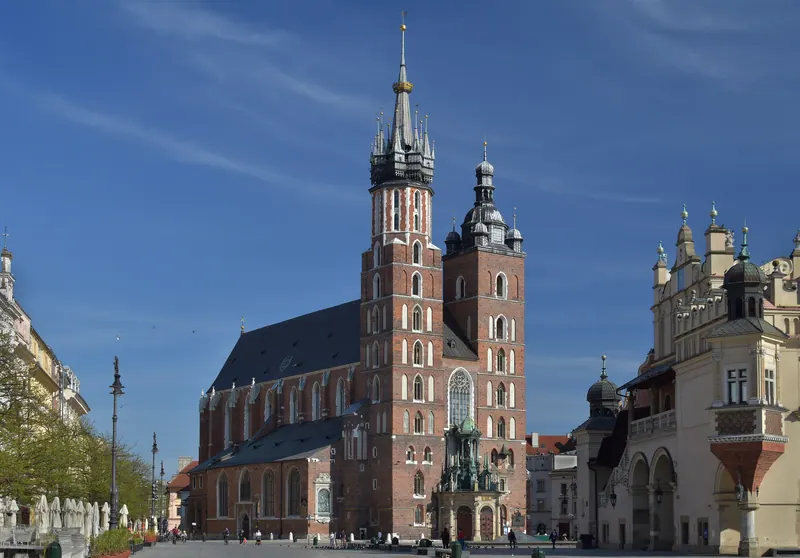
St Mary's Basilica

Chancel from the 1350s, nave completed late 14th century; Veit Stoss altarpiece 1477–89

Veit Stoss spent twelve years, from 1477 to 1489, carving the largest Gothic altarpiece in the world for the burghers of Kraków, and it still stands in the chancel it was made for. Be inside before 11:50, when the wings are opened by hand; the hejnał is played from the taller tower on the hour and breaks off mid-phrase.

Works in the rain Good with children
Walking directions
Castle

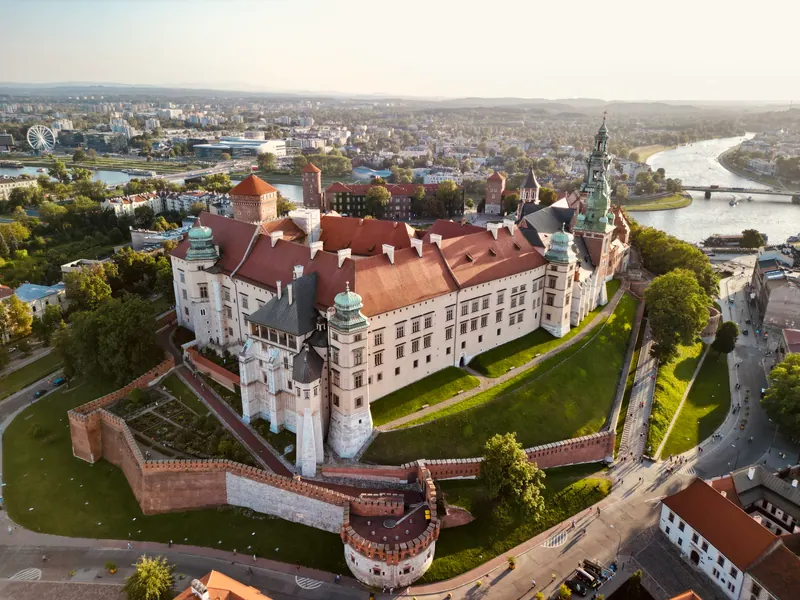
Wawel Royal Castle

Royal seat from the 11th century; Gothic castle of Casimir the Great, 14th century; Renaissance rebuilding 1507–1536

The seat of the Polish kings on the limestone hill above the Vistula — a Gothic castle of Casimir the Great rebuilt from 1507 around a three-tier arcaded courtyard. Nothing here is a single ticket: the two castle floors, the Crown Treasury and Armoury, the Castle Dungeons and the Dragon's Den are sold separately in timed slots with daily caps, so buy online before you walk up the hill.

Good with children Works in the rain
Walking directions
Church

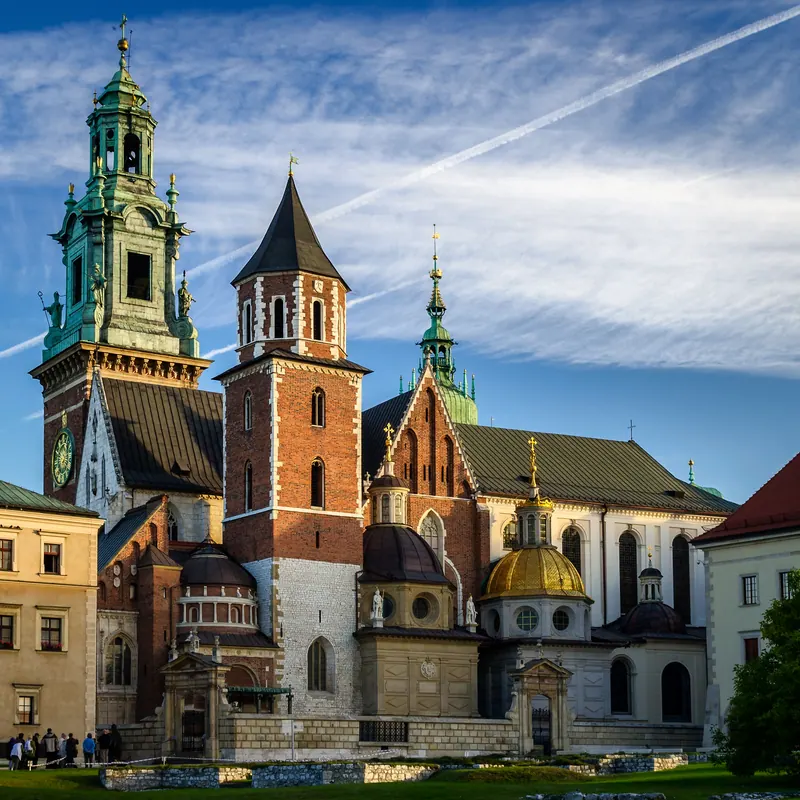
Wawel Cathedral

Gothic cathedral begun 1320, consecrated 1364; St Leonard's Crypt c. 1090–1118; Sigismund Bell cast 1520

The coronation and burial church of the Polish monarchy — kings crowned here from 1320 to 1734, and most of them buried under the floor. It is ticketed separately from the castle and the castle box office will not sell it to you: one ticket of 26 zł covers the cathedral, the royal crypts, the Cathedral Museum and the wooden climb to the Sigismund Bell of 1520.

Works in the rain
Walking directions