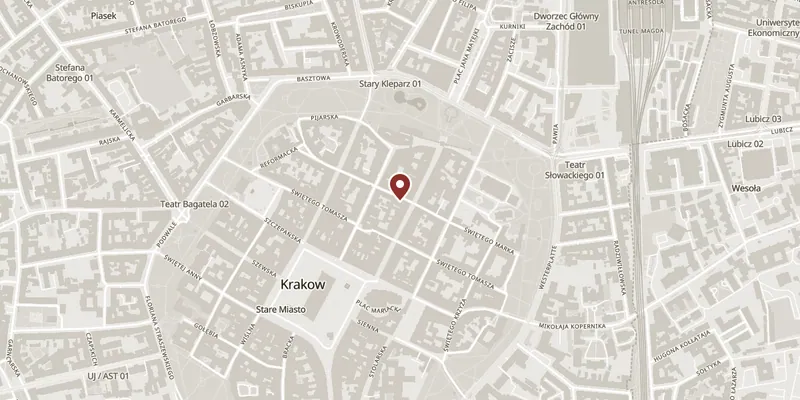
The Jagiellonian University’s pharmacy collection lives at ul. Floriańska 25, on the stretch of the Royal Route between St Florian’s Gate and the market square. The museum describes the house as a fourteenth-century townhouse, and it has kept its Gothic vaulted cellars, Renaissance stone portals and Renaissance beamed ceilings. The exhibition runs up through it on five levels — cellars, ground floor, two floors and the attic — across twelve rooms.
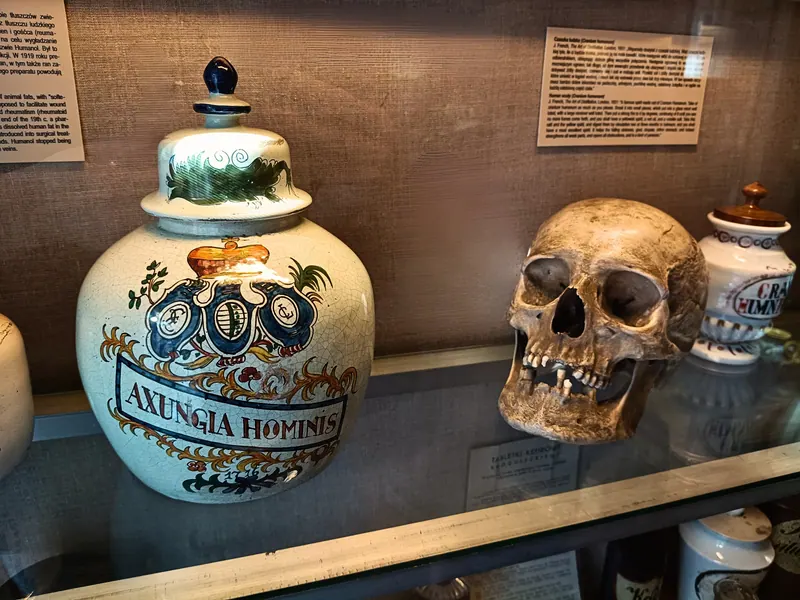
What is in them is the working equipment of the pre-modern apothecary. Mortars, presses, filters and herb grinders. Vessels for storing and dispensing, including a large run of majolica drug jars from manufactories across Europe. Medicinal raw materials of plant, mineral and animal origin — the actual substances behind the recipes. And a library of old pharmaceutical books, from Hippocrates to medieval apothecary manuals.
The honest version: the fitted pharmacy interiors are Baroque, Empire and Biedermeier, so a good deal of what you walk through is 17th- to 19th-century. The medieval content is the building, the cellars, the books and the raw materials. If you have ever wanted to know what a fantasy apothecary would actually have had on the shelf, this is where you find out, and 16 zł is not much to ask for it.
The hours are the trap. As of August 2026 the museum opens Tuesday 12:00–18:30 and Wednesday to Saturday 09:30–15:00, and it is closed on Sunday and Monday. Last entry is 45 minutes before closing. Tuesday is the only day you can come in the late afternoon; on every other open day it shuts at three. The museum’s own average visit is an hour and a half.
One clear warning, in the museum’s own words: there is no lift and no facilities for visitors with disabilities. The exhibition is five levels of stairs in a medieval house, and it cannot be made otherwise.