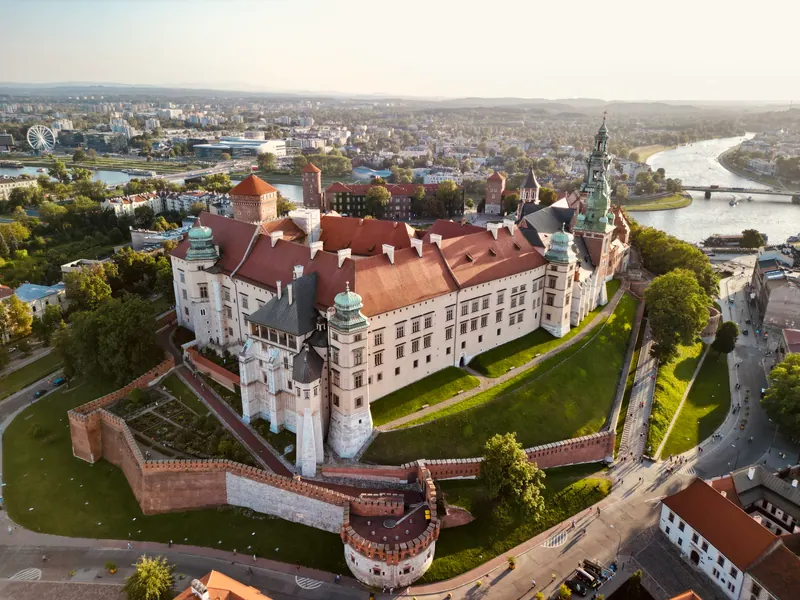
The Prussians broke up and melted the Polish crown jewels in 1809 and 1811. Szczerbiec is what got away — a 13th-century ceremonial sword, gold-mounted, its blade slotted and inscribed, which was used at nearly every Polish coronation from Władysław Łokietek in 1320 to Stanisław August Poniatowski in 1764. It came back to Wawel in 1928 and is displayed in the room it was kept in, a Gothic chamber built in the late 14th century and now called the Jadwiga and Jagiełło Room. It belongs to a very small group of surviving medieval European ceremonial swords. Stand in front of it before you look at anything else.
The rest of the Crown Treasury runs to a few hundred objects: royal insignia and reliquaries, the swords of state, gifts and trophies, the coronation robes and jewels that outlived the plunder. The rooms themselves are part of the display — these are the castle’s medieval undercrofts, not gallery boxes.
The Armoury occupies the adjoining ground floor and cellars and is the strongest arms-and-armour display in Poland outside the national museums: medieval swords, mail and plate, crossbows and pole weapons, jousting harness, banners, and then on into the decorated firearms and the hussar equipment of the 16th and 17th centuries. It is one ticket with the Treasury.
Practically, as of August 2026 the ticket is 47 zł normal / 35 zł reduced and it also lets you into the Royal Gardens during their season (24 April to 4 October). Opening is Tuesday to Sunday from 09:00, closing at 19:00 in the summer months and 17:00 from September, with last entry 30 minutes before; the exhibition is closed on 1 and 11 November and from 24 to 26 and on 31 December. Audio guides run in Polish, English, Ukrainian, German, French, Italian and Spanish, and the Crown Treasury has a separate family track.
One warning worth having in advance: the basement armoury rooms are reached by stairs with no lift.