Medieval Booker

Museum ◆ Kraków

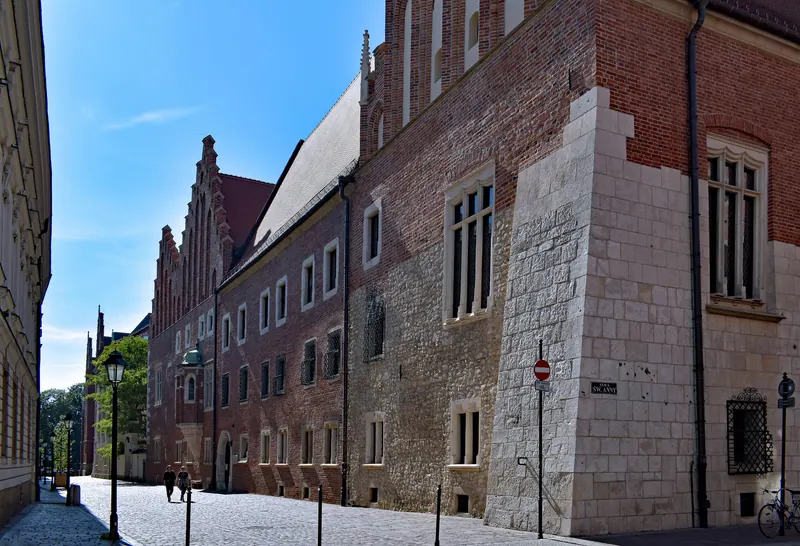
Collegium Maius

One of the very few medieval university buildings still standing and still in use in continental Europe — an arcaded Gothic courtyard, a professors' common room, and a treasury holding the earliest surviving globe with the word America on it. The courtyard is free; the interior is closed on Sundays, free on Wednesdays, and the good tours run in the morning.

Where and when

Where
ul. Jagiellońska 15, 31-010 Kraków, Kraków, Poland Open in Google Maps Walking directions
Era
University founded 1364; the Collegium Maius begun in 1400 with Queen Jadwiga's bequest and assembled through the 15th century
Opening
Museum: Monday 09:00–17:00, Tuesday–Friday 13:30–17:00, Saturday 10:00–16:00, closed Sunday; last entry 16:30 Monday–Friday and 15:30 Saturday. Guided tours Tuesday–Friday in the morning, around 09:00, 09:45, 10:30 and 11:15 in Polish or English, with an extended instrument tour at 12:30 in English. Courtyard daily 09:00–18:00. The university changes the timetable for its own ceremonies (as of August 2026)
Price
Guided tour 26 zł normal / 14 zł reduced; self-guided individual visit 17 zł / 10 zł. Wednesdays are free for individual visits. The courtyard is free at all times. Tickets at the desk or bilety.uj.edu.pl (as of August 2026)
Best time
A weekday morning for a guided tour, arriving in the courtyard a few minutes before 11:00 so you catch the clock first. Wednesday is free but self-guided only, and it is the busiest day.
Good for
Works in the rainQuiet corner
Official site
maius.uj.edu.pl
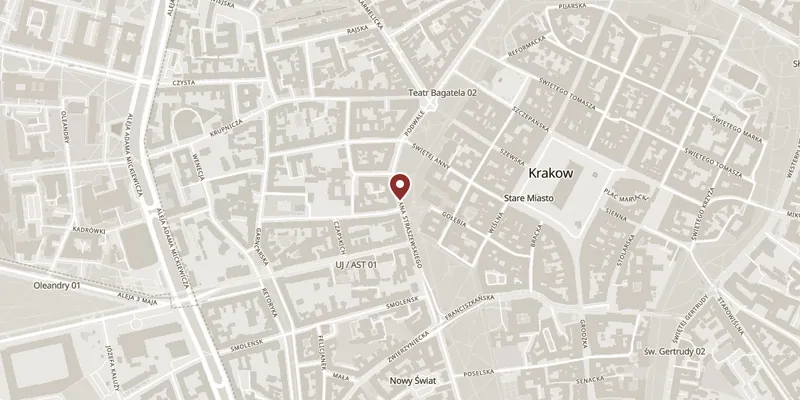
Map showing where Collegium Maius is
Open in Google Maps Walking directions © MapTiler © OpenStreetMap contributors

Checked

What is Collegium Maius?

Casimir III the Great founded a studium generale in Kraków in 1364, the second university in central Europe after Prague. It faltered, and in 1400 Władysław Jagiełło refounded it using the jewels Queen Jadwiga had left for the purpose in her will the year before. The Academy’s first property was a corner tenement house on this site, and through the 15th century the university swallowed the houses around it and knitted them into one building around a single arcaded courtyard.

That courtyard is the reason to come and it costs nothing: open daily 09:00–18:00 as of August 2026, brick and stone arcades on two levels, a well in the middle, and a staircase called the Professors’ Stairs. On the odd hours — 09:00, 11:00, 13:00, 15:00 and 17:00 — a small green door opens and carved figures process out to Gaudeamus Igitur and a 16th-century piece from the tablature of Jan of Lublin: a beadle, Queen Jadwiga, Władysław Jagiełło, St John Cantius, Stanisław of Skalbmierz and Hugo Kołłątaj.

Inside, the standard route runs Stuba Communis – Treasury I – Treasury II – Libraria – the Globe Room – the Gallery of Medieval Sculpture. The Stuba Communis is the professors’ common room, with its long table; the Libraria is the old library hall; the Treasury holds the university’s ceremonial maces and sceptres. The object to find is in the Treasury: the Jagiellonian Globe, an armillary clock made in France before 1510 whose brass earth-sphere is engraved AMERICA NOVITER REPERTA — the earliest surviving globe carrying the name America. A longer tour adds the scientific-instrument rooms, including the astronomical collection from the period when Nicolaus Copernicus matriculated here in 1491.

The visiting rules matter more here than anywhere else on this list. As of August 2026 the museum opens Monday 09:00–17:00, Tuesday–Friday 13:30–17:00 and Saturday 10:00–16:00 — closed Sundays — with last entry at 16:30 on weekdays and 15:30 on Saturday. A guided tour is 26 zł normal / 14 zł reduced; a self-guided individual visit is 17 zł / 10 zł. Wednesday is free for individual visits. Guided tours in Polish or English run Tuesday to Friday in the morning, at roughly 09:00, 09:45, 10:30 and 11:15, with the extended instrument tour at 12:30 in English. Book at bilety.uj.edu.pl; this is a working university and the timetable is changed for its own ceremonies.
What visitors say

4.7 from 1,534 ratings

  • N

    5 out of 5 3 months ago

    In this building is where Nicolaus Copernicus once studied. The museum is upstairs (sometimes the door is closed, but the museum is actually open). It is small but contains some interesting objects. Approx. 30min to see it. In the courtyard, the clock springs to life every 2 hours and you can see a procession of historic figures.

    Read this review on Google
  • Bertrand Toulouse

    5 out of 5 3 months ago

    We visited this very interesting university museum.on a Wednesday. Well design and thoughtful historical rooms, objects and paintings

    Read this review on Google
  • Andrea Favero

    5 out of 5 5 months ago

    The **Collegium Maius** in Kraków is one of the most fascinating historical sites in the city, but one of its most charming and memorable moments happens at the stroke of every odd hour. In the quiet courtyard, visitors gather beneath the elegant Gothic arcades, waiting for a small yet delightful spectacle that brings the past to life. As the clock strikes, a wooden door above the courtyard slowly opens and a procession of small figurines appears. These moving statues represent important figures connected to the history of the Jagiellonian University, including scholars and medieval personalities. One by one, they pass across the small stage, as if marching through time. The scene is accompanied by the gentle sound of a trumpet melody that echoes softly through the courtyard, giving the performance a ceremonial and almost magical atmosphere. The combination of historic architecture, mechanical artistry, and music creates a moment that feels both playful and deeply rooted in tradition. Visitors often pause their tours just to witness this short performance, cameras ready, yet many end up simply enjoying the atmosphere. Although the show lasts only a few minutes, it captures the spirit of the Collegium Maius perfectly: a place where scholarship, history, and a touch of wonder come together in a unique and memorable experience.

    Read this review on Google

Ratings and reviews from Google. See all on Google Maps

Frequently asked questions

Can you visit Collegium Maius without a guide?

Yes. Alongside the guided tour at 26 zł normal / 14 zł reduced there is a cheaper self-guided individual visit at 17 zł / 10 zł, which is what runs on weekday afternoons and on the free Wednesdays. The guided tour covers more rooms.

Is Collegium Maius free?

The courtyard is always free and open daily 09:00–18:00. The museum interior is free on Wednesdays for individual visits; otherwise it is 26/14 zł guided or 17/10 zł self-guided as of August 2026.

What time is the Collegium Maius clock?

The courtyard clock performs on the odd hours — 09:00, 11:00, 13:00, 15:00 and 17:00. A green door opens and carved figures process out to Gaudeamus Igitur and a 16th-century piece from the tablature of Jan of Lublin. It is free to stand and watch.

What is the Jagiellonian Globe?

An armillary clock made in France before 1510 and kept in the Collegium Maius treasury. Its brass earth-sphere carries the engraving AMERICA NOVITER REPERTA, making it the earliest surviving globe on which the name America appears.

Did Copernicus study at Collegium Maius?

He matriculated at the Kraków Academy in 1491 and studied here until about 1495, in the period when the university's astronomy was at its strongest. The extended tour takes in the scientific-instrument rooms that hold the astronomical collection.

Is Collegium Maius open on Sundays?

No. As of August 2026 the museum opens Monday to Saturday only, and on Tuesday to Friday not until 13:30 for individual visitors. The courtyard is open daily.

Festivals in Kraków

Medieval festivals in Kraków
Historic City Celebrations

Lajkonik Procession

Kraków, Poland

Once a year a bearded rider in Tatar dress on a white hobby-horse — the Lajkonik, or Konik Zwierzyniecki — parades across Kraków with a band and a costumed retinue, from Zwierzyniec to the Main Market Square, tapping bystanders with his mace for luck. The pageant is held on the octave of Corpus Christi, the Thursday eight days after Corpus Christi, and is organised by the Museum of Kraków; the 2026 edition was on 11 June and 3 June 2027 is expected.

Expected 2027
Family

More places in Kraków

Places in Kraków
Church Start here

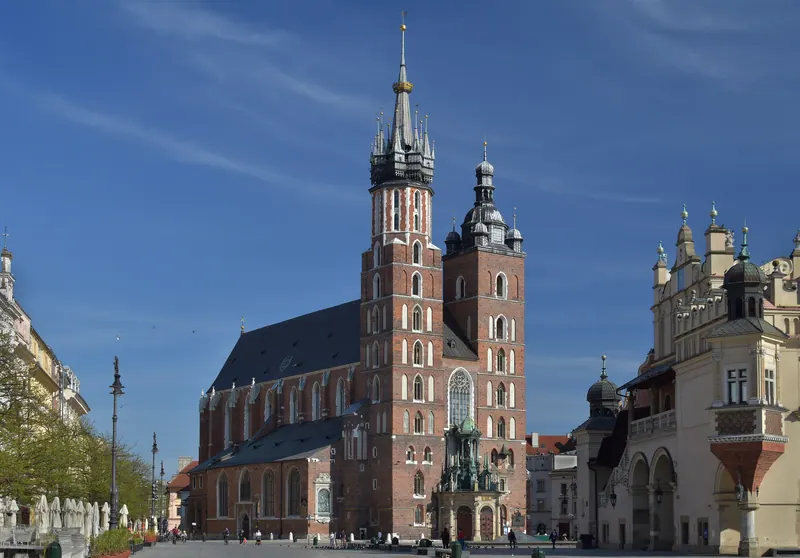
St Mary's Basilica

Chancel from the 1350s, nave completed late 14th century; Veit Stoss altarpiece 1477–89

Veit Stoss spent twelve years, from 1477 to 1489, carving the largest Gothic altarpiece in the world for the burghers of Kraków, and it still stands in the chancel it was made for. Be inside before 11:50, when the wings are opened by hand; the hejnał is played from the taller tower on the hour and breaks off mid-phrase.

Works in the rain Good with children
Walking directions
Castle

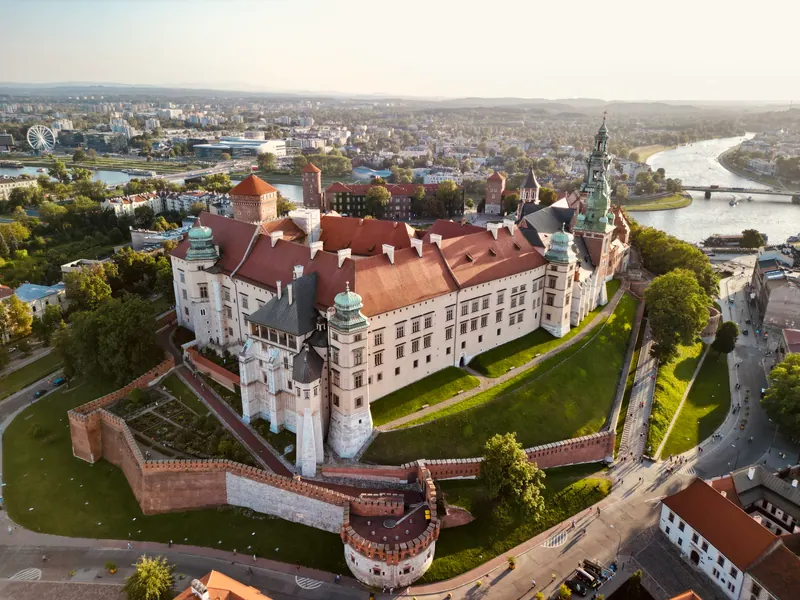
Wawel Royal Castle

Royal seat from the 11th century; Gothic castle of Casimir the Great, 14th century; Renaissance rebuilding 1507–1536

The seat of the Polish kings on the limestone hill above the Vistula — a Gothic castle of Casimir the Great rebuilt from 1507 around a three-tier arcaded courtyard. Nothing here is a single ticket: the two castle floors, the Crown Treasury and Armoury, the Castle Dungeons and the Dragon's Den are sold separately in timed slots with daily caps, so buy online before you walk up the hill.

Good with children Works in the rain
Walking directions
Church

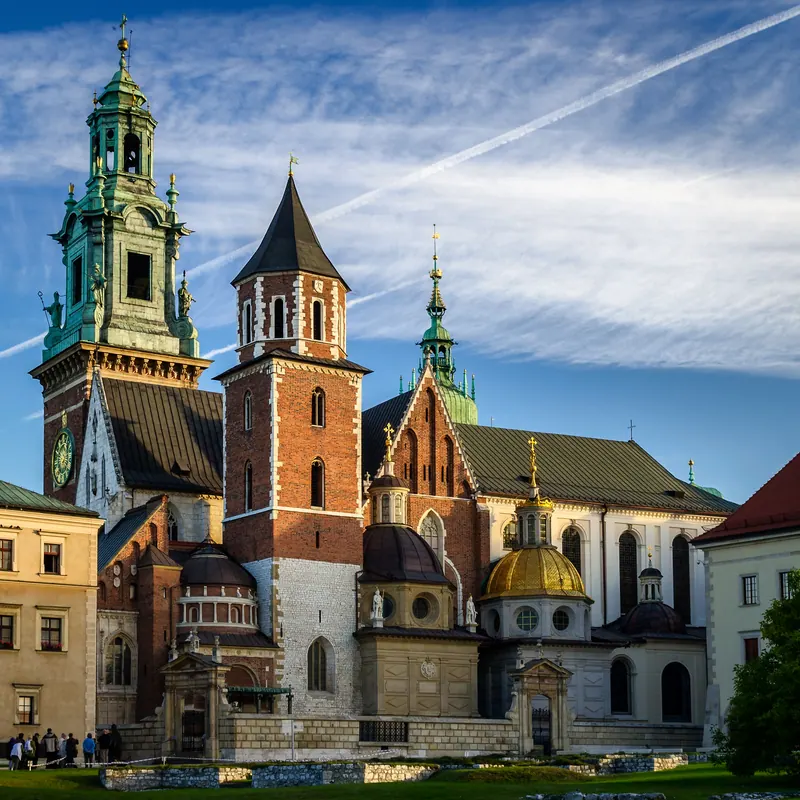
Wawel Cathedral

Gothic cathedral begun 1320, consecrated 1364; St Leonard's Crypt c. 1090–1118; Sigismund Bell cast 1520

The coronation and burial church of the Polish monarchy — kings crowned here from 1320 to 1734, and most of them buried under the floor. It is ticketed separately from the castle and the castle box office will not sell it to you: one ticket of 26 zł covers the cathedral, the royal crypts, the Cathedral Museum and the wooden climb to the Sigismund Bell of 1520.

Works in the rain
Walking directions