Medieval Booker

Landmark ◆ Kraków

The Barbican and St Florian's Gate

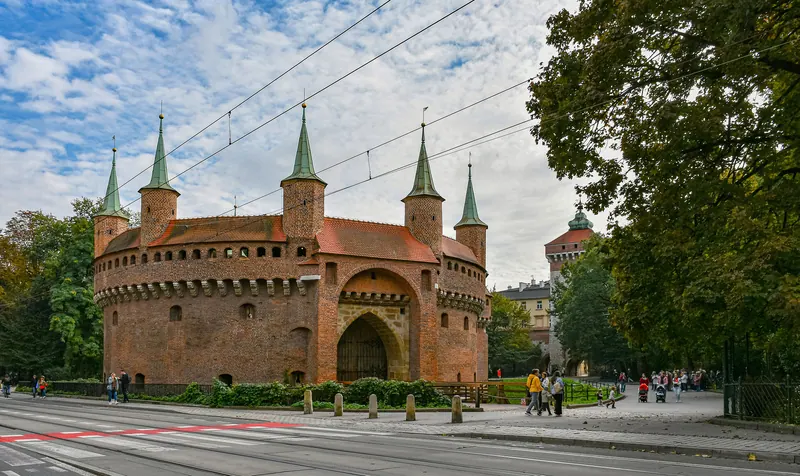
Kraków had three kilometres of wall, eight gates and dozens of towers. The Austrians took almost all of it down between 1810 and 1814; what one stubborn professor saved in 1817 is this — a gate of about 1300, three guild towers, a stretch of curtain wall, and the great brick drum of the Barbican of 1498, built with walls three metres thick and seven turrets.

Where and when

Where
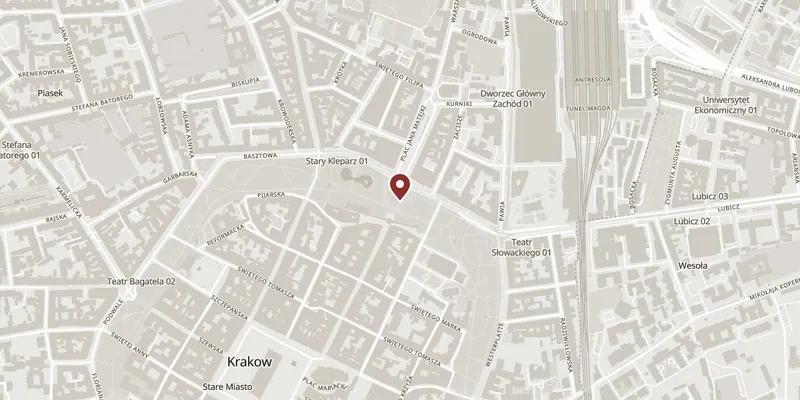
Barbican: ul. Basztowa, 30-547 Kraków. St Florian's Gate and the wall stretch: ul. Pijarska / Floriańska, Kraków, Poland Open in Google Maps Walking directions
Era
St Florian's Gate c. 1300 with a 15th-century upper storey; the Barbican built 1498–99 under Jan Olbracht
Opening
Both the Barbican and the City Defence Walls are listed by the museum's central timetable as Tuesday–Sunday 10:30–18:00, closed Mondays, last entry 30 minutes before closing, with no free day. Note that the museum's English branch pages currently show 10:00–16:00 for both — the Polish pages and the central timetable agree on 10:30–18:00, and that is what we publish. Neither structure is roofed throughout, and the museum has flagged partial renovation works at the Barbican while keeping it open; check before an off-season visit (as of August 2026)
Price
Barbican 22 zł normal / 16 zł reduced / 44 zł family; City Defence Walls the same, as separate tickets. The Museum of Kraków's combined "Kraków Średniowieczny" route is 64 / 56 / 128 zł and adds the Town Hall Tower and Rynek Underground; with a Kraków Card it is 51.20 / 44.80 zł. The outside of the gate, the wall and the Barbican costs nothing (as of August 2026)
Best time
Late afternoon. Walk the outside of the wall on ul. Pijarska first, where painters hang canvases on the brick — it is Kraków's open-air art market and costs nothing — then go through the gate and up onto the wall walk.
Good for
Free or cheapGood with children
Official site
muzeumkrakowa.pl
Map showing where The Barbican and St Florian's Gate is
Open in Google Maps Walking directions © MapTiler © OpenStreetMap contributors

Checked

What is The Barbican and St Florian's Gate?

Start at the far end and walk in, the way an arriving merchant would.

The Barbican went up in 1498–99, the last and strongest thing Kraków ever built for its own defence. King Jan Olbracht laid the foundation stone; his catastrophic Moldavian campaign of 1497 and the pressure from Wallachia, the Tatars and the Ottomans are why it was built in a hurry. It is a Gothic brick drum with an internal diameter of a little over 24 metres and walls up to three metres thick, ringed by seven turrets and pierced by a hundred and thirty arrow loops. A moat about thirty metres wide ran round it, and a walled corridor — the szyja, the neck — carried the road across that moat to the gate. It is routinely described as one of only three surviving barbicans of its kind in Europe and the best preserved of them; treat that as the standard claim rather than a checked fact, and judge the thing itself, which is genuinely enormous from the inside.

St Florian’s Gate is the one gate of eight that still stands. The stone lower stage is about 1300; the brick storey above it, with its machicolated gallery on stone corbels, was added in the 15th century. It is 34.5 metres tall and it also carried a guild name, the Furriers’ Tower. This was the head of the Royal Route: coronation processions came in here and went down Floriańska to the square and on to Wawel.

The wall survives for one short stretch behind the gate, on ul. Pijarska, with three towers on it — the Carpenters’, the Joiners’ and the Haberdashers’ — each named for the guild that was responsible for manning and maintaining it. That is the medieval system made visible: the walls were not the king’s problem, they were the trades’.

It exists because of Feliks Radwański, who in January 1817 argued to the Senate of the Free City that pulling this piece down would let the north wind blow straight from Kleparz onto the market square and ruin the citizens’ health. The argument was nonsense and it worked.

The money-saving fact: the Barbican and the walls are 22 zł each, but the Museum of Kraków’s Kraków Średniowieczny route ticket is 64 zł normal / 56 zł reduced / 128 zł family and covers both plus the Town Hall Tower and Rynek Underground — 111 zł of tickets if bought separately.
What visitors say

4.7 from 12,777 ratings

  • Paulina Al Jindi

    5 out of 5 a month ago

    Florian Gate (Brama Flory) is a must-see when visiting Kraków. It's always busy with people, but it's definitely worth seeing as you walk from the Main Market Square (Rynek) to the Barbican (Barbakan). One of the city's most iconic landmarks and an important part of Kraków's history.

    Read this review on Google
  • Nojan K

    5 out of 5 a month ago

    St. Florian's Church is a large and beautiful church with impressive architecture. The building is very well maintained, and the atmosphere inside is peaceful and pleasant. It is definitely worth a visit if you are in the area.

    Read this review on Google
  • OutnAbout57

    5 out of 5 2 months ago

    This structure is part of the Old town. It's centuries old and a great example of construction back in the day. It's also a good landmark to use to get your bearings in this area. Recommended

    Read this review on Google

Ratings and reviews from Google. See all on Google Maps

Frequently asked questions

How much does it cost to go inside the Kraków Barbican?

22 zł normal, 16 zł reduced, 44 zł family as of August 2026, with the City Defence Walls a separate ticket at the same price. The Museum of Kraków's combined Medieval Kraków route is 64 / 56 / 128 zł and covers both plus the Town Hall Tower and Rynek Underground.

Why is so little of Kraków's city wall left?

The Austrian authorities demolished the walls between 1810 and 1814 and laid out the Planty gardens on the line. Only St Florian's Gate, three towers, one stretch of curtain wall and the Barbican survived, after Feliks Radwański argued in January 1817 that removing them would expose the market square to the north wind.

How old is the Kraków Barbican?

It was built in 1498–99, with the foundation stone laid by King Jan Olbracht. It is a Gothic brick drum with an internal diameter of just over 24 metres, walls up to three metres thick and seven turrets, and was once ringed by a moat about thirty metres wide.

How old is St Florian's Gate?

The stone lower stage dates from about 1300; the brick storey above it, with the machicolated gallery on stone corbels, was added in the 15th century. It stands 34.5 metres tall and is the only one of Kraków's eight medieval gates still standing.

Why are the towers named after crafts?

Because the guilds were responsible for them. The three towers on the surviving wall — the Carpenters', the Joiners' and the Haberdashers' — each fell to the trade that had to man and maintain that section. St Florian's Gate itself was the Furriers' Tower.

Is the Barbican worth paying to go inside?

It depends what you want. The building's impact is its bulk and its arrow loops, which you get for free from the Planty. The ticket buys a wall walk and a small display inside a largely empty brick ring. If you only pay for one, the wall walk at St Florian's Gate has more to look at.

Festivals in Kraków

Medieval festivals in Kraków
Historic City Celebrations

Lajkonik Procession

Kraków, Poland

Once a year a bearded rider in Tatar dress on a white hobby-horse — the Lajkonik, or Konik Zwierzyniecki — parades across Kraków with a band and a costumed retinue, from Zwierzyniec to the Main Market Square, tapping bystanders with his mace for luck. The pageant is held on the octave of Corpus Christi, the Thursday eight days after Corpus Christi, and is organised by the Museum of Kraków; the 2026 edition was on 11 June and 3 June 2027 is expected.

Expected 2027
Family

More places in Kraków

Places in Kraków
Church Start here

St Mary's Basilica

Chancel from the 1350s, nave completed late 14th century; Veit Stoss altarpiece 1477–89

Veit Stoss spent twelve years, from 1477 to 1489, carving the largest Gothic altarpiece in the world for the burghers of Kraków, and it still stands in the chancel it was made for. Be inside before 11:50, when the wings are opened by hand; the hejnał is played from the taller tower on the hour and breaks off mid-phrase.

Works in the rain Good with children
Walking directions
Castle

Wawel Royal Castle

Royal seat from the 11th century; Gothic castle of Casimir the Great, 14th century; Renaissance rebuilding 1507–1536

The seat of the Polish kings on the limestone hill above the Vistula — a Gothic castle of Casimir the Great rebuilt from 1507 around a three-tier arcaded courtyard. Nothing here is a single ticket: the two castle floors, the Crown Treasury and Armoury, the Castle Dungeons and the Dragon's Den are sold separately in timed slots with daily caps, so buy online before you walk up the hill.

Good with children Works in the rain
Walking directions
Church

Wawel Cathedral

Gothic cathedral begun 1320, consecrated 1364; St Leonard's Crypt c. 1090–1118; Sigismund Bell cast 1520

The coronation and burial church of the Polish monarchy — kings crowned here from 1320 to 1734, and most of them buried under the floor. It is ticketed separately from the castle and the castle box office will not sell it to you: one ticket of 26 zł covers the cathedral, the royal crypts, the Cathedral Museum and the wooden climb to the Sigismund Bell of 1520.

Works in the rain
Walking directions