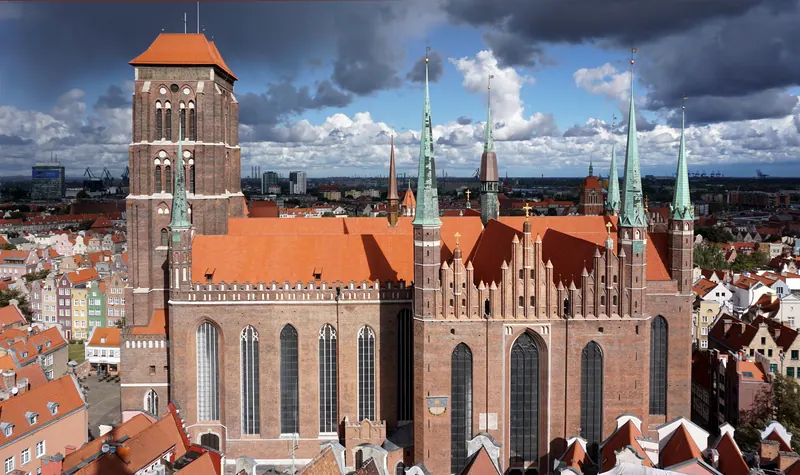
Gdańsk’s parish church is a hall of brick roughly 105 m long and 66 m across the transept, with room for something like 25,000 people standing. The foundation stone went down on 25 March 1343; the last vault keystone was set in 1502. It is the largest medieval building in the city and, by most counts, the largest brick church in Europe.
What is medieval and what is not. The church burned on 15 March 1945. The parish’s own account is blunt: the main tower roof was torn off and the tower interior burned, six great bells fell and broke, seven of the small turrets burned, the roof over the sanctuary collapsed and its weight destroyed part of the vaulting, and every window and door was lost. What stood were the walls, the piers and the tower shell — and those are the fabric of 1343–1502 that you walk through. Reconstruction began in 1952: the vaults were rebuilt and a steel roof structure was put on. The church was reconsecrated on 17 November 1955. The whitewash, the glass and the roof are post-war; the brick is not.
The astronomical clock stands in the north transept, about 14 m of painted woodwork completed in 1470 by Hans Düringer. It carries a calendar disc, an astrolabe dial and a gallery of moving figures, and it survived only because it was taken apart and stored during the war. The parish runs the figure display daily at 11:57 — that is their published time, not a rounded noon.
Other things to find: the Gothic Trinity altarpiece that came back from Berlin in 2020, 78 years after it left; the ledger slabs underfoot, worn flat by five centuries of feet; and the ring of some thirty side chapels, each once paid for by a guild or a merchant family. The Hans Memling Last Judgement here is a copy — the original, taken off a Florentine galley by the Gdańsk privateer Paul Beneke in 1473, is in the National Museum on Toruńska.
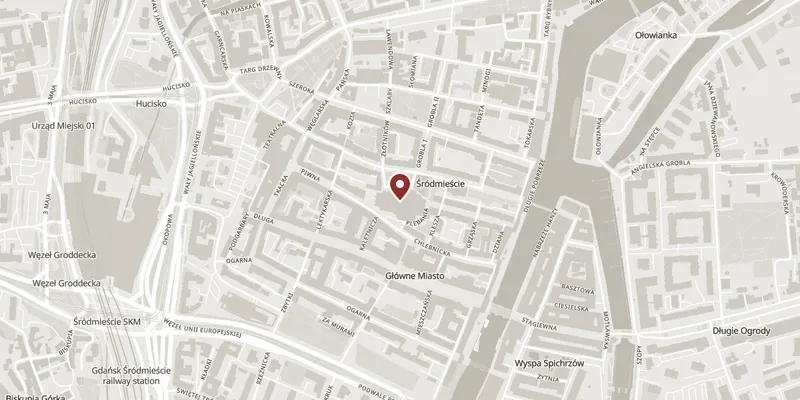
The tower is just over 400 steps (405 and 409 both circulate) up brick spiral and then timber flights, with no lift, to a small terrace near the top; the tower’s height is published as 78 m in some places and 82 m in others. From it the reconstructed street grid of the Main Town reads like a plan.