Medieval Booker

Castle ◆ Gdańsk

Malbork Castle

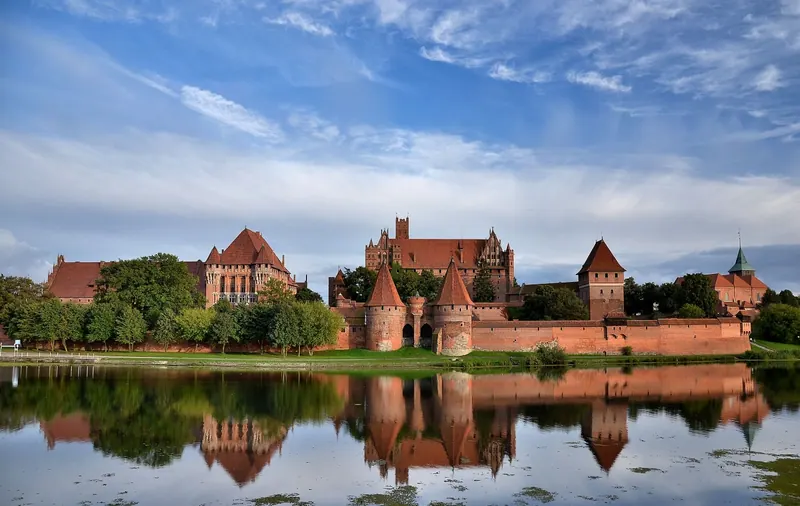
The Teutonic Order's headquarters from 1309 and the capital of its state until 1457: three castles inside one wall, 21 hectares of it, the largest brick fortress in the world. It is 60 km from Gdańsk and about an hour on the train, and the Historical Route ticket at 80 zł is the one to buy — the cheaper Walking Route only gets you into the grounds.

Where and when

Where
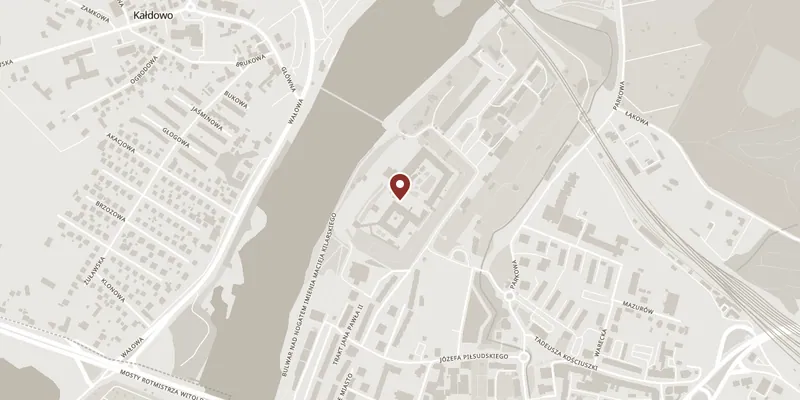
ul. Starościńska 1, 82-200 Malbork (about 60 km south-east of Gdańsk), Gdańsk, Poland Open in Google Maps Walking directions
Era
Begun 1274; Teutonic Order's headquarters from 1309 to 1457; restored from 1882, rebuilt again after 1945
Opening
Historical Route Tuesday–Sunday 09:00–20:00, last entry 16:30; Walking Route Tuesday–Sunday 16:45–20:00, last entry 18:30; box offices 08:30–18:30. These are summer hours — the museum publishes a separate winter timetable (as of August 2026)
Price
Historical Route 80 zł normal / 60 zł reduced, audioguide or Polish-language guide included. Mondays are free, but only the Walking Route runs and you must collect a free ticket from the box office (as of August 2026)
Best time
First entry of the day on a weekday, and buy online. Come out of season if you can: the Historical Route is a fixed sequence and it backs up behind large groups.
Good for
Good with children
Official site
zamek.malbork.pl
Map showing where Malbork Castle is
Open in Google Maps Walking directions © MapTiler © OpenStreetMap contributors

Checked

What is Malbork Castle?

Building began in 1274 on the Nogat, and in 1309 the Grand Master moved the Order’s seat here from Venice. For nearly a century and a half Marienburg was the administrative capital of a monastic state that ran the Baltic coast. In 1410, after the Order was broken at Grunwald, Władysław Jagiełło besieged the castle and failed to take it. It fell without a fight in 1457, when the Order’s unpaid Bohemian mercenaries sold it to the King of Poland. UNESCO listed it in 1997.

It is three castles in sequence, and the plan is the point. The High Castle is the convent proper — a four-winged claustral block around a courtyard, with the chapter house, dormitory, church and the well. The Middle Castle holds the Grand Master’s Palace and the Great Refectory, roofed on palm vaults springing from slender granite piers and warmed by a hypocaust system that blew heat up through floor grilles from a furnace below. The Outer Bailey held the workshops, granaries and stables that fed the whole machine. Look for the dansker towers — latrines pushed out on bridges over running water, which is a more medieval detail than any throne room.

Say plainly what this building is. It decayed into barracks and a granary, and it was rebuilt from 1882 under Konrad Steinbrecht in a campaign that ran for forty years; UNESCO’s own citation notes that many conservation techniques now standard were worked out here. Then roughly half of it was destroyed in the fighting of 1945, and the restoration has run more or less continuously since. The castle church in the High Castle stayed a ruin until a restoration completed in April 2016, including the great figure of the Virgin on its east end. Very little of what you touch is untouched; almost all of what you see is where it was and what it was.

Allow three to four hours for the Historical Route, longer if you stop. The audioguide is included in the ticket and runs in fourteen languages.
What visitors say

4.8 from 84,618 ratings

  • Sharon Frilich

    5 out of 5 a month ago

    A very large and beautiful castle, including a promenade around it. A tour inside the castle takes about 3 hours, with many exhibits. It is advisable to take the audio tour in order to hear explanations of each room you enter. Very impressive, even for children. You move from room to room with detailed explanations about the room. Full of exhibits and walls full of paintings.

    Read this review on Google
  • Olha Danchevska

    4 out of 5 a month ago

    Malbork Castle truly impresses with its scale. It is a huge medieval fortress with incredible architecture. It is clear that a tremendous amount of work has been done on its restoration and reconstruction. Some architectural details are simply breathtaking. If you have enough time, it is definitely worth walking around the outside of the castle, where you can enjoy beautiful views from different perspectives. However, the organization of the visit, in my opinion, could be improved. Visitor flows are not managed very well, and almost everywhere you find yourself surrounded by crowds. It is especially challenging when large groups of schoolchildren arrive at the same time, as they do not always seem genuinely interested in what they are seeing. Considering the high number of visitors, a better-designed visitor route system would make the experience much more enjoyable. The exhibitions inside the castle also did not leave a particularly strong impression. In many rooms, it feels like you are simply walking past the exhibits while following the audio guide, without having enough opportunity to stop and explore them at your own pace. We purchased tickets with an audio guide, but upon arrival we found out that the device had to be collected in another building. This was quite inconvenient, took additional time, and created unnecessary confusion. If possible, it is better to visit during the low season, when there are fewer tourists. This allows you to explore the castle more calmly and fully appreciate its unique atmosphere and architecture.

    Read this review on Google
  • Donald “Don” Hoffmann

    5 out of 5 a month ago

    Wonderful experience at a massive castle complex! The grounds are well maintained and the castle has been taken care of and is easy to navigate. The audio guide gives a great deal of information and takes you through the grounds efficiently. The tower is worth the small extra fee to visit with beautiful views of the surrounding city and landscape.

    Read this review on Google

Ratings and reviews from Google. See all on Google Maps

Frequently asked questions

How do you get to Malbork Castle from Gdańsk?

By train from Gdańsk Główny to Malbork — roughly half an hour on a fast Intercity service and closer to an hour on a regional train — then about fifteen minutes on foot from the station to the castle gate.

Which Malbork ticket should I buy?

The Historical Route, 80 zł normal and 60 zł reduced as of August 2026, which covers the High Castle, the Middle Castle, the Grand Master's Palace and the Great Refectory and includes an audioguide in fourteen languages. The Walking Route is grounds only.

Is Malbork Castle free on Mondays?

Yes, but only the Walking Route operates on the free day, and you still have to collect a free ticket at the box office. The Historical Route does not run on Mondays.

Is Malbork the largest castle in the world?

By land area, yes — about 21 hectares within the walls — and it is the largest brick fortress in the world. It was inscribed on the UNESCO World Heritage list in 1997.

How much of Malbork Castle is original?

Less than it looks. The castle was restored over four decades from 1882 under Konrad Steinbrecht, then roughly half of it was destroyed in 1945 and rebuilt from the 1960s onward. The castle church remained a ruin until a restoration completed in April 2016. The plan, the masses and much of the brick are medieval; the finishes largely are not. Allow three to four hours for the Historical Route, and treat the day trip as a full day.

Festivals in Gdańsk

Medieval festivals in Gdańsk
Featured
Medieval Markets & Fairs Historic City Celebrations

St. Dominic's Fair (Jarmark św. Dominika)

Gdańsk, Poland

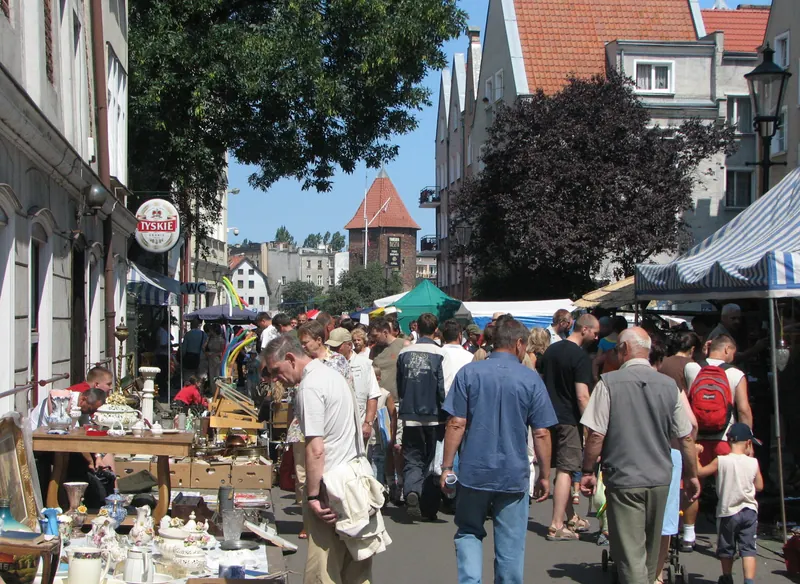
St. Dominic's Fair is a three-week street fair in the centre of Gdańsk that traces its origins to a papal privilege of 1260, making it one of the oldest trading fairs in Europe. Around 700 stalls of craftspeople, antique dealers, artists and food sellers fill the Main Town from late July to mid-August, with some 200 concerts and events alongside.

Expected 2027
Family

More places in Gdańsk

Places in Gdańsk
Church Start here

St Mary's Basilica

Begun 25 March 1343, last vault keystone 1502; burned 1945, vaults and roof rebuilt 1952–55

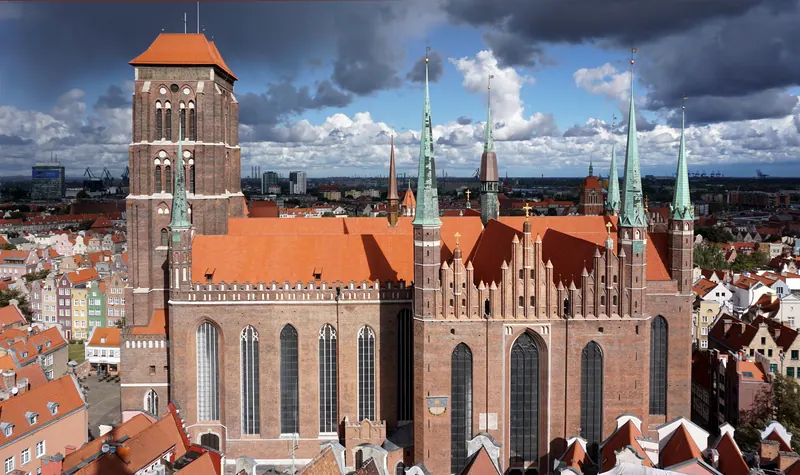
The largest brick church in Europe, begun on 25 March 1343 and closed with its last vault keystone in 1502 — 159 years of building for a merchant parish that wanted room for the whole town. Come at 11:57 for the figure show on Hans Düringer's astronomical clock of 1470, then climb the tower.

Free or cheap Good with children Works in the rain
Walking directions
Landmark

The Gdańsk Crane (Żuraw)

Built 1442–44 as gate and hoist; timber structure burned 1945 and reconstructed by 1962; restored 2021–24

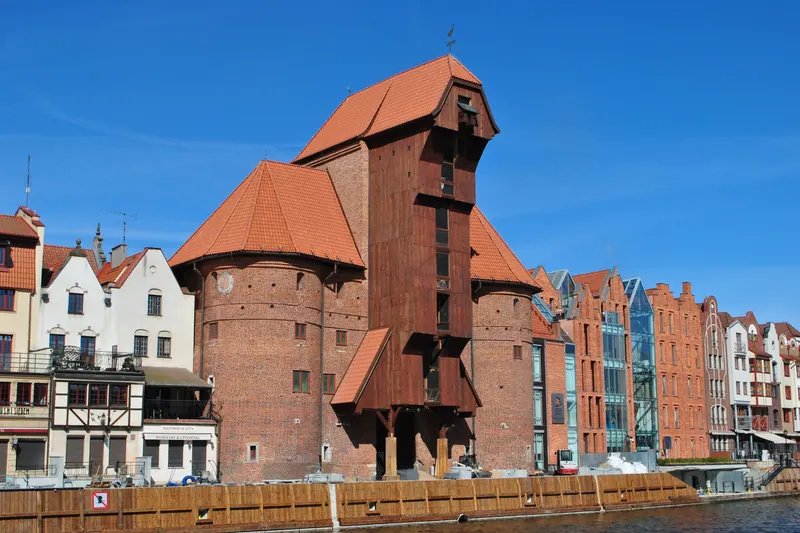
A water gate and port hoist built in 1442–44, with two pairs of treadwheels 6 to 6.5 m across that men walked inside to lift about four tonnes to a height of 11 m — the only medieval port crane of its kind left in Europe. It reopened on 30 April 2024 after a three-year restoration; go on a Wednesday, when the permanent exhibition is free.

Good with children Works in the rain
Walking directions
Landmark

Artus Court

First built 1348–50; rebuilt after the fire of 1476–77 and reopened 1481; Great Stove 1545–46, reconstructed 1995

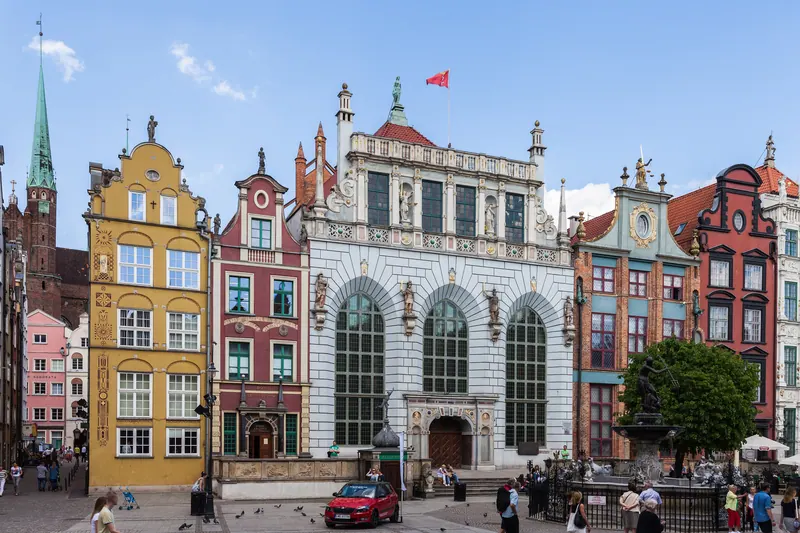
The merchants' hall on Długi Targ, named for King Arthur and rebuilt after a fire so that the first beer could be served in it on 2 December 1481. Go for one object: the Great Stove of 1545–46, 10.64 m of tiles carrying the portrait heads of Europe's rulers, the tallest tiled stove on the continent.

Works in the rain Free or cheap
Walking directions
All articles