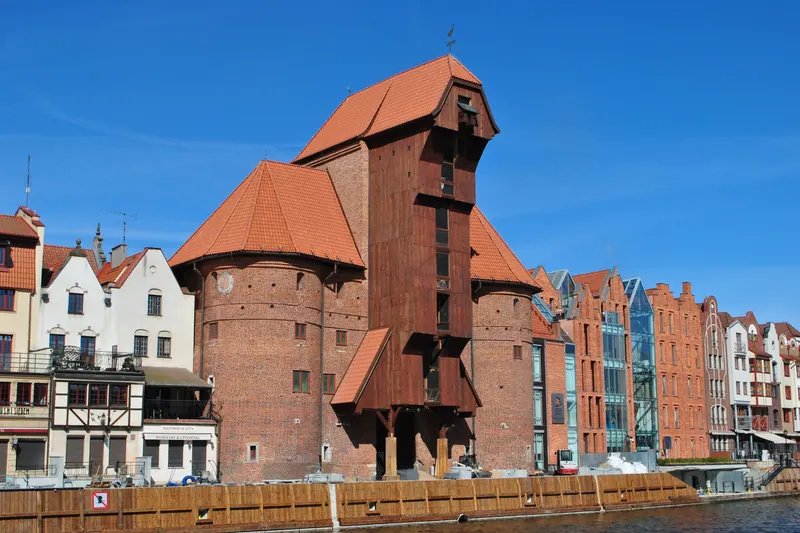
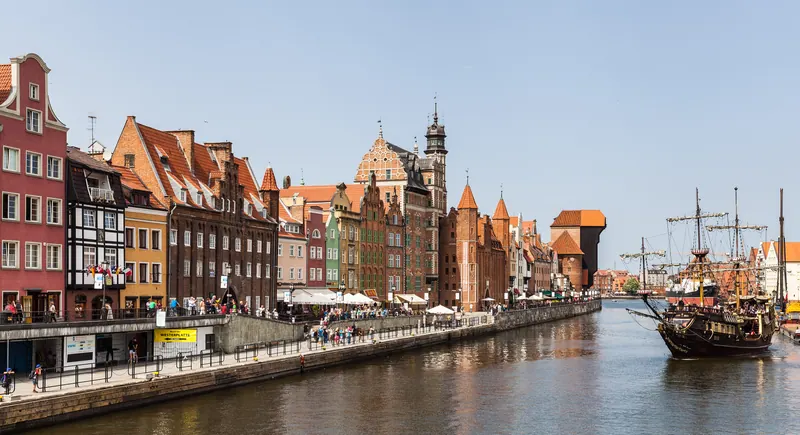
The Crane does two jobs at once, which is why it looks the way it does. It is a gate in the town’s waterfront wall, with a barrel-vaulted passage through it onto Szeroka street, and it is a hoist, the timber housing between the two brick towers carrying the lifting gear. It was built after a fire in 1442 and finished in 1444. It loaded and unloaded cargo, and it stepped masts into ships lying in the Motława.
The mechanism is the reason to go in. Inside are two pairs of treadwheels, 6 to 6.5 m in diameter by the National Maritime Museum’s figures, driven by men walking inside them — no animal, no water, no counterweight. The museum’s figure for the lift is about four tonnes to a height of 11 m. Standing under the wheels and working out how many paces that took is the single best thing here.
What is original. The timber heart of the Crane burned in 1945; the museum’s own account is that about 60 percent of the brick survived. Reconstruction documentation was drawn up in 1956 and the rebuilt Crane was handed to the Maritime Museum in 1962. So: the brick towers and the gate passage are largely medieval fabric, the timber hoist housing, the roof and the wheels themselves are a post-war reconstruction of what was there. It is an honest reconstruction of a real machine, not a fantasy of one.
The building closed in 2021 for the largest works since the post-war rebuild — foundations, drying the cellars, brick conservation, new services — costing 18 million zł, and reopened to the public on 30 April 2024 with a new permanent exhibition, Gold for Grain: The Maritime Power of Gdańsk (Złoto za zboże). Be clear about what that exhibition is: it is about the 17th-century port at its richest — navigation, cargoes, shipbuilding, a reconstructed tavern — with 3D mapping, panoramic screens and holograms. The medieval part of the visit is the building.
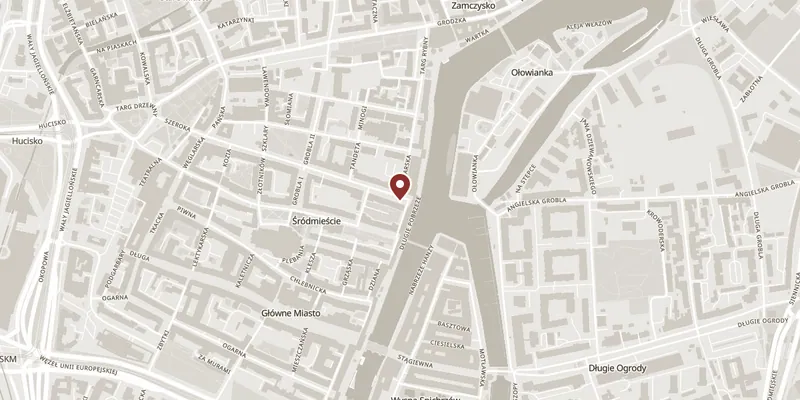
Allow about an hour. It is on the Motława waterfront, five minutes from Długi Targ through the Green Gate.