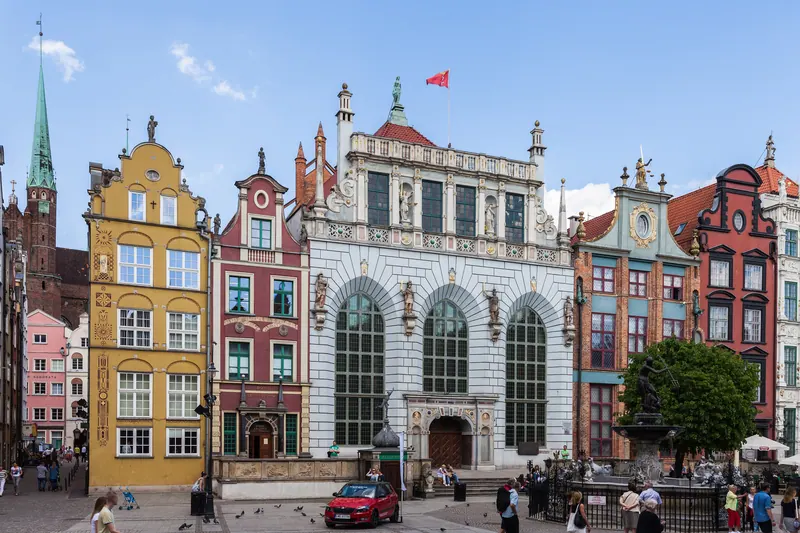
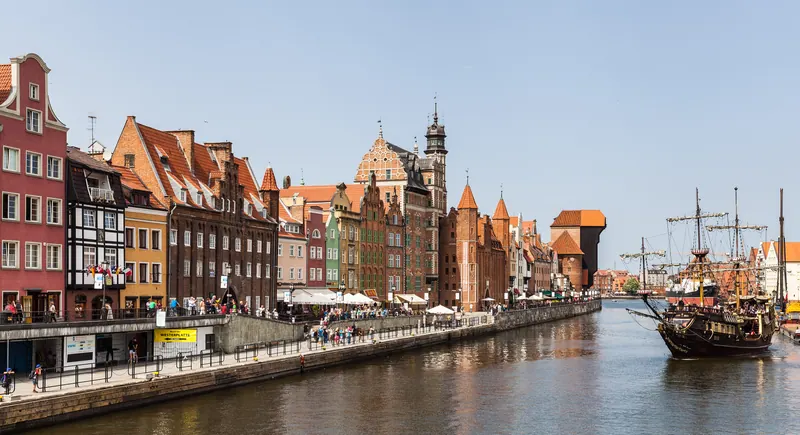
Artus courts were a northern European fashion: halls where merchants met to drink, do business, hear news and eat together, named after the Round Table because the brotherhoods that used them liked the association. Gdańsk built its first in 1348–50, and the name curia regis Artus is recorded in 1357. It burned in 1476–77, and the rebuilt hall opened for business when the first beer was served on 2 December 1481. From 1742 it worked as the city’s exchange.
The Great Hall is a single room under a Gothic star-and-palm vault carried on four granite piers — merchant-guild architecture on a cathedral’s terms. Round the walls hung the equipment of the brotherhoods: benches, painted panels, armour, model ships. The brotherhoods were named (St Reinhold’s, St Christopher’s, the Malbork bench, the Three Kings) and each had its own corner and its own drinking rules.
The Great Stove is the thing to come for. Georg Stelzener built it in 1545–46, 10.64 m high on a base 2.25 m wide, out of 520 glazed tiles. The tiles carry portrait heads of the rulers of Europe, Catholic and Protestant together — Charles V and Isabella of Portugal among them — which is a piece of mid-16th-century diplomacy done in ceramic on the wall of a merchants’ club.
And here is the honest part. Of the roughly 500 original tiles, 235 survived 1945 and are held by the National Museum in Gdańsk. The stove standing in Artus Court is a reconstruction, completed in 1995, fifty years after the war. The museum describes the interior overall as a partial reconstruction: original pieces that came back after conservation, standing alongside reproductions and, where objects are simply gone, large-format printed images in their place. That mix is stated on the museum’s own pages and it is what you should expect when you walk in.
Entry is on the Museum of Gdańsk ticket, and Mondays are free.