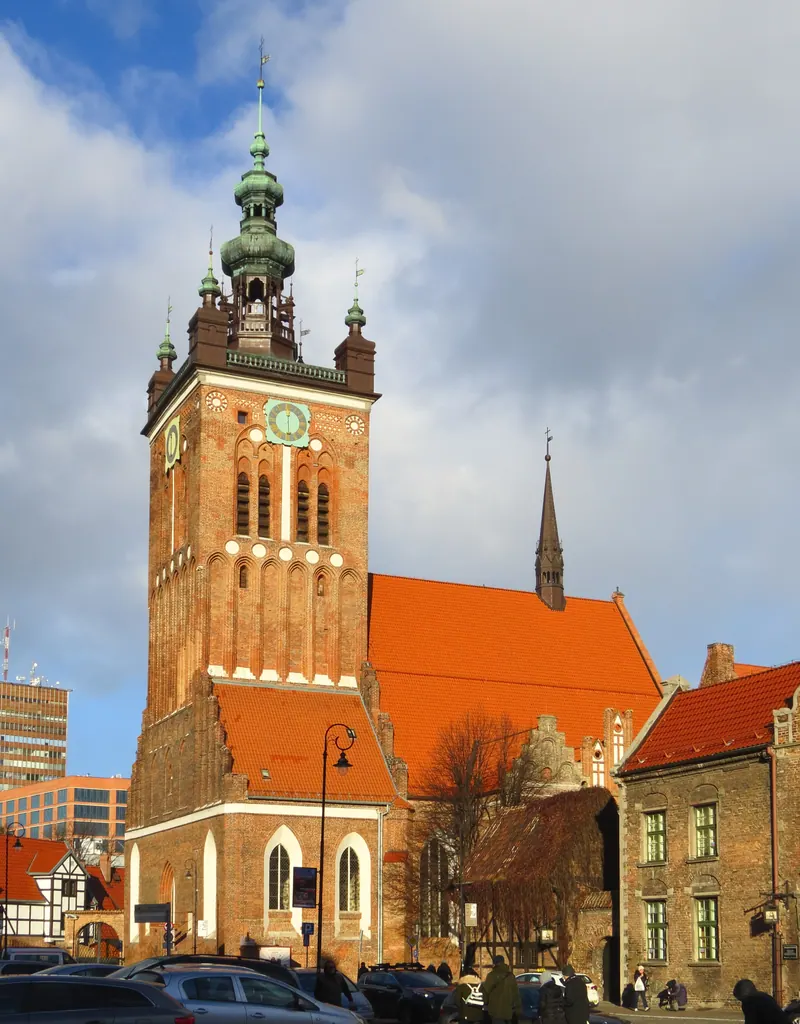
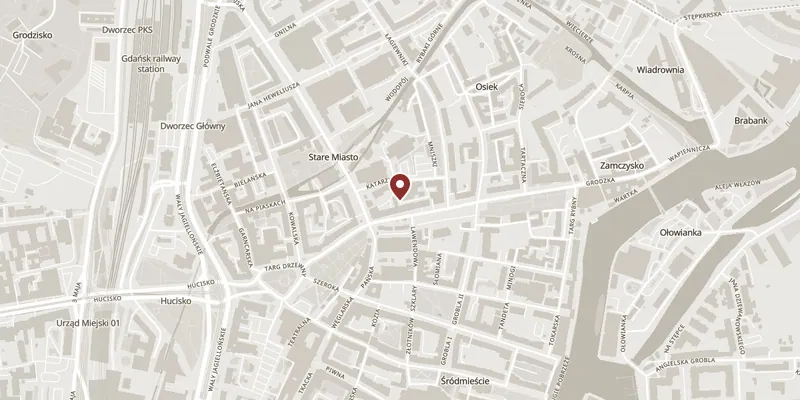
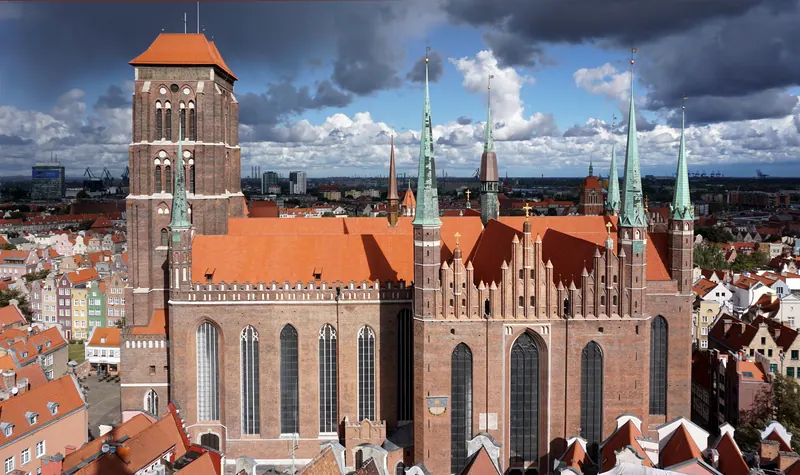
St Catherine’s was the parish church of the Old Town, the settlement north of the Main Town, and it is the oldest parish church in the city: brick from the late 12th or early 13th century, parochial from 1227, when the town held its charter under Lübeck law. It is plainer and lower than St Mary’s and far less visited, which is most of its appeal. Johannes Hevelius, the brewer-astronomer who mapped the Moon from a rooftop observatory a few streets away and died in 1687, is buried here.
It has burned twice in living memory of the city. It was gutted in 1945 like everything around it, and then on 22 May 2006 the roof caught fire again and was destroyed completely, with the sanctuary damaged by the water used to put it out; a public subscription paid to put it back. So the roof over your head is younger than most of the people reading this.
The tower holds a branch of the Museum of Gdańsk, set up in 1996 as the Tower Clock Museum and now called the Museum of Gdańsk Science. It is a working collection of tower-clock mechanisms — the museum dates some as far back as the 14th or 15th century — climbing floor by floor beside the bell chamber, along with a rare rocking clock, the HEVELIUS-2011 precision pendulum clock and a clock of 2011 driven by pulsar signals from a neutron star. The carillon is 50 bells and the museum calls it the largest concert carillon in Poland and Central Europe; recitals are played from this tower on Fridays at 11:00, and from the Main Town Hall tower on Saturdays at 12:05.
At the top, at about 50 m, a balcony runs round the helm. It is the closest thing Gdańsk has to a working medieval belfry visit: clocks, bells, timber and a view over the Great Mill and the Radunia canal.
The church door is free; the tower is ticketed. Last entry is 45 minutes before closing.