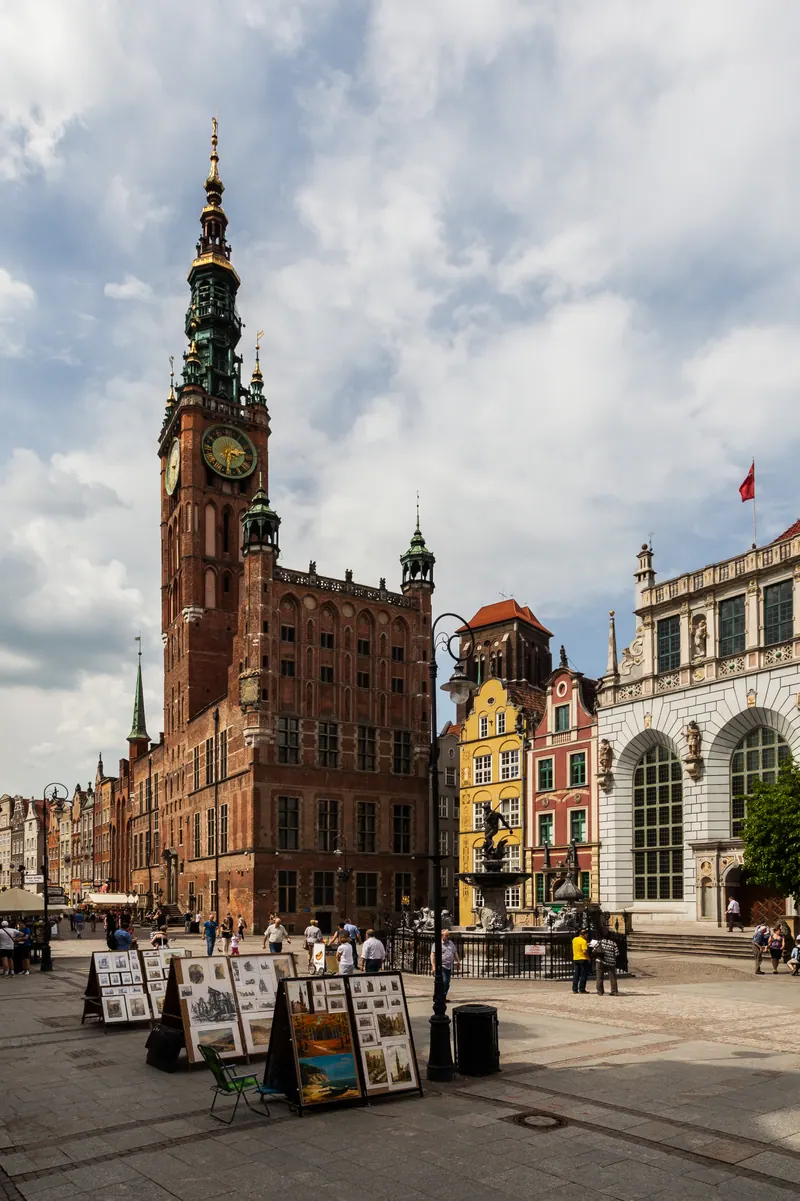
Gdańsk’s Main Town — Rechtstadt — governed itself from this building, and the council that ran the 1454 rising against the Teutonic Order sat in it. The core is 14th-century; the hall was enlarged through the 15th and 16th centuries, burned on 3 October 1556, and was rebuilt in Renaissance dress with a new tower helm in 1559–60 and a gilded figure of the king on top in 1561.
The Red Room (Sala Czerwona), the Great Council Chamber, is what the ticket is for. Its ceiling was fitted out at the turn of the 16th and 17th centuries by the woodcarver Simon Herle and the painter Isaac van den Blocke, whose plafond of 1608 — twenty-five painted fields around a central oval known as the Apotheosis of Gdańsk — is a merchant city’s argument that it is under God’s particular protection, painted for the men who ran it. The ceiling was dismantled from 1942, which is why it exists: it came back after long conservation, with seven older paintings, once the room was rebuilt. The room around it is a reconstruction; the ceiling in it is not.
The rest of the museum runs through the city’s history in the White Room and the council chambers, and the whole visit takes about an hour.
What burned and what stood. In March 1945 fire took the tower helm and the wooden floors, and shellfire and bombs damaged the walls; the reconstruction began in 1946 and was completed on 2 April 1970. The tower carries a carillon of 37 bells, installed in 2000, which plays on the hour.
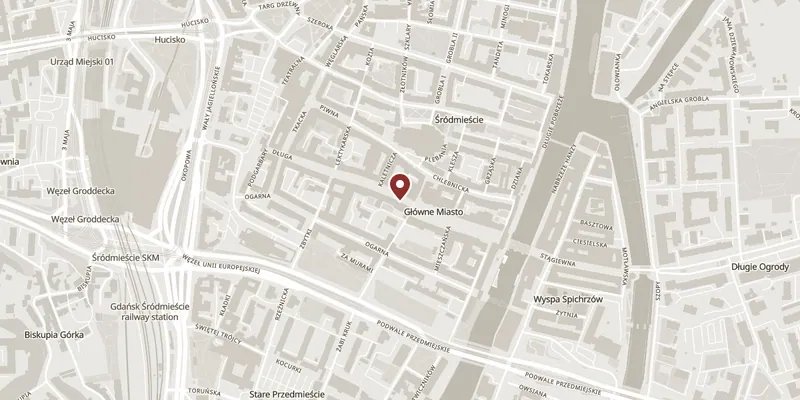
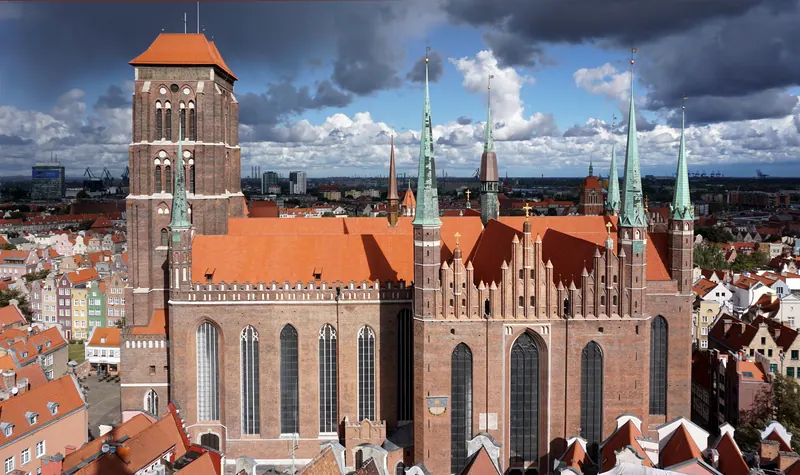
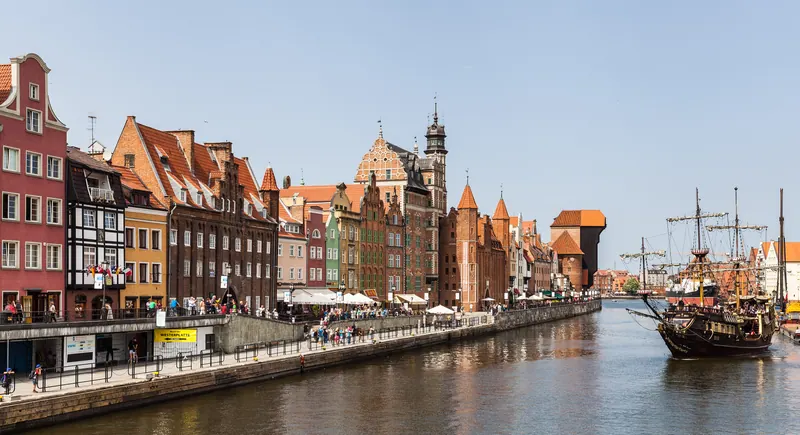
The tower viewing gallery, at about 50 m, is the best place to understand what happened to this city: from it you look down on a Main Town whose street plan is medieval, whose facades are a 1950s and 1960s idealisation of the 17th and 18th centuries, and whose skyline is punctuated by shipyard cranes. The gallery opens from the beginning of May to the end of September only, and the stairs are steep, narrow and poorly signed.