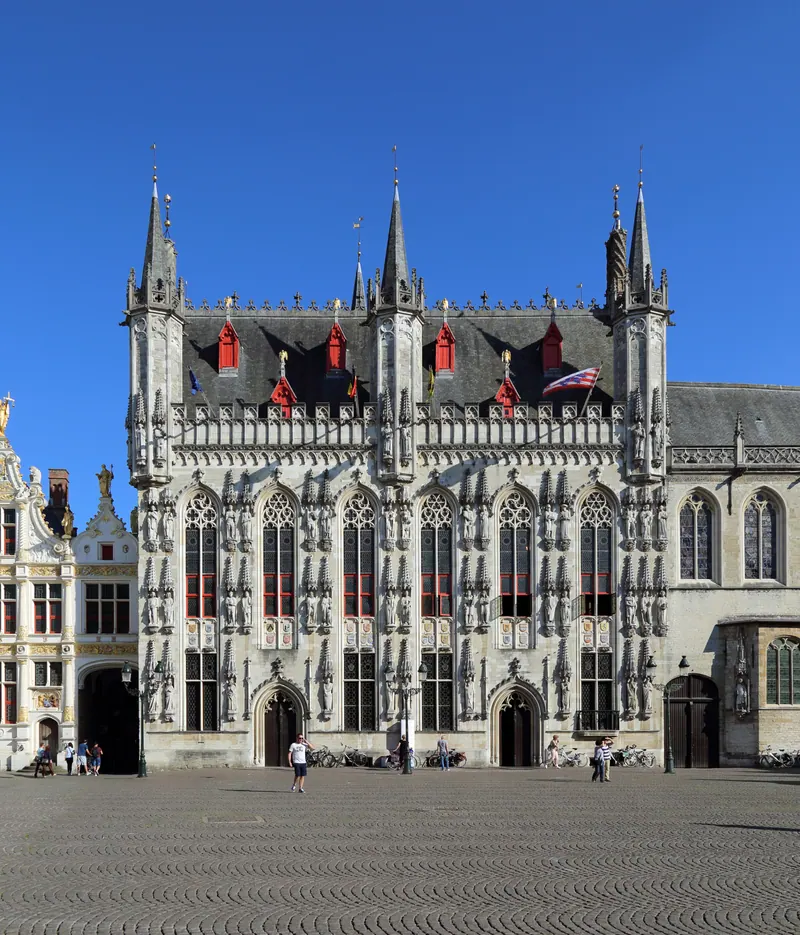
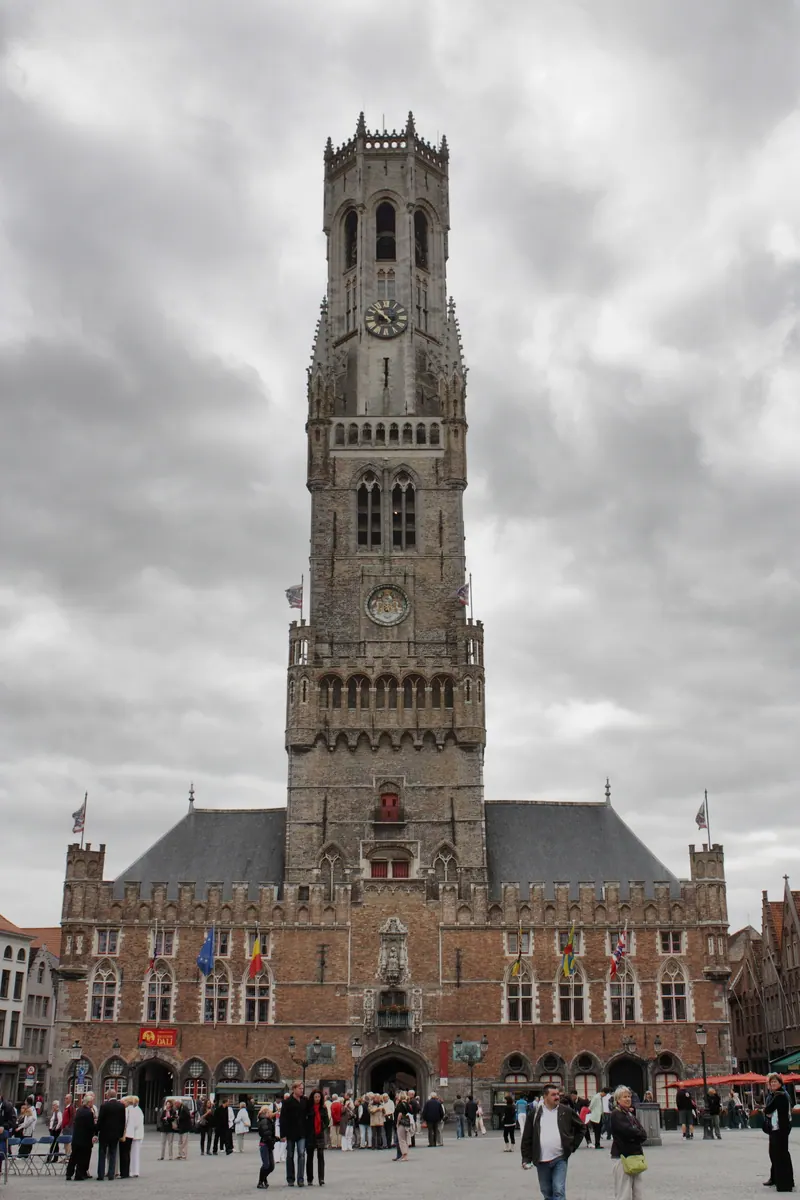
Work started in 1376 and ran to 1421. This is a town hall built while Bruges was still the richest trading city in northern Europe, and the front is a statement of civic self-government: a screen of pinnacled Gothic tracery with niches full of statues of the counts and countesses of Flanders. The statues you see are not the medieval ones. The originals were destroyed during the French period at the end of the 18th century, and the figures in the niches now are modern replacements — the same story as half of the Burg.
Inside, the Gothic Hall on the first floor is the room. Its timber vault comes down onto original 14th-century polychromed consoles, and those consoles — carved corbels showing the months and the biblical scenes — are the genuinely medieval sculpture in the building. Everything filling the wall surfaces beneath them is a different century: the great cycle of paintings of scenes from the history of Bruges is 20th-century work, commissioned when the city was busy telling itself its own story. Stand under the vault, find the consoles first, and then read the paintings as what they are — a Victorian-and-after idea of the Middle Ages, put up in a medieval room.
The ticket also gets you the Historic Room next door, on Bruges as a port and a trading city, and the ground-floor gallery of life-size portraits of the town’s successive rulers. Both are short. Musea Brugge and Visit Bruges word it differently, but the same ticket also admits you across the square to the Liberty of Bruges (Brugse Vrije) and its Renaissance chimneypiece — Musea Brugge describes that as a weekend inclusion, Visit Bruges as included with every paid ticket, so ask at the desk which applies on the day you go.
At €8 it is the cheapest historic interior in the centre of Bruges by some distance, and it takes about forty minutes.