Medieval Booker

Historic City Celebrations ◆ Belgium

Procession of the Holy Blood

Every Ascension Day more than 1,800 people from Bruges carry the relic of the Holy Blood through the historic centre in a four-part pageant of Old Testament, New Testament and city history, with horses, carts, choirs and over 250 live musicians. The procession is dated by the city to 1304, has been on UNESCO's Representative List of Intangible Cultural Heritage since 2009, and next takes place on Thursday 6 May 2027.

When is Procession of the Holy Blood 2027?

Next edition
2027 Procession of the Holy Blood 2027 See all editions
Where
Bruges, Belgium
How often
Every year
Entry
Free to watch standing anywhere along the route; reserved bench and grandstand seats are ticketed (about €13–15 for the Markt grandstand in 2026) through bloedprocessiebrugge.be and In&Uit Brugge.
Family-friendly
Yes — bring the kids
Founded
1304
Attendance
~40,000 visitors

Checked · we re-check every festival twice a year.

Past and upcoming editions

Editions of Procession of the Holy Blood
EditionDatesStatusCalendar
2027 edition 2027 Google Calendar · .ics · Get tickets
2028 edition Expected 2028 Google Calendar · .ics

Expected means the organiser hasn't announced yet; we show the usual window.

Past editions (1)
  • 2026 edition — 14 May 2026

What happens at Procession of the Holy Blood?

The Heilig-Bloedprocessie is the oldest and largest annual event in Bruges. It is held on Ascension Day, which is the Thursday 39 days after Easter Sunday, so the date moves every year between late April and early June — 14 May in 2026, 6 May in 2027, 25 May in 2028. The city dates the procession itself to 1304; the relic it honours, a phial containing cloth said to be stained with the blood of Christ and brought back from the Holy Land according to tradition by Count Thierry of Alsace, is documented in Bruges from the middle of the 13th century. UNESCO inscribed the procession on the Representative List of the Intangible Cultural Heritage of Humanity in 2009.

The day begins in the Basilica of the Holy Blood on the Burg with Lauds at 09:30. At 10:30 the relic is carried to St Salvator’s Cathedral for an 11:00 Eucharist. The procession leaves the Dijver at 14:30 and winds through the historic centre by way of Wollestraat, the Markt, the Burg and Rozenhoedkaai; it takes roughly an hour and a half to pass any one point on the route, and the day closes with a ceremony on the Burg from about 17:30.

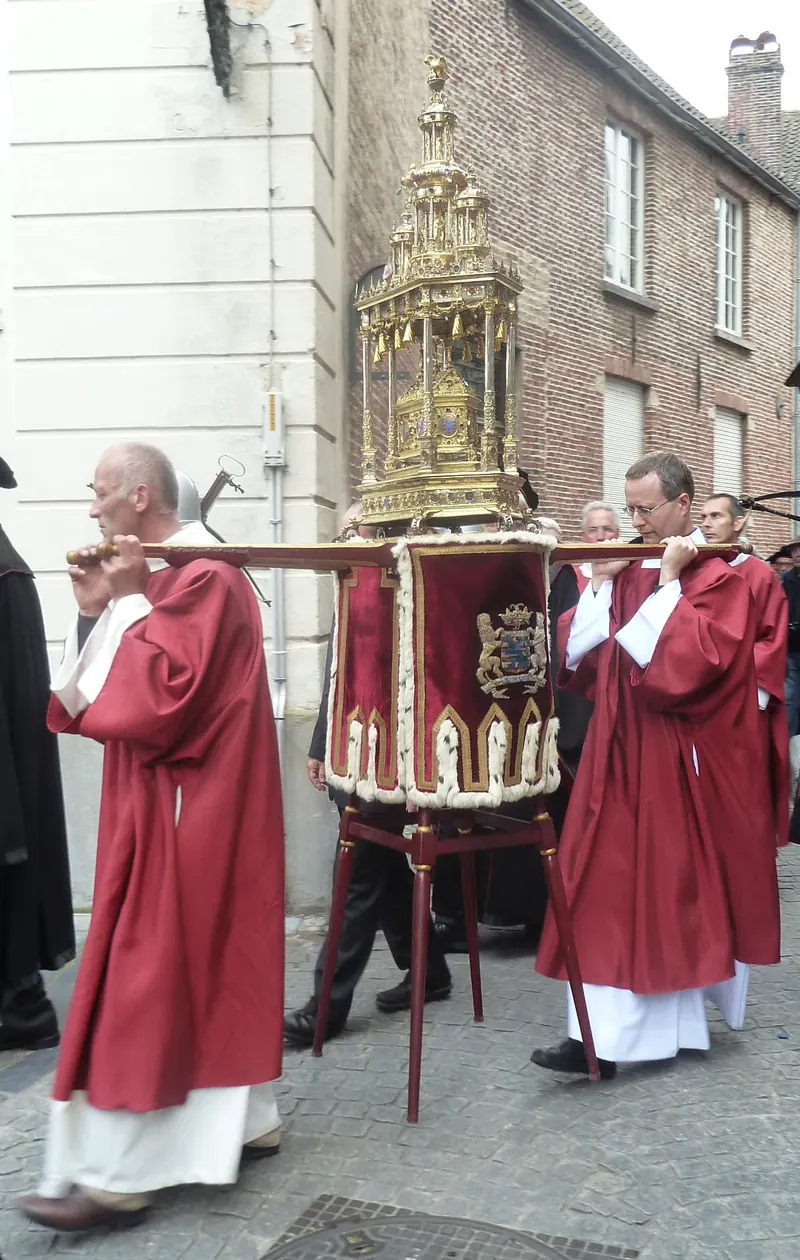
What passes is a pageant in four thematic parts, performed by citizens rather than professionals: scenes from the Old Testament from the Creation onwards, then the New Testament from the Nativity to Pentecost, then the story of how the relic reached Bruges, and finally the shrine itself, escorted on foot by the thirty members of the Noble Brotherhood of the Holy Blood. More than 1,800 people usually take part; the 2026 edition set a record with 1,986 actors, dancers, singers, musicians, riders and extras, and over 250 musicians play live along the route.

Watching from the street is free — you can stand anywhere along the route. Seats on the benches and grandstands are ticketed, at roughly €13–15 for a place on the Markt grandstand in 2026, sold through the procession’s website and In&Uit Brugge; the good positions go early. UNESCO puts spectator numbers at 30,000 to 45,000, so the centre is closed to traffic and crowded from late morning. Audio description and signed, subtitled clips are offered through the Erfgoedapp, and the procession is broadcast live on Focus & WTV for anyone who cannot get a place on the route.
Frequently asked questions

When is the Procession of the Holy Blood in Bruges in 2027?

Thursday 6 May 2027. The procession is always held on Ascension Day, the Thursday 39 days after Easter, and leaves the Dijver at 14:30.

Is the Procession of the Holy Blood free?

Yes, standing anywhere along the route is free. A reserved seat on a bench or grandstand needs a ticket — about €13–15 for the Markt grandstand in 2026 — booked through the procession's website or In&Uit Brugge.

How long does the Holy Blood procession last?

It takes about an hour and a half to pass any single point. The procession starts at 14:30 and the closing ceremony on the Burg is at about 17:30.

What is the route of the Procession of the Holy Blood?

It leaves the Dijver at 14:30 and passes through the historic centre by Wollestraat, the Markt, the Burg and Rozenhoedkaai. A detailed map is published on bloedprocessiebrugge.be.

How old is the Procession of the Holy Blood?

The city dates the procession to 1304, and the relic is documented in Bruges from the mid-13th century. UNESCO added it to the Representative List of the Intangible Cultural Heritage of Humanity in 2009.

How many people take part in the procession?

More than 1,800 in a typical year. The 2026 edition was the largest the organisers have recorded, with 1,986 participants and over 250 live musicians; UNESCO estimates 30,000 to 45,000 spectators.

More medieval festivals in Belgium

Same country, upcoming first.

All festivals in Belgium
Featured
Jousting & Tournaments Living History & Museums +1

Ommegang of Brussels

Brussels, Belgium

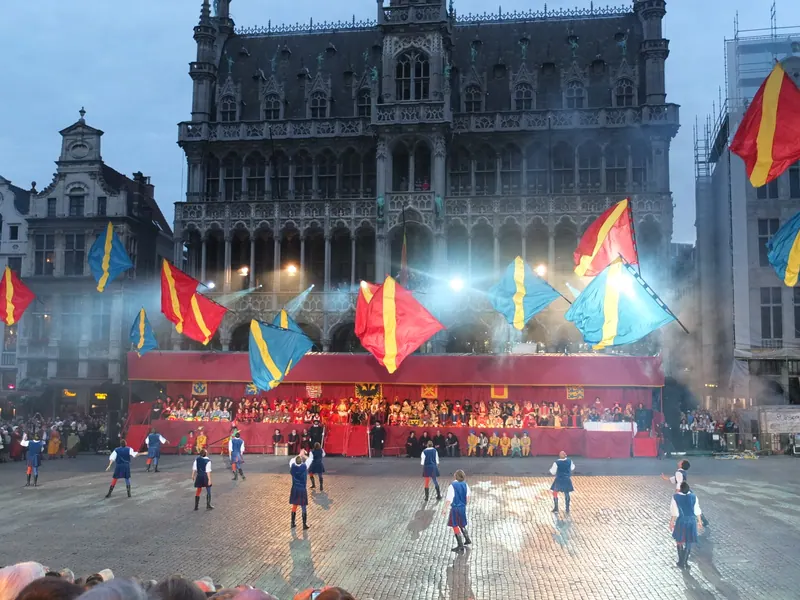
The Ommegang is Brussels' great historical pageant: more than 1,400 participants in costume, with horses, giants, stilt-walkers, crossbowmen and flag-throwers, process from the Sablon to the Grand-Place on two evenings in early July to recreate the 1549 entry of Emperor Charles V and his son Philip. Its roots go back to a 1348 procession of the crossbowmen's guild; it was revived in 1930 and has been on UNESCO's intangible heritage list since 2019. The 2026 shows were on 1 and 3 July.

Expected 2027
Family

Other historic city celebrations

All historic city celebrations
Featured
Medieval Markets & Fairs Jousting & Tournaments +1

Jornadas Medievales de Ávila (Mercado de las Tres Culturas)

Ávila, Spain

Ávila's Jornadas Medievales turn the walled UNESCO city into the 'Market of the Three Cultures' for four days on the first weekend of September, with more than 300 stalls, around 150 free shows, nine mounted tournaments and a grand parade recalling the town's Christian, Jewish and Muslim past. Held since 1997 and declared a Festival of National Tourist Interest, it drew about 130,000 visitors in 2025.

2026
Family
Featured
Living History & Museums Historic City Celebrations

Der Meistertrunk (Rothenburg Whitsun Festival)

Rothenburg ob der Tauber, Germany

Rothenburg ob der Tauber's Whitsun festival re-enacts the legend of 1631, when former mayor Nusch supposedly saved the town from General Tilly's army by emptying a tankard holding more than three litres of wine in one draught. Citizens have performed the play 'Der Meistertrunk' since 1881, framed by a four-day festival with a costumed procession, military camp, shepherds' dance and crafts market.

2026
Family
Reenactment & Battles Medieval Markets & Fairs +1

Sajam u srednjovjekovnom Šibeniku (Medieval Fair in Šibenik)

Šibenik, Croatia

The Medieval Fair in Šibenik turns the Dalmatian port's waterfront below the UNESCO-listed Cathedral of St James and the lanes of the old town into a three-day market of costumed craftspeople, with knights' combat, cannon fire, period music and an evening re-enactment of a 1378 naval battle along the riva. Revived in 2025 after a five-year pause, the 17th edition is scheduled for 4–6 September 2026 and the programme is free.

2026
Free Family

Read more about Bruges

Stories and guides from medieval Bruges.

Medieval Bruges — the city guide

Medieval Bruges

Belgium

For roughly two centuries Bruges was the commercial capital of north-west Europe: English wool arrived here, left as Flemish cloth, and the Burgundian dukes kept their court in the middle of it. The sea channel that made the town rich silted up, the money moved to Antwerp, and Bruges became too poor to rebuild itself — which is the real reason so much of it is still standing.