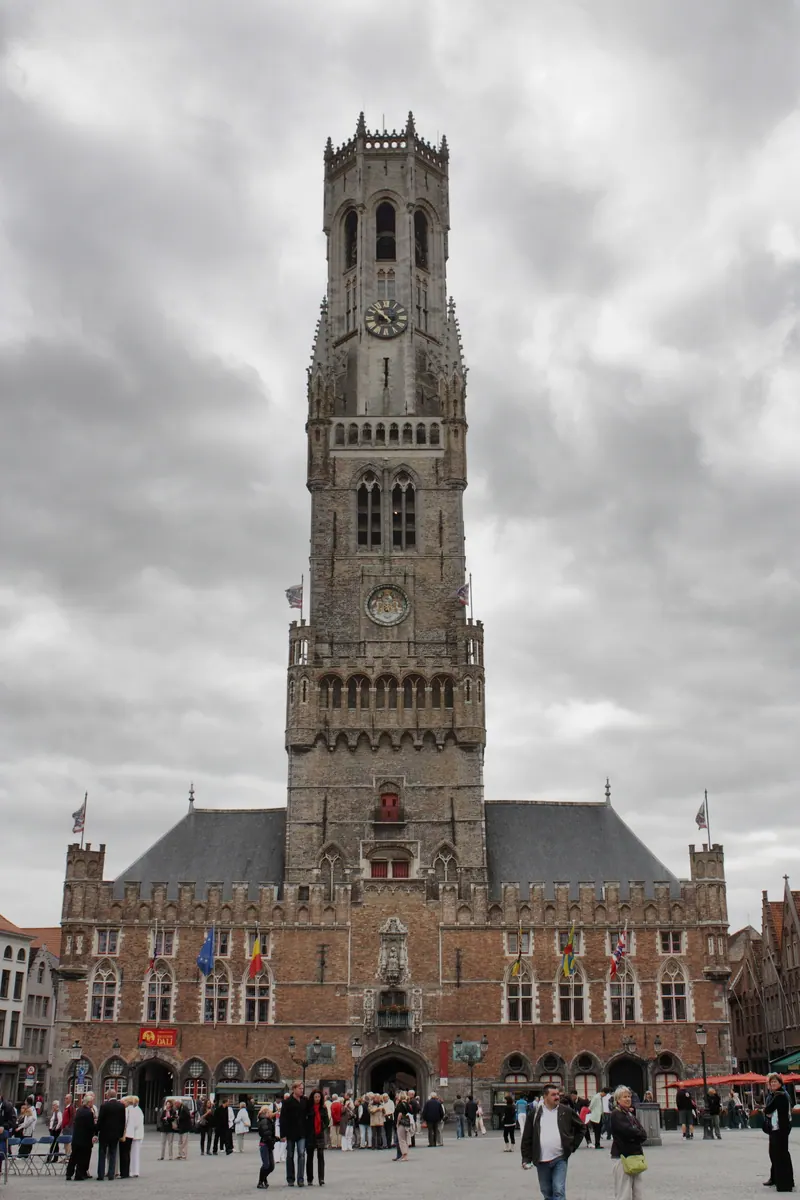
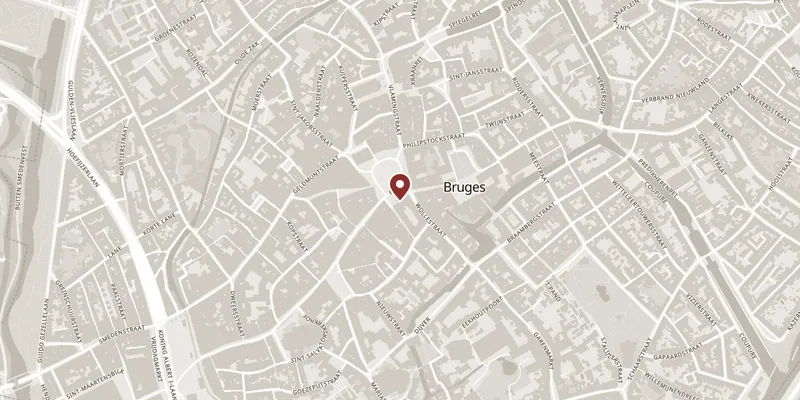
Bruges did not build its tallest tower for a bishop. The belfry stands on the market halls, the commercial heart of the town, and it held the things a self-governing commune could not afford to lose: the city charters — the written proof of Bruges’ privileges — the municipal seal and the treasury, kept in iron boxes with padlocks, set in niches behind a double set of wrought-iron doors. That room is on the climb and it is the reason to come; the view is the bonus.
The tower went up in phases between the 13th and 15th centuries. Fire destroyed a large part of it in 1280, taking much of the city archive with it. The octagonal upper stage in Brabant sandstone was added in 1483–86, and it originally carried a wooden spire; that burned, was rebuilt, and was destroyed again by lightning in 1741, which is why the tower ends flat. The stone crown around the top is a 19th-century addition. The whole thing leans about a metre to the south-east, which you can see from the far end of the Markt. It was inscribed on the UNESCO World Heritage list in 1999 as part of the Belfries of Belgium and France.
The carillon has 47 bells. Visit Bruges records 26 of them as original 18th-century castings and lists the city carillonneur’s concerts on Wednesday, Saturday and Sunday from 11:00 to 12:00; the drum plays automatically every quarter of an hour. You pass the carillonneur’s keyboard on the way up, and if a concert is running you will be inside the instrument, which is loud in a way photographs cannot warn you about.
The climb is 366 steps, no lift, and the staircase narrows to a single-file spiral near the top with passing places. Entry is by timed slot with roughly 15 to 25 people released every 20 minutes, which is the reason to book online rather than queue on the Markt. The courtyard of the halls below is free to walk into.