Bruges built its second and final circuit of walls between 1297 and 1304, enclosing the town that the cloth trade had already outgrown once. The curtain wall itself is gone. What survives is the line — the moat, the earth bank and four of the medieval gates — and Visit Bruges now describes the whole thing as the Vesten: 26 hectares, more than 3,000 trees and a 7 km walking and cycling route past the Minnewater, the Coupure marina and all four gates. Say plainly what that means: this is a medieval defensive perimeter turned into a 19th-century-and-later public park. The stones you touch are medieval, the parkland is not, and the combination is the pleasantest hour in the city.
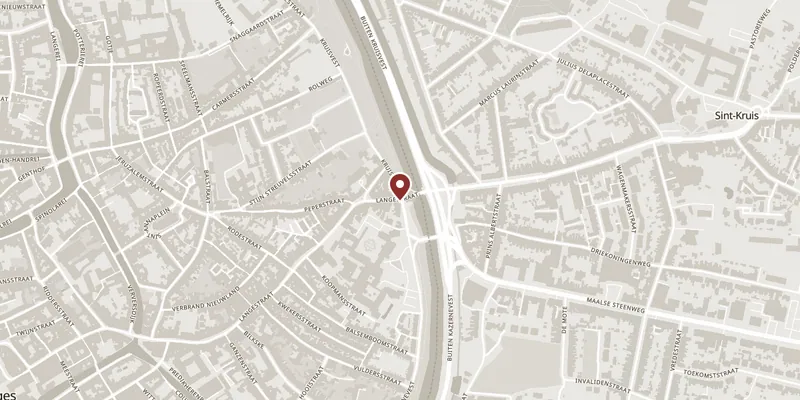
Go anti-clockwise from the Minnewater and take the gates in order. The Gentpoort on the south side sits over the road with a statue of St Adrian in a niche above the passage, believed to protect the town in time of plague; Visit Bruges says it is at its best in the evening, when it is floodlit. The Kruispoort on the east is the most military-looking of the four — two heavy towers, a narrow passage, two octagonal turrets — and was built in 1400 to replace a gate destroyed in 1382. Charles V and, much later, Napoleon both rode in through it.
The Smedenpoort on the west is the one to save. Visit Bruges dates the original gate to 1297–1299 and the standing structure to 1367, and above the left-hand passage there is a bronze skull. It commemorates François Vander Straeten, who tried to let a French force into the city in the late 17th century and had his head fixed to the gate for it. The skull on the gate today is generally described as a replacement, with the original in the city’s archaeological collection — which is very Bruges: even the grisly bit has been restored. The fourth gate, the Ezelpoort, is on the north-west.
Between the gates on the eastern stretch stand the windmills. Four of them line the Kruisvest, and they are honest about their dates: the Sint-Janshuismolen was built in 1770 and is, on Musea Brugge’s own account, the only one of the four where grain is still ground. Mills have stood on this line since the 13th century, but none of the present ones is medieval. You can go inside the Sint-Janshuismolen for €5 in season and watch the mechanism turn when there is wind.
Only the Gentpoort has an interior open to visitors, and only at weekends. Visit Bruges lists the gate as free while other listings quote around €4 for the display inside, so check with Musea Brugge before you build a day round it.