Medieval Booker

Church ◆ Bruges

Basilica of the Holy Blood

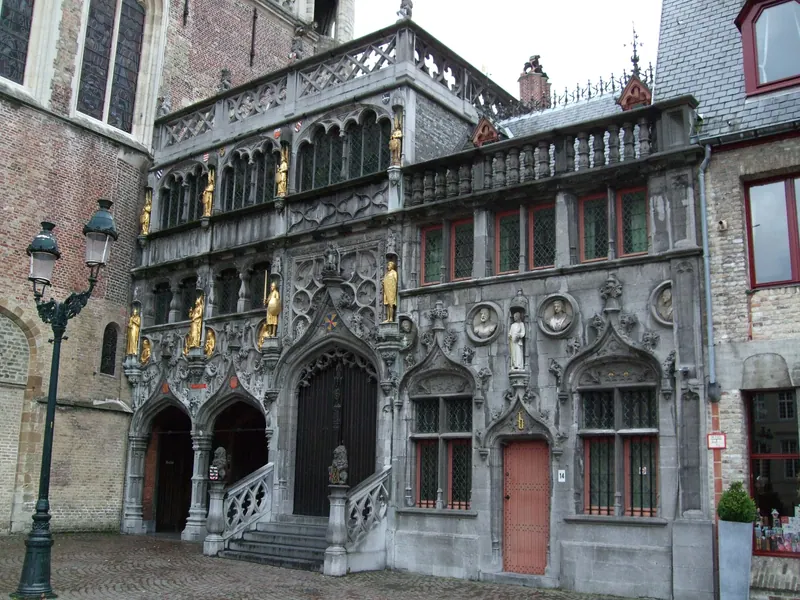
Two chapels stacked on the corner of the Burg: a bare 12th-century Romanesque one downstairs that Visit Bruges calls the only nearly complete Romanesque church building in West Flanders, and a Gothic one upstairs whose colour is almost entirely late-19th century. The relic of the Holy Blood is brought out for veneration daily between 14:00 and 16:00, and entry to both chapels is free.

Where and when

Where
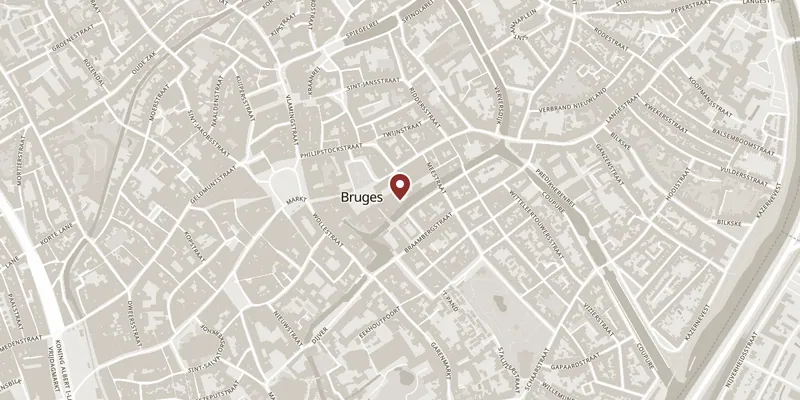
Burg 13, 8000 Brugge, Bruges, Belgium Open in Google Maps Walking directions
Era
Lower chapel of St Basil c. 1134–1157, Romanesque; upper chapel 15th-century Gothic with late-19th-century neo-Gothic decoration; Great Shrine 1614
Opening
Daily 10:00–17:15. Veneration of the relic daily 14:00–16:00 and Fridays 10:15–11:00. The site listed a closure 12–17 January 2026 and publishes its own calendar (as of August 2026)
Price
The basilica and both chapels are free. The treasury museum is €5 for adults and free under 12 (as of August 2026)
Best time
At 14:00, when the relic is brought out — arrive a few minutes early and you will be near the front. Otherwise 10:00, before the Burg fills. The lower chapel is worth five minutes on its own at any hour, and on a hot August afternoon it is the coldest, quietest room on the square.
Good for
Free or cheapWorks in the rainQuiet corner
Official site
www.holyblood.com
Map showing where Basilica of the Holy Blood is
Open in Google Maps Walking directions © MapTiler © OpenStreetMap contributors

Checked

What is Basilica of the Holy Blood?

This is the clearest lesson in Bruges on what is medieval and what is Victorian, and you get it by climbing one staircase.

The lower chapel of St Basil is Romanesque, usually dated to about 1134–1157 and built for Thierry of Alsace, count of Flanders. Visit Bruges describes it as the only Romanesque church building in West Flanders that has survived almost complete. It is dark, low, undecorated, roofed with stone rib-vaulting on heavy round pillars, and it holds a 12th-century relief of the Baptism of Christ. Nothing here is trying to impress you, which is precisely why it is the most convincingly medieval interior in the city centre.

Go up the Steegheere staircase — the bluestone front is a reconstruction, in a style caught between late Gothic and early Renaissance — and the upper chapel is a different world: painted, gilded, stencilled, crowded with statuary and stained glass. The shell is 15th-century Gothic. Almost all of the decoration is late-19th-century neo-Gothic, and Visit Bruges says as much. Neither chapel is a fake, but only one of them looks the way it looked to a Burgundian. Stand at the top of the stairs and compare.

The relic of the Holy Blood is a phial of cloth said to be stained with the blood of Christ. The tradition is that crusaders brought it to Bruges — the count Thierry of Alsace, returning from the Second Crusade, is the name usually attached. Visit Bruges words it carefully as “said to have been brought to Bruges by the crusaders”, and the documentary record of the relic in Bruges begins about a century later than the tradition claims, so treat the 1150 story as a story. What is not in doubt is that the town organised itself around this object for 700 years, and still does: the relic is brought out every day for veneration from 14:00 to 16:00, and on Fridays also from 10:15 to 11:00, and you can join the short queue and see it at arm’s length for nothing.

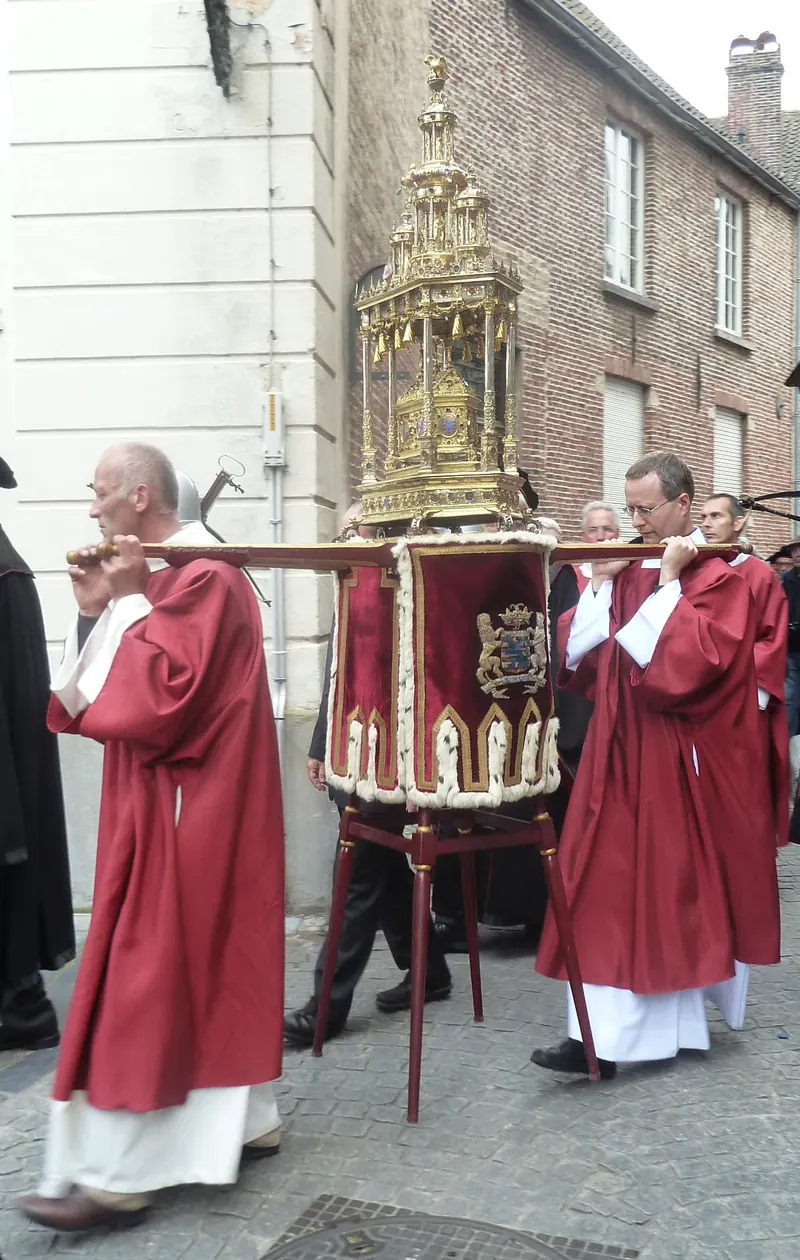
The adjoining treasury costs €5 and holds the Great Shrine of the Holy Blood, made by the Bruges silversmith Jan Crabbe in 1614 — the reliquary carried through the streets on Ascension Day. The church was raised to the rank of basilica in 1923.

One date to know: the Procession of the Holy Blood takes over the whole city on Ascension Day, and the basilica’s own site gives the next as Thursday 6 May 2027. On that day the relic is not in the building.
What visitors say

4.6 from 5,999 ratings

  • Sarah Hands

    2 out of 5 a month ago

    It was beautiful inside, but struggling to understand how it could be considered one of the top things to do in Bruges. We paid extra for the museum ticket, only to discover it was a single room about the size of a lounge that contained some religious artifacts. Think the word "museum" was a bit of a stretch

    Read this review on Google
  • R AY

    5 out of 5 2 months ago

    The Basilica of the Holy Blood is one of Bruges’ most fascinating and spiritually significant landmarks. Located on Burg Square, just steps from the city’s Gothic Town Hall, this small yet richly decorated church offers a powerful blend of history, art, and devotion. The chapel is colorful and ornate, with stained-glass windows, detailed murals, and gilded decorations. The vibrant interior feels intimate yet grand, especially when sunlight streams through the stained glass. The craftsmanship here is impressive and visually striking.

    Read this review on Google
  • GNAL

    5 out of 5 3 months ago

    The only church opened on ascension day. Beautifully painted church and free to enter. Make sure you visit the basilica underneath the church. Thank you for being open and not using the public holiday to be a reason to close. As the city was full of people looking to enjoy the city attractions.

    Read this review on Google

Ratings and reviews from Google. See all on Google Maps

Frequently asked questions

Is the Basilica of the Holy Blood free?

Yes. Both the Romanesque lower chapel and the upper chapel are free to enter. Only the treasury museum charges, at €5 for adults and free for under-12s as of August 2026.

When can you see the relic of the Holy Blood in Bruges?

It is brought out for veneration every day from 14:00 to 16:00, and additionally on Fridays from 10:15 to 11:00, as of August 2026. Check the basilica's own calendar, as the schedule changes around feast days.

How old is the Basilica of the Holy Blood?

The lower chapel of St Basil is Romanesque, usually dated to about 1134–1157 and built for Thierry of Alsace, count of Flanders. The upper chapel is 15th-century Gothic, but nearly all of its decoration is late-19th-century neo-Gothic work.

Did the crusaders really bring the Holy Blood to Bruges?

That is the tradition, usually credited to Thierry of Alsace returning from the Second Crusade around 1150. Visit Bruges hedges it as "said to have been brought to Bruges by the crusaders", and the documented history of the relic in the town starts appreciably later. Treat it as tradition rather than fact.

When is the Procession of the Holy Blood?

On Ascension Day. The basilica's own site gives the next as Thursday 6 May 2027. The relic leaves the building for the day and the city centre is closed to traffic.

Festivals in Bruges

Medieval festivals in Bruges
Featured
Historic City Celebrations

Procession of the Holy Blood

Bruges, Belgium

Every Ascension Day more than 1,800 people from Bruges carry the relic of the Holy Blood through the historic centre in a four-part pageant of Old Testament, New Testament and city history, with horses, carts, choirs and over 250 live musicians. The procession is dated by the city to 1304, has been on UNESCO's Representative List of Intangible Cultural Heritage since 2009, and next takes place on Thursday 6 May 2027.

2027
Family

More places in Bruges

Places in Bruges
Museum Start here

Museum Sint-Janshospitaal

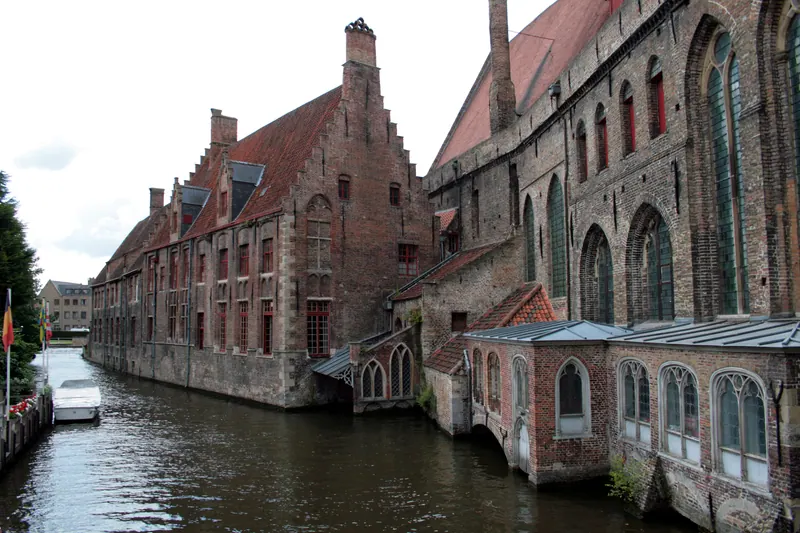
Hospital documented from 1188; medieval wards and church; Memling panels made for the house from the 1470s–1480s

A hospital first documented in 1188, run by lay brothers and sisters, and still taking patients until 1977 — with seven paintings by Hans Memling, four of them made for this building and never moved out of it. Go for the Shrine of St Ursula, a gilded reliquary painted as a miniature Gothic chapel, and then climb to the attic roof truss.

Works in the rain Quiet corner
Walking directions
Church

Church of Our Lady and the O.L.V.-kerk Museum

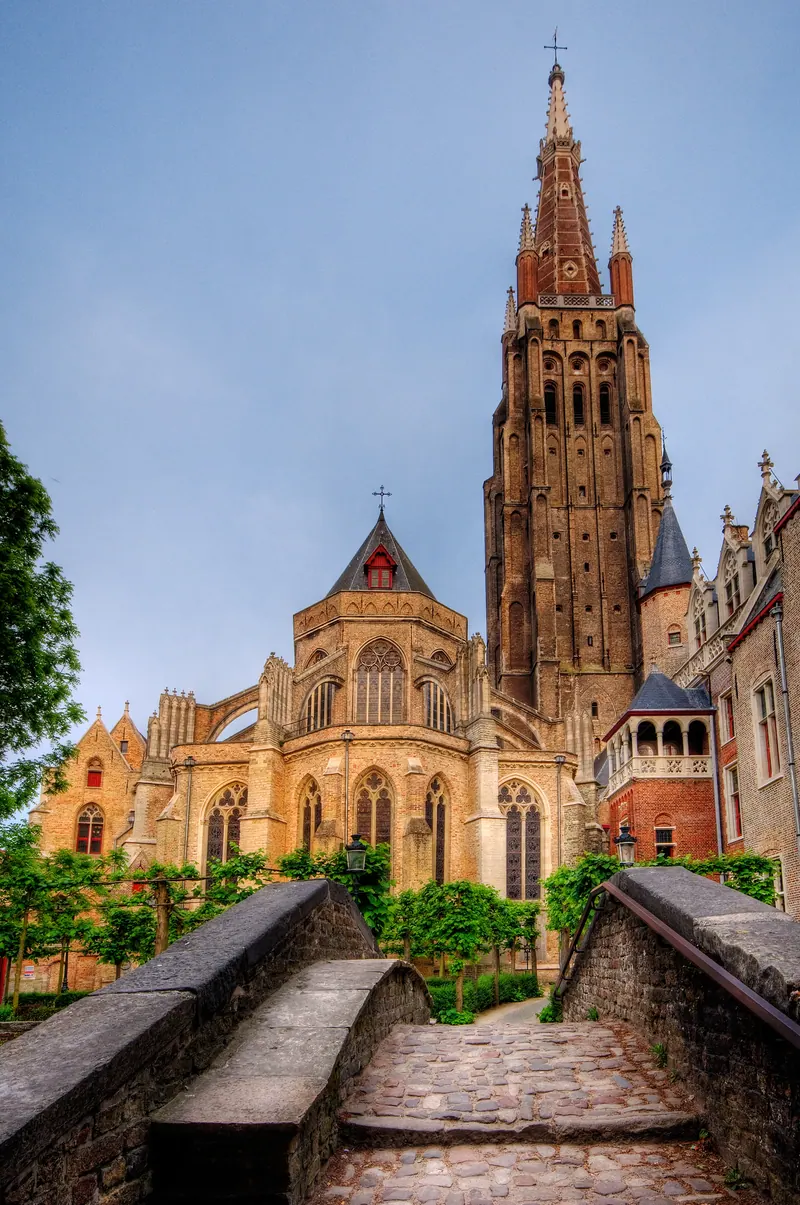
Brick tower and church 13th–15th century; Michelangelo Madonna c. 1504, given 1514; Mary of Burgundy's tomb c. 1501–02, Charles the Bold's 1558–63

A 115.5-metre brick tower — Musea Brugge calls it the second-highest brick church tower in the world — over the only sculpture Michelangelo let leave Italy in his lifetime and the tombs of the last two rulers of Burgundy. The nave is free; the Madonna, the mausoleums and the painted grave niches under the glass floor are all inside the ticketed part, which is the part you came for.

Works in the rain Quiet corner
Walking directions
View

The Belfry

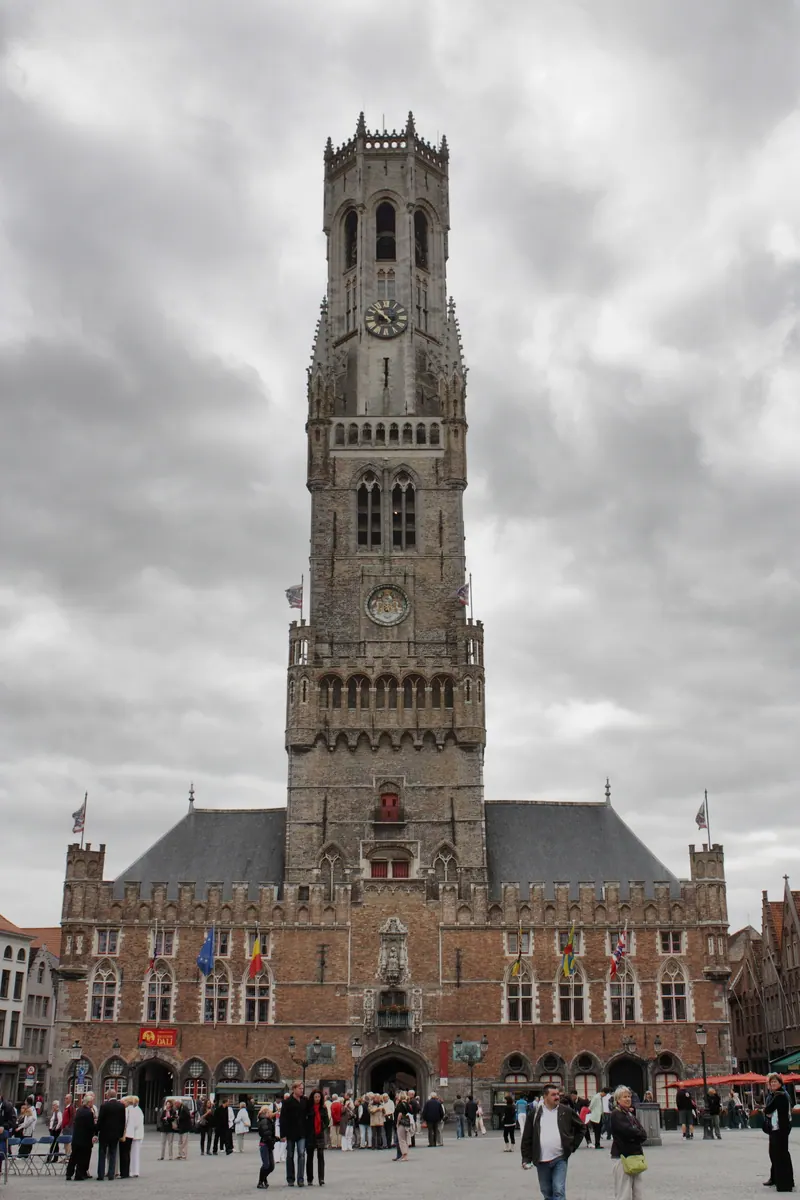
Begun 13th century on the market halls; octagonal upper stage 1483–86; spire lost to lightning 1741

83 metres and 366 steps of the building the guilds and the town council put their identity into, begun in the 13th century and topped with its octagonal lantern in the 1480s. Stop on the way up at the treasury room, where the town's charters, seal and money were locked in iron chests behind double wrought-iron doors.

Good with children
Walking directions