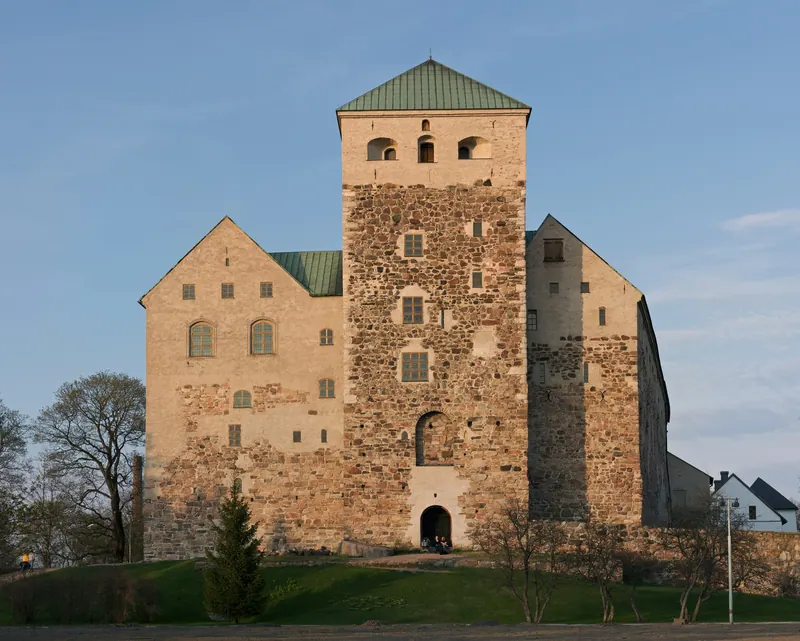
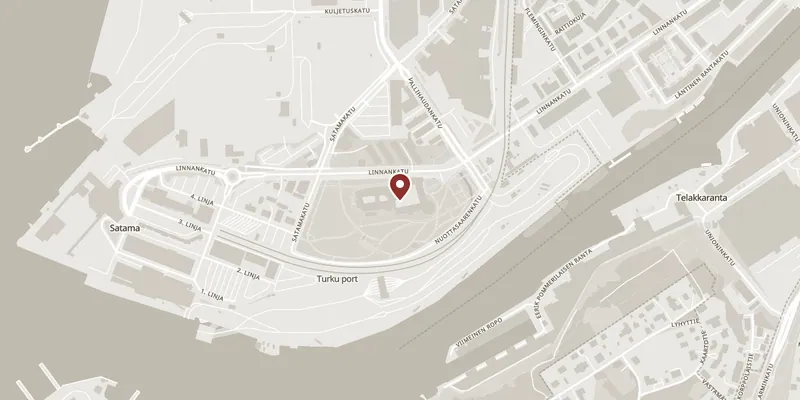
Swedish forces began a fort at the mouth of the Aura around 1280, guarding the river approach to the bishop’s town upstream. It grew into two joined buildings, and the join is the thing to understand before you go in. The main castle — the keep, päälinna — is the medieval part, grey granite, finished in the early 15th century. The bailey (esilinna) was begun in the late 15th century and completed in the 16th, and it is where the Renaissance work is.
The castle’s best years were 1556–63, when Gustav Vasa’s son Duke John of Finland and his Polish wife Catherine Jagiellon kept a court here and built the Renaissance floor with the King’s Hall and the Queen’s Hall. It ended badly. John rebelled, took the Swedish throne, and held his deposed brother Erik XIV prisoner in this castle in 1570–71.
Two things to look for. In the Nun’s Chapel hangs a 14th-century painting of the Virgin attributed to the Master of Lieto, the most famous single object in the castle. In the King’s Hall hangs Albert Edelfelt’s Duke Karl Insulting the Corpse of Klaus Fleming, painted in 1878 — a 19th-century picture of a 16th-century humiliation, hung in the room it imagines.
Be clear about what you are walking through. The Great Fire of 1827 that took three-quarters of the town never reached out here, but a fire in 1614 destroyed the wooden structures of the old castle almost completely, and Soviet incendiary bombs badly damaged the building in 1941. What stands is the result of a restoration run from 1946 to 1961 by the architect Erik Bryggman and continued by the interior architect Carin Bryggman — the largest project of its kind in the Nordic countries at the time. Their rule was to keep what stood and rebuild only what the evidence supported. The reconstructed castle church and medieval King’s Hall were the parts that caused arguments, and the museum’s own Built from Ruins display in the Southern Exhibition Hall says so plainly.
The exhibitions are extensive. The History of Turku Castle, in the bailey, runs from the 13th century to the present with nearly 1,000 objects, life-size wax figures of Duke John, Catherine Jagiellon and the Turku merchant Valpuri Innamaa, and a model of the castle in Per Brahe’s time showing its 17th-century halls, kitchens and sauna.