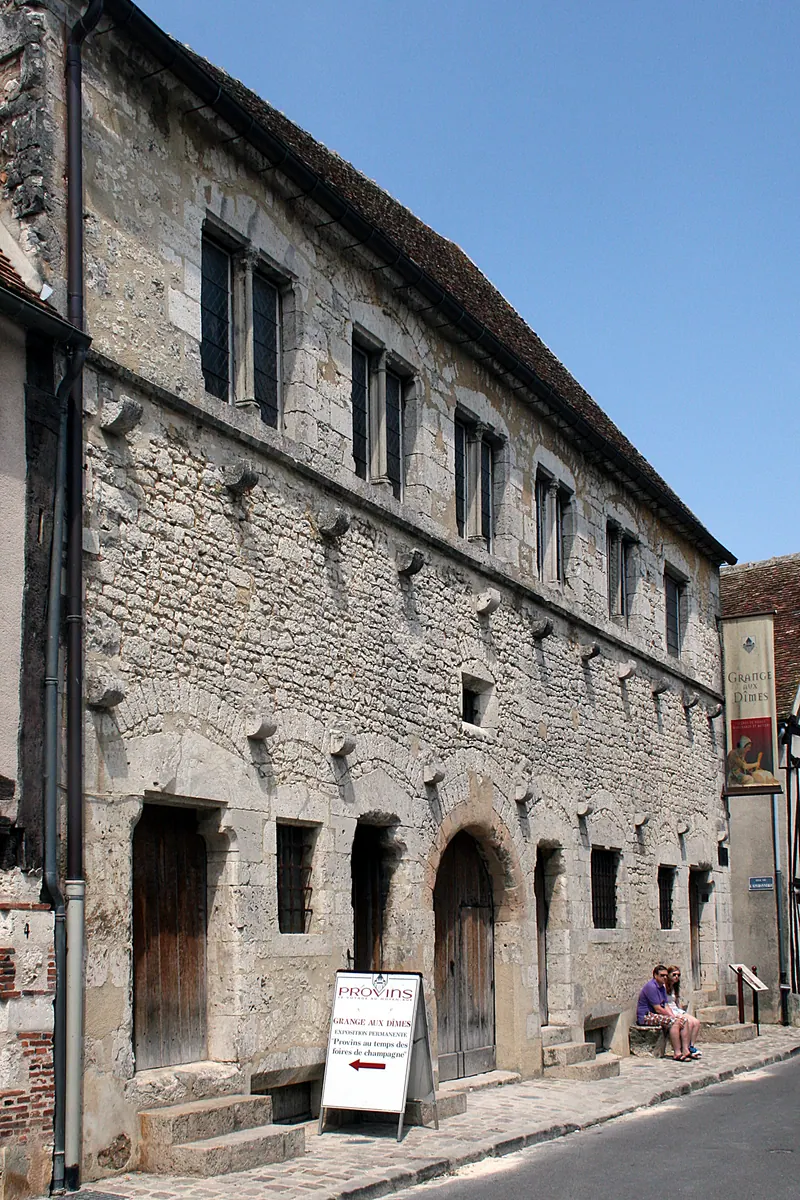
This is the building that explains the town. Provins hosted two of the six annual Champagne fairs, the May fair of Saint-Quiriace and the September fair of Saint-Ayoul, where Flemish cloth was sold to Italian buyers and settled by Italian bankers, and where the prices agreed set rates across Europe. The Grange aux Dîmes is what that machinery looked like as a building.
It was put up in the 13th century as a merchant’s house with three working levels — a vaulted cellar for goods, a shop or covered hall at street level, and living quarters above. Surviving leases show it was rented out to merchants from Toulouse in 1223, which is about as direct a piece of evidence for the fair economy as a building can give you. The cellar is the best room: cross-ribbed vaults on squat columns with foliage capitals, the standard high-status storage of the fair town. The “tithe barn” name is a later accident — in the 16th and 17th centuries the building was used to store the harvest tax, and the name stuck.
The permanent display is a set of costumed figures set out through the levels, each with an audio-guided commentary: the Italian merchant, the Provins wool-cloth merchant, the money-changer, the Flemish merchant, the écrivain public who wrote letters and contracts for people who could not, and craftsmen — a potter, a stone cutter, a parchment maker. It is frankly old-fashioned museography, mannequins and voices rather than objects, and it is nonetheless the clearest account of how a medieval international fair actually worked that you will get in France for €5.
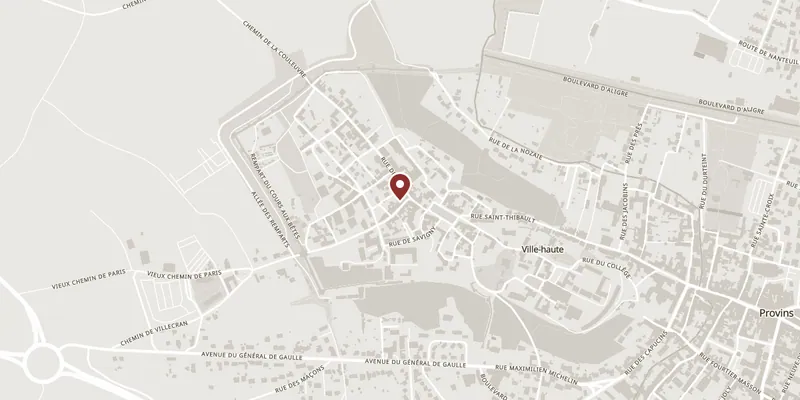
Allow about 35 minutes. The audio guide is handed out against an identity document, so carry one. The building stands on rue Saint-Jean between Place du Châtel and the Porte Saint-Jean, on the street the fair traffic used.