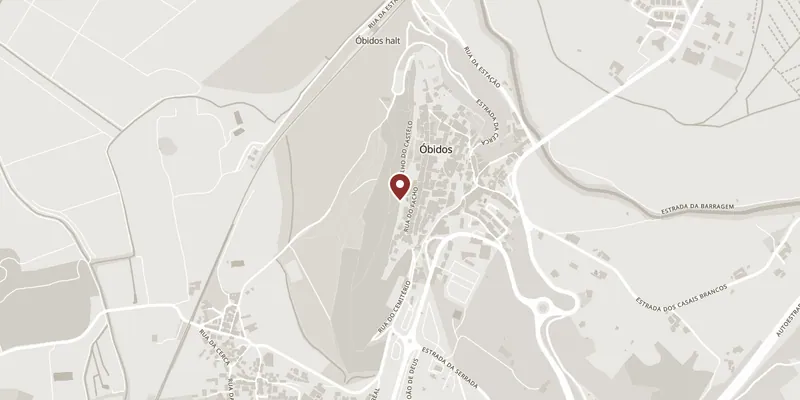
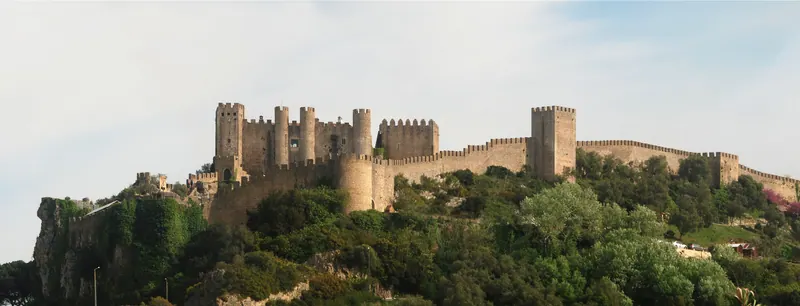
Óbidos is enclosed, not decorated. The wall runs unbroken around the hilltop — the castle’s own site gives the circuit as 1,565 m — and you can walk the whole of it, which is rare: most European wall towns give you a restored fragment behind railings and charge for it. Here the parapet walk is the medieval one, worn round by six centuries of feet, and it is a public right of way.
The fabric is 13th–14th century, built up on Moorish and Roman work after Afonso Henriques took the hill in 1148 and expanded under King Dinis, who gave the town to Isabel of Aragon in 1282. The 1755 earthquake brought down long stretches and the repairs are visible if you look at the coursing. The circuit is roughly rectangular with the castle at the high north end; the eastern run has the drop to the plain, the western run looks over rooftops into the town.
Where to get up. The two usual access stairs are beside the Porta da Vila at the south end, immediately inside the gate, and at the Largo de São Tiago below the castle at the north end. The steps are steep, open-sided and worn. Allow about an hour for the full circuit at a walking pace, more if you stop.
What to look for. From the eastern wall you see the Usseira aqueduct, a single-storey arcade of 1573 built on Queen Catherine of Austria’s orders, running across the fields towards the town — it is best seen from up here and is not worth a separate visit. From the western wall you look straight down into the walled gardens and back yards behind Rua Direita, which is the only way to see how the town is actually built. From the north end you get the keep and the Cerca do Castelo at eye level.
There is nothing on the wall: no rail, no bench, no shade, no water, no lighting and nobody supervising. Wind on the exposed east side is real. Wear something with a grip and keep your camera on a strap.