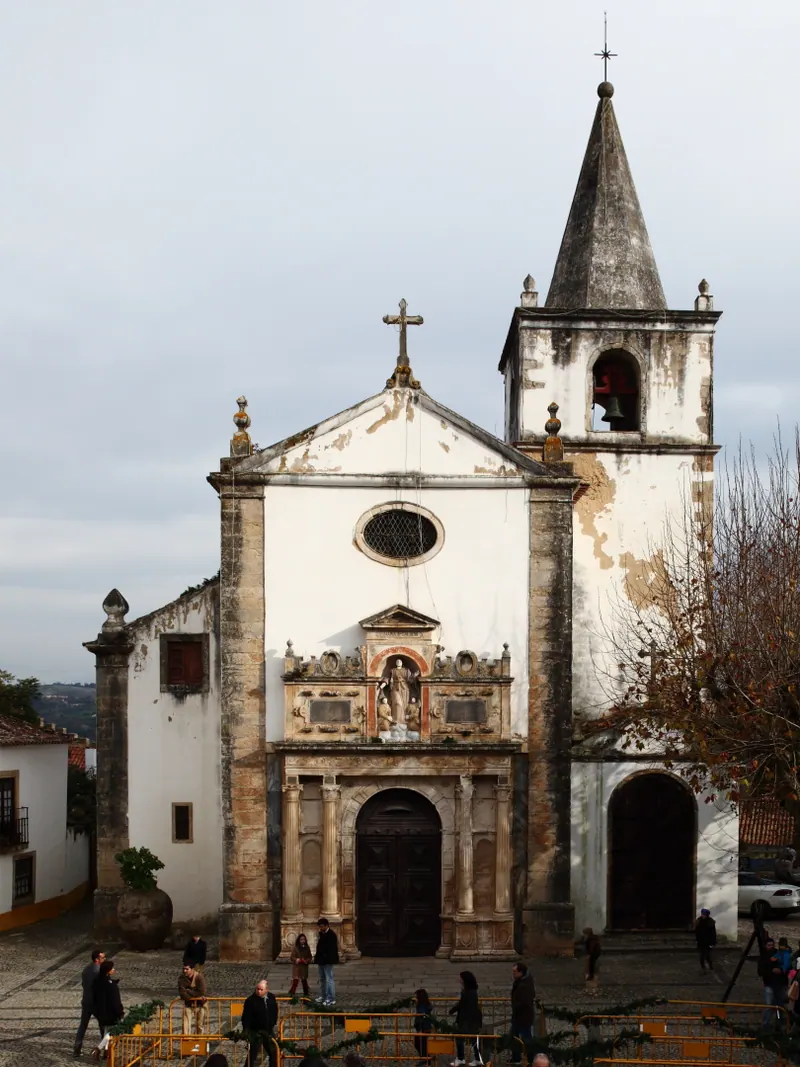
This is the main church of Óbidos and it stands where the mosque stood. Afonso Henriques took the hill from the Moors in 1148 and the building was consecrated for Christian use; Queen Leonor reworked it heavily in the late 15th century, and after earthquake damage it was largely rebuilt from 1571, which is why the portal is Mannerist with a figure of Our Lady of the Assumption over it rather than Gothic.
In 1441 the betrothal of Afonso V, then nine years old, to his cousin Isabel of Coimbra was celebrated in this church — a political marriage arranged by the regent, her father Pedro, Duke of Coimbra. The couple were actually married six years later at Santarém; Pedro was killed fighting his son-in-law’s army at Alfarrobeira in 1449.
Inside, three things are worth the walk. The nave is lined to the ceiling with 17th-century blue-and-white azulejos, one of the largest tiled church interiors in Portugal, under a painted wooden ceiling designed by Francisco de Azevedo Caminha. In the chancel wall is the tomb of D. João de Noronha the Younger and his wife D. Isabel de Sousa, carved by the French sculptor Nicolau Chanterene in about 1526–28 and classified as a National Monument in its own right — Renaissance work of a quality you would not expect in a town of this size. In the Chapel of the Epistle, the altar of St Catherine of Alexandria carries five canvases by Josefa de Óbidos, the painter who lived and died in the town; it is possibly the only work of hers still standing where she put it, and the altar front is faced with 16th-century polychrome Seville tiles.
Before you go in, look at the pelourinho in the square. Portuguese towns all have a pillory; this one carries the royal arms and a camaroeiro, a shrimping net. Queen Leonor had it cut there for the fishermen who pulled her son Afonso from the Tagus after his fatal riding accident in 1491 — the death that ended the direct line and sent the crown to Manuel I.