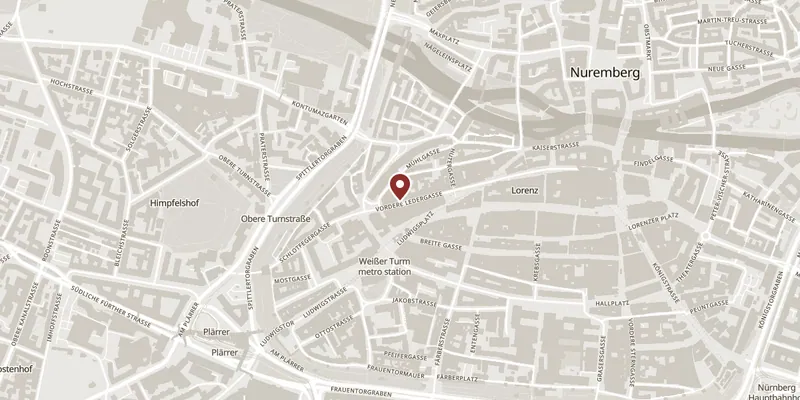
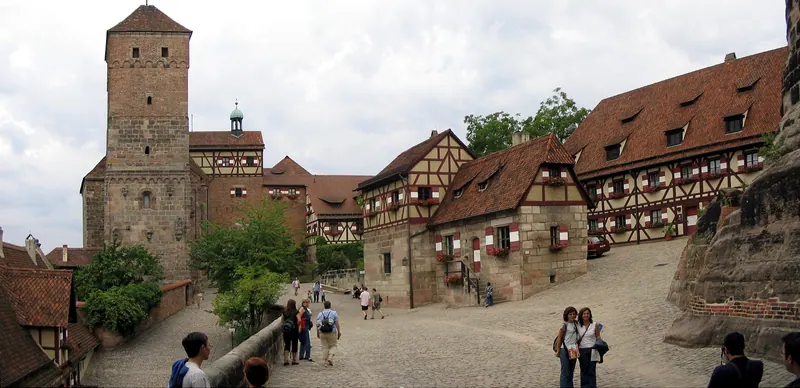
The street is called Zirkelschmiedsgasse — compass-smiths’ lane — after the trade that worked in it, and Nuremberg’s compass and instrument makers were among the best in 15th-century Europe. Number 26 has been a bratwurst kitchen since 1419, which the city’s tourism office and the Nuremberg bratwurst producers’ association both describe as making it the oldest bratwurst kitchen still working on its original spot. The house calls its own walls six hundred years old, and the sandstone ground floor is the medieval fabric.
In 1640 the inn Zum Gulden Stern was moved up into the higher class of eating houses and given the rare right to slaughter its own pigs on the premises. Guests have been served since then at the hearth that is still there, and the sausages — small, thumb-sized Nuremberg Rostbratwürste — are still grilled over a beech fire in the room, not in a kitchen out of sight.
It very nearly went. In 1980 the property was bought by Martin Hilleprandt with a demolition permit already granted, and was restored instead. That is why there is a late-medieval eating house in a city where almost nothing of the kind survived.
Practically: open daily 11:00–22:00, kitchen until 21:30, main dishes from about €9.50. Order by the number — six, eight, ten or twelve sausages on a pewter plate with sauerkraut or potato salad — and drink Franconian beer or wine with them. The rooms are small, low and dark; the one you want has the fire in it.
The alternative, judged honestly. The other famous house is the Bratwursthäusle by St Sebald on Rathausplatz, which also grills over beech and makes its own sausages, and which trades on a council ordinance of 1313 said to have fixed the recipe. That ordinance is about the sausage, not the building: the house at Rathausplatz 1 stands in a quarter that was flattened on 2 January 1945. If you want the old building, come here. If you want the view of St Sebald, go there.