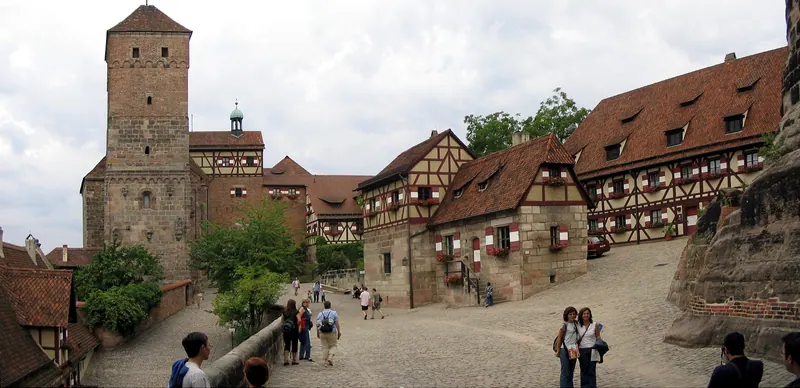
The museum was founded in 1852 to collect the material history of the German-speaking lands, and it holds roughly 1.3 million objects from prehistory to the present. It is built around the Kartause, the Carthusian monastery of 1380: the cloister, the monks’ houses and the church are part of the museum, so you walk through 14th-century architecture between galleries.
For this audience the route is short and specific.
The Kartäuserkirche. The single-nave Gothic sandstone church with cross-ribbed vaults now holds late-medieval sculpture — Madonnas, the three-figure crucifixion group of the Deichsler altar, carved and painted retables. It is the right room for the material and worth more time than the label count suggests.
Waffen, Jagd, Gartenkultur — the arms and hunting display in the Garden and Weapons Hall. Tournament and field armour, edged weapons, crossbows, early firearms and ballistic instruments, running from the high Middle Ages to the 18th century. Named highlights include the medieval great helm of Hans Rieter zu Kornburg and what the museum describes as the oldest securely dated firearm, a 14th-century hand cannon.
The Behaim Globe. Martin Behaim, a Nuremberg merchant who had sailed with the Portuguese, had this globe made in the city in 1492 — before news of Columbus’s landfall reached Europe. It is the oldest surviving terrestrial globe and was added to the UNESCO Memory of the World register in 2023. Be warned: it is fragile, light-sensitive and, after centuries of ageing and repeated restoration, hard to read in places. Two digitisation projects, in 1992 and 2011, exist precisely because the object itself no longer shows its own detail well.
The “Henlein watch.” A small drum-shaped watch long presented as the world’s first pocket watch, made by the Nuremberg locksmith Peter Henlein around 1510. The museum’s own 2014 exhibition, Der Henlein-Uhrenstreit, put that attribution under scientific examination rather than defending it. Read the label; it is more honest than the legend.