Medieval Booker

Castle ◆ Nuremberg

Kaiserburg (Imperial Castle)

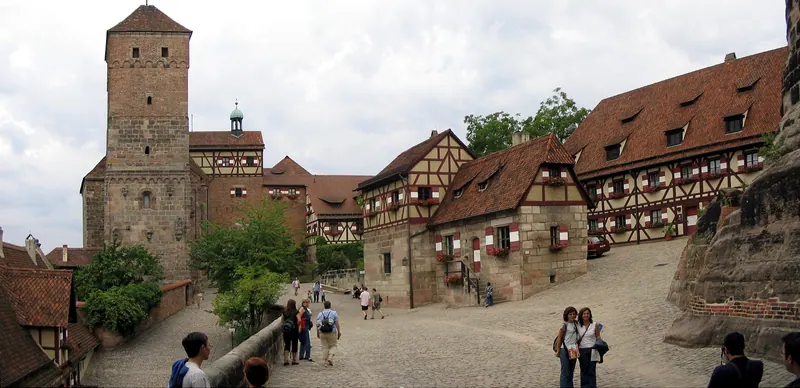
The Hohenstaufen castle on the sandstone ridge above the old town, held by the emperors from about 1200 and bought outright by the city between 1422 and 1427. The Palas you tour was rebuilt after 1945; the Romanesque double chapel beside it came through the bombing almost undamaged, so go there first and look down through the opening in the floor.

Where and when

Where
Auf der Burg 13, 90403 Nürnberg, Nuremberg, Germany Open in Google Maps Walking directions
Era
Palas and double chapel from c. 1200; Sinwell tower later 13th century; Palas rebuilt after 1945
Opening
Daily 09:00–18:00 April–September, 10:00–16:00 October–March; last admission about 60 minutes before closing. Closed only on 1 January, Shrove Tuesday, and 24, 25 and 31 December. The Deep Well is shown only on a guided demonstration, included in the ticket (as of August 2026)
Price
Combined ticket (Palas with Double Chapel and Kaiserburg Museum + Deep Well + Sinwell Tower) €10 / €9 reduced. Palas and museum alone €7 / €6. Deep Well + Sinwell Tower alone €4 / €3. Under-18s free; castle gardens free. Kaiserburg + Fembo-Haus city museum €15 / €13. No online booking — tickets are sold at the outer courtyard office (as of August 2026)
Best time
First thing in the morning, or the last hour before closing. In summer the free castle gardens on the north side are the best place in Nuremberg to be at about 19:00, long after the ticketed parts have shut.
Good for
Good with childrenQuiet corner
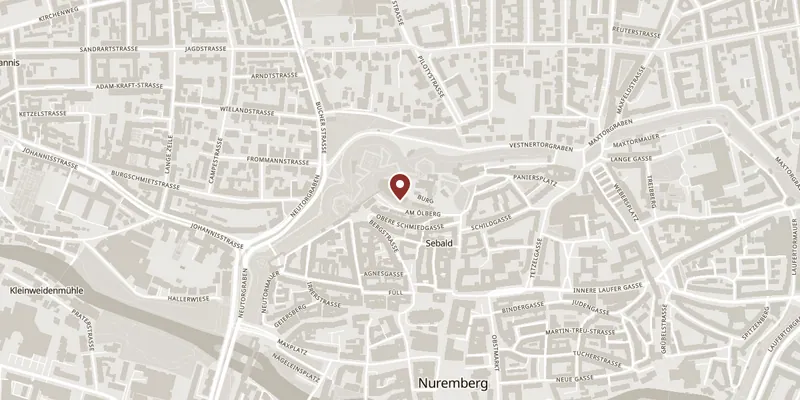
Map showing where Kaiserburg (Imperial Castle) is
Open in Google Maps Walking directions © MapTiler © OpenStreetMap contributors

Checked

What is Kaiserburg (Imperial Castle)?

Nuremberg appears in the records as royal property in 1050. The castle on the rock was two castles for most of the Middle Ages — the emperor’s and the burgrave’s — until the city bought the burgraves out between 1422 and 1427 and became, in effect, its own landlord. The Palas, the great hall block, went up from about 1200 together with the chapel; it was first substantially rebuilt at the end of the 13th century.

The Doppelkapelle is the reason to come and the oldest thing you can stand in. It is two chapels of identical plan stacked on top of each other, with an opening in the middle of the floor so that one congregation could hear the service in the other. The lower Margaretenkapelle has stout, heavy columns; the upper Kaiserkapelle has four remarkably slender columns of marble-like limestone. On the west side is the ruler’s gallery, which kept the emperor above and apart from his court and gave him a level walk straight into his own chambers; a heated oratory was built into it for Charles V in 1520. The crucifix is attributed to Veit Stoss. The building survived the Second World War, in the Bavarian Palace Department’s own words, “almost undamaged”, along with its choir tower and the Sinwell tower next door. The Palas did not: its upper floor was torn away, and Rudolf Esterer rebuilt it after 1945, lengthening the hall westwards by about a third.

The Sinwellturm — Middle High German for something like “mightily round” — was built in the second half of the 13th century, is 41 m high, and gained an extra storey and its pointed helm in the 1560s. A wooden stair inside goes to the platform; there is a photographic exhibition on the destruction of castle and city on the way up.

The Tiefer Brunnen is a shaft driven over 50 m into bedrock, first documented in the 14th century, with the sandstone parapet added in the 16th. It can only be seen on a short guided demonstration, included in the ticket, in which a camera is lowered down the shaft. The castle garden and the Maria Sibylla Merian garden are free.
What visitors say

4.6 from 43,765 ratings

  • Behruz Khalatai

    5 out of 5 3 weeks ago

    One of the main castles of the Holy Roman Empire. Most of the castle was destroyed during World War II, but it was later rebuilt to its original appearance. Inside, you can learn a lot about the Holy Roman Empire through the exhibitions. You can also enjoy a beautiful panoramic view of Nuremberg from the tower. Don't forget to join the short guided demonstration of one of the deepest wells in Europe. As of July 2026, the ticket for the castle, the exhibitions, the tower, and the well demonstration costs €10

    Read this review on Google
  • Patrick Xu

    5 out of 5 2 months ago

    We did the introduction walking tour starting from the castle and eniat the Nuremberg Transport Museum. We spent quite sometime here at the castle and it was remarkable. Along the way, we also took some street photos, though the city was from the rebuilding after the war, it was felt historic.

    Read this review on Google
  • hm dm

    4 out of 5 3 months ago

    Interesting history and nice castle ground. Reasonable ticket prices to see inside museums. Steep incline for walking to be aware of. Best to go in sunny day time. Cute cafe at the top and nice souvenirs.

    Read this review on Google

Ratings and reviews from Google. See all on Google Maps

Frequently asked questions

How much does the Imperial Castle in Nuremberg cost?

The combined ticket covering the Palas with the Double Chapel, the Kaiserburg Museum, the Deep Well and the Sinwell Tower is €10, or €9 reduced, as of August 2026. The Palas and museum alone are €7; the Deep Well and Sinwell Tower alone €4. Under-18s go free and the gardens cost nothing.

Can you book Kaiserburg Nuremberg tickets online?

No. The Bavarian Palace Department states that tickets are sold at the ticket office in the outer courtyard and that online booking is not available, as of August 2026.

What survived the war at Nuremberg Castle?

The Romanesque double chapel with its choir tower and the Sinwell tower came through the bombing almost undamaged. The Palas lost its upper floor and was rebuilt after 1945 by Rudolf Esterer, who extended the hall westwards by about a third.

How deep is the Deep Well at Nuremberg Castle?

The shaft is driven more than 50 metres into the rock. It is first documented in the 14th century, and the sandstone parapet at the top was added in the 16th. It can be seen only on a short guided demonstration, which is included in the admission price.

What is the Doppelkapelle?

Two chapels of identical plan built one above the other around 1200, linked by an opening in the floor so that both congregations could follow the same service. The lower Margaret Chapel has heavy columns, the upper Imperial Chapel four slender ones, and the emperor's gallery on the west side gave the ruler a private level entrance from his own rooms.

Festivals in Nuremberg

Medieval festivals in Nuremberg
Medieval Christmas

Nürnberger Christkindlesmarkt

Nuremberg, Germany

Nuremberg's Christkindlesmarkt fills the Hauptmarkt and the Rathausplatz from the Friday before the first Advent to Christmas Eve with 168 red-and-white wooden stalls and about 180 traders, opened each year by the Christkind's prologue from the gallery of the Frauenkirche and drawing around two million people; the 2026 market runs 27 November to 24 December. It is not a medieval market: the square is 14th-century and the Frauenkirche was Charles IV's imperial court chapel, but the market itself is first documented in 1678 — a date the market's own historians revised from 1628 — and t...

2026
Family

More places in Nuremberg

Places in Nuremberg
Museum

Germanisches Nationalmuseum

Founded 1852 in the Carthusian monastery of 1380; collections from prehistory to the present

The largest museum of cultural history in the German-speaking world, founded in 1852 and built into and around a late-medieval Carthusian monastery. Two things justify the visit on their own: the arms and armour hall, and Martin Behaim's terrestrial globe of 1492, the oldest globe in existence.

Works in the rain Good with children Free or cheap
Walking directions
Church

St Lorenz

Begun c. 1250; hall choir 1439–77; Kraft's tabernacle 1493–96; Stoss's Annunciation 1517–18

The great parish church of the southern half of the city, begun about 1250 and finished with a late-Gothic hall choir between 1439 and 1477. Two things in it are worth the trip: Adam Kraft's 20-metre stone tabernacle of 1493–96, which he signed by carving himself kneeling under it, and Veit Stoss's suspended Annunciation of 1517–18.

Free or cheap Works in the rain Quiet corner
Walking directions
Church

St Sebald

Begun c. 1230/40; Gothic hall choir 14th century; Vischer shrine cast 1508–19; rebuilt 1945–78

The older of Nuremberg's two great parish churches, begun in the 1230s as a twin-choired Romanesque basilica and given a tall Gothic hall choir in the 14th century. Walk round the bronze shrine of St Sebald to its east end and look low down for a small bearded man in a leather apron holding a chisel — Peter Vischer the Elder, who cast the whole thing with his sons.

Quiet corner Works in the rain
Walking directions