This is the best five minutes of walking in Nuremberg and most of it is free.
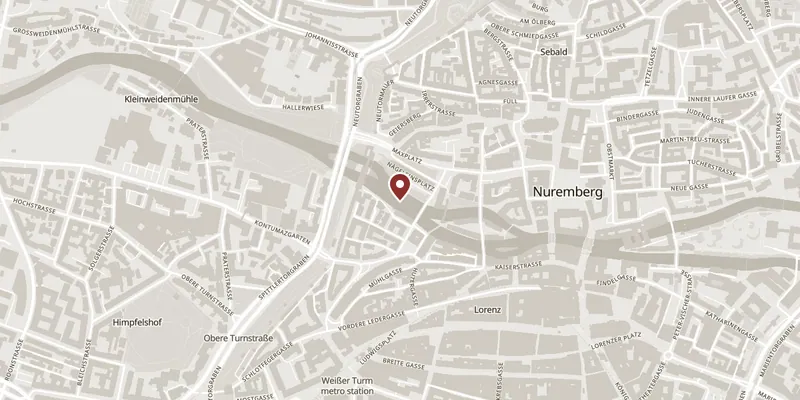
The Weinstadel was built in 1446–48, just outside what was then the city wall, on the north bank of the Pegnitz. At 48 m long — a sandstone ground floor, two half-timbered storeys above it and three more inside the roof — it is the largest half-timbered building in Germany. It was not built as anything picturesque: it housed and fed lepers in Holy Week, on the foundation of the Sondersiechen-Almosen of 1394, and from the 16th century it took in craftsmen, poor families and the sick. From 1571 the imperial city kept part of its wine stock on the ground floor, which is where the name comes from. It was badly hit in the war, narrowly escaped total loss, was rebuilt, and since 1950 has been a student hall of residence — so you cannot go in, and there are usually bicycles and washing on the balconies. That is fine. Look at it from the Maxbrücke.
The Henkersteg, the Hangman’s Bridge, is the covered wooden footbridge running from the Weinstadel’s water tower across to the Trödelmarkt island. It was destroyed in the war and rebuilt in 1954 to the old design. Walking it is free, at any hour.
The Henkerhaus at the far end is built directly over the river channel, and from the 15th to the 19th century the city’s executioner and his assistant were required to live in it — at the edge of the town, over the water, because the office made a man legally unehrlich, dishonourable, and no guild or parish would have him inside the walls.
Inside is a small museum of Nuremberg’s legal and criminal history, run by the association Geschichte Für Alle. Its centre is Frantz Schmidt, executioner of Nuremberg from 1 May 1578 until the end of 1617, who kept a service journal from 1573 onwards recording every sentence he carried out: by his own count 361 executions, 187 of them by the sword, and 345 corporal punishments. It is one of the strangest first-person documents to survive from the 16th century, and this is the house it belongs to.