Medieval Booker

Experience ◆ Nuremberg

The Medieval Dungeons (Lochgefängnisse)

The "Nuremberg Hole" — twelve cells, a smithy, a prison kitchen, a well room and a torture chamber cut into the oldest part of the town hall, in use from 1332. Tours run hourly from 11:00 to 18:00, tickets are sold only in advance and never at the town hall itself, and nobody under ten gets in.

Where and when

Where
Rathausplatz 2, 90403 Nürnberg (entrance at the Old Town Hall), Nuremberg, Germany Open in Google Maps Walking directions
Era
Town hall and prison from 1332; the oldest surviving part of the Nuremberg Rathaus
Opening
Guided tours only, daily on the hour 11:00–18:00, about 45 minutes. English-language tours Mon–Thu 15:15, 16:15, 17:15 and Fri–Sun 11:15, 12:15, 15:15, 16:15, 17:15. Booking online is recommended (as of August 2026)
Price
€10 adult, €8 reduced (students and pupils aged 10+, severely disabled). With a NÜRNBERG CARD, €5 and €4. Advance sale only — tickets are not sold at the town hall (as of August 2026)
Best time
Book an English tour a day or two ahead; the museum says demand is high and there is no box office on site.
Good for
Works in the rain
Official site
museen.nuernberg.de
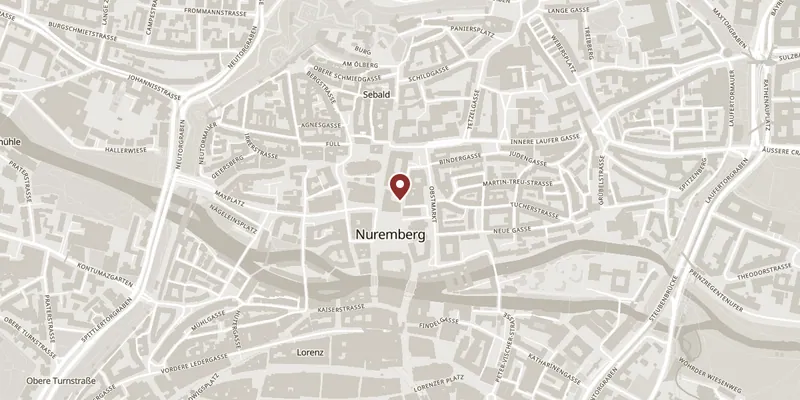
Map showing where The Medieval Dungeons (Lochgefängnisse) is
Open in Google Maps Walking directions © MapTiler © OpenStreetMap contributors

Checked

What is The Medieval Dungeons (Lochgefängnisse)?

When Nuremberg laid out its Hauptmarkt and turned the Heilsbronn abbey bread house into a town hall from 1332, it put the prison in the basement. The result is the oldest part of the Rathaus and one of the largest surviving town prisons of the Middle Ages: a low, narrow run of rooms in the rock and masonry under the building, reached by a stair that gets tighter as you go.

This was not a prison for serving sentences. Imperial-city justice was quick: you were held here while the case was decided, and then fined, mutilated, banished or executed. The cells are single, timber-lined boxes with a bench; the smithy is where irons were fitted; the kitchen fed the prisoners; the well room supplied them; and the Folterkammer, the torture chamber, is where confession was obtained, which under imperial law was needed before a capital sentence could be passed. The guide will name the Lochschöffen and the Nachrichter — the city’s official interrogators and its executioner — and the executioner’s own house is a ten-minute walk away over the Pegnitz.

The practicalities are unusually strict and worth reading twice.

  • Guided tour only, about 45 minutes, run by the Förderverein Nürnberger Felsengänge.
  • Hourly, every day, 11:00 to 18:00. English tours are listed Monday–Thursday at 15:15, 16:15 and 17:15, and Friday–Sunday at 11:15, 12:15, 15:15, 16:15 and 17:15.
  • Tickets are advance sale only, and the museum states plainly that no tickets are sold at the town hall. Buy online.
  • No children under 10. Not step-free, sure footwear required, and the museum says people with claustrophobia should not take part, because the route runs through narrow passages.

The Renaissance wing of the town hall above it, built by Jakob Wolff the Younger from 1616, was gutted in 1945 and rebuilt; the prison below survived.
What visitors say

4.5 from 772 ratings

  • Bel P

    5 out of 5 8 months ago

    Thank you so much to Leena for a wonderful tour and accommodating our situation. We really appreciated your help and fantastic tour. Recommend being super early to the meeting point to make sure you’re in the right spot, as guides take off quickly without making sure ticket holders are present.

    Read this review on Google
  • Alex Fryer

    5 out of 5 a year ago

    A fascinating tour of the dungeons under the Rathaus in Nuremberg. We found the English speaking tour excellent with our guide's English really good and an appropriate sense of humour. There are a fair amount of stairs as the tour goes underground. Book ahead - the maximum is 20 for each tour and don't be late - the tour starts at the time stated. It is suitable for all ages and there's no people jumping out and going boo!

    Read this review on Google
  • Adrian Su

    5 out of 5 3 years ago

    I recommend purchasing your ticket online as it is impossible to buy it on the spot. Although there is a qr code that you can scan at the meeting point (on a small plaque on the wall of the old city hall, very inconspicuous), each tour is limited to 20 people so advance booking is still the best option. There is only one English guided tour at 18.00. If you end up in a German guided tour and don't understand much German, tell your guide at the beginning - - they will give you an audio guide. It doesn't give as much as information as the guide themselves, but at least you won't be completely lost. The tour takes about 50 minutes during which one goes through a series of dungeon chambers with the guide. It is a very cool place; one can learn quite some history down there.

    Read this review on Google

Ratings and reviews from Google. See all on Google Maps

Frequently asked questions

How do I get tickets for the Nuremberg medieval dungeons?

Only in advance, ideally online. The museum states that no tickets are sold at the town hall itself. Tours run hourly from 11:00 to 18:00 every day.

How much are the Lochgefängnisse in Nuremberg?

€10 for an adult and €8 reduced as of August 2026, or €5 and €4 with a NÜRNBERG CARD. The price covers the compulsory 45-minute guided tour.

Are there English tours of the Nuremberg dungeons?

Yes. English-language tours are listed Monday to Thursday at 15:15, 16:15 and 17:15, and Friday to Sunday at 11:15, 12:15, 15:15, 16:15 and 17:15.

Can children visit the Lochgefängnisse?

Not under the age of ten. The museum also warns that the route is not step-free, that sure footwear is needed and that people with claustrophobia should not take part.

What is the Nuremberg Hole?

The prison built into the basement of Nuremberg's town hall from 1332, the oldest surviving part of the building and one of the largest preserved town prisons of the Middle Ages. It holds cells, a smithy, a prison kitchen, a well room and a torture chamber.

Festivals in Nuremberg

Medieval festivals in Nuremberg
Medieval Christmas

Nürnberger Christkindlesmarkt

Nuremberg, Germany

Nuremberg's Christkindlesmarkt fills the Hauptmarkt and the Rathausplatz from the Friday before the first Advent to Christmas Eve with 168 red-and-white wooden stalls and about 180 traders, opened each year by the Christkind's prologue from the gallery of the Frauenkirche and drawing around two million people; the 2026 market runs 27 November to 24 December. It is not a medieval market: the square is 14th-century and the Frauenkirche was Charles IV's imperial court chapel, but the market itself is first documented in 1678 — a date the market's own historians revised from 1628 — and t...

2026
Family

More places in Nuremberg

Places in Nuremberg
Castle Start here

Kaiserburg (Imperial Castle)

Palas and double chapel from c. 1200; Sinwell tower later 13th century; Palas rebuilt after 1945

The Hohenstaufen castle on the sandstone ridge above the old town, held by the emperors from about 1200 and bought outright by the city between 1422 and 1427. The Palas you tour was rebuilt after 1945; the Romanesque double chapel beside it came through the bombing almost undamaged, so go there first and look down through the opening in the floor.

Good with children Quiet corner
Walking directions
Museum

Germanisches Nationalmuseum

Founded 1852 in the Carthusian monastery of 1380; collections from prehistory to the present

The largest museum of cultural history in the German-speaking world, founded in 1852 and built into and around a late-medieval Carthusian monastery. Two things justify the visit on their own: the arms and armour hall, and Martin Behaim's terrestrial globe of 1492, the oldest globe in existence.

Works in the rain Good with children Free or cheap
Walking directions
Church

St Lorenz

Begun c. 1250; hall choir 1439–77; Kraft's tabernacle 1493–96; Stoss's Annunciation 1517–18

The great parish church of the southern half of the city, begun about 1250 and finished with a late-Gothic hall choir between 1439 and 1477. Two things in it are worth the trip: Adam Kraft's 20-metre stone tabernacle of 1493–96, which he signed by carving himself kneeling under it, and Veit Stoss's suspended Annunciation of 1517–18.

Free or cheap Works in the rain Quiet corner
Walking directions