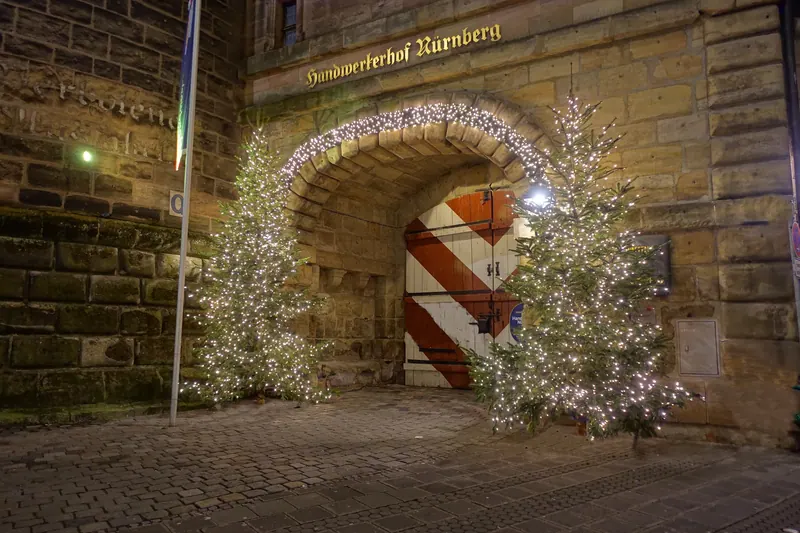
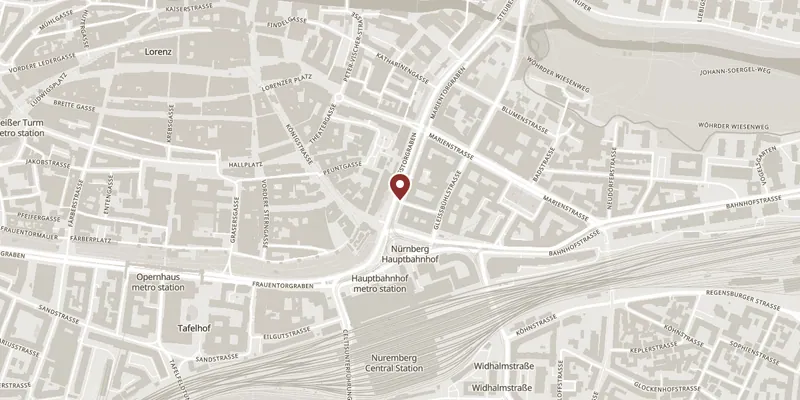
What the Handwerkerhof actually is. The Waffenhof — the armoury court inside the Frauentor bastion at the Königstor — is medieval and real. What stands in it is not. On 1 April 1971, for the Dürer year marking the 500th anniversary of the artist’s birth, the trade-fair company AFAG spent 800,000 DM building a little craftsmen’s town of small houses with imitation half-timbered façades inside the court. It was supposed to come down again in 1972. It was popular, so it stayed. There are about ten businesses: pottery, leather, wooden and tin toys, gingerbread, glass, candles, soap, a goldsmith, and four eating places. Most of it is a gift-shop village on the walk from the main station into the old town, and you should treat it as one.
Then there is the pewter foundry. Nuremberg’s Zinngießer were among the best in Europe in the 16th century, casting tableware and figures that were traded across the continent; the trade survived here into living memory, and when Georg Stanisavljevic started, about forty years ago, there were still around thirty pewter casters in the city. He is now close to the last of them.
He does the whole job in the workshop. He cuts the moulds himself and makes the wax models for his fully three-dimensional figures — about 500 of them so far — and then casts, patinates, washes, polishes and mills the pieces on the premises. He also works in ceramic and bronze. What is on the shelves is tableware, miniature animals, and historical figures: this is the place to buy a cast-pewter knight that was actually made in Nuremberg by the man selling it, rather than a resin one that was not.
Go on a weekday inside shop hours, ask before you photograph anyone working, and expect a working bench rather than a demonstration laid on for visitors.