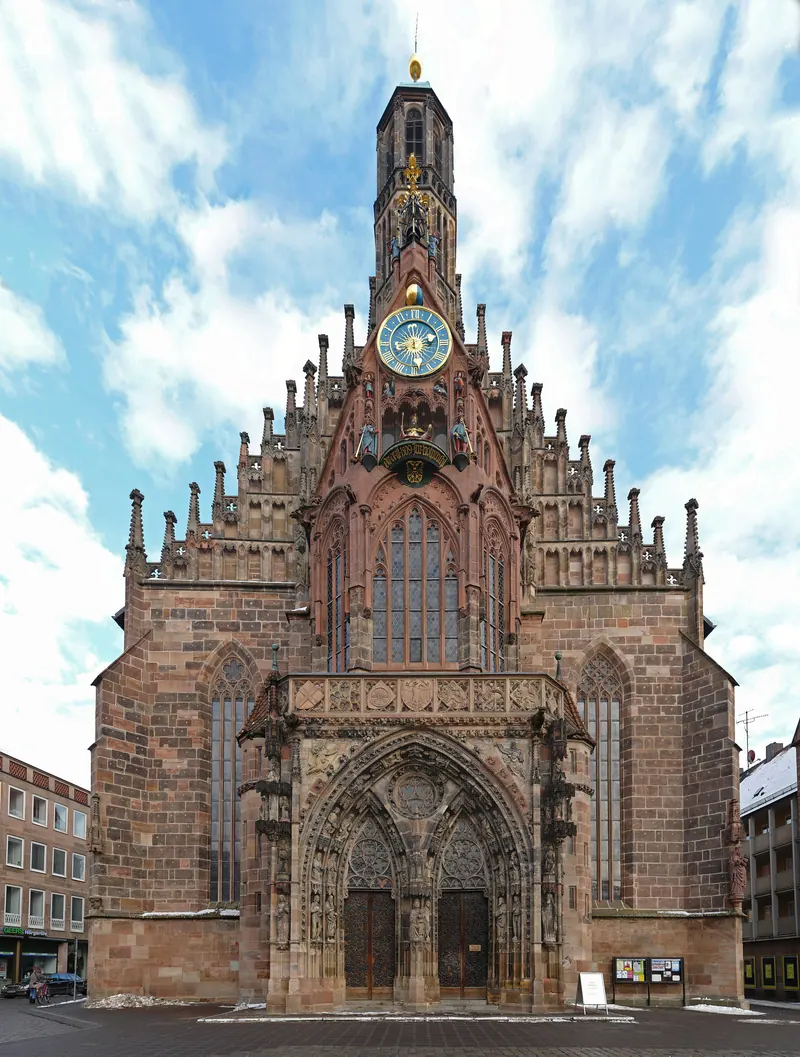
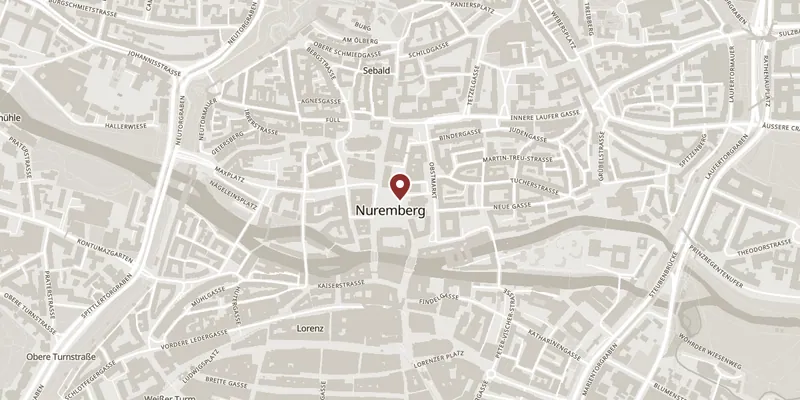
The Hauptmarkt is not an organic medieval square. It was cleared and laid out around 1350 on the ground of Nuremberg’s Jewish quarter, destroyed in the pogrom of December 1349, and Charles IV had the Frauenkirche built as an imperial court chapel on the site of the demolished synagogue. It is a hall church of the Parler period, mid-14th century, with a stepped gable, a slender turret and a porch facing the market.
The Männleinlaufen in the west gable dates from 1509. Every day at 12:00 the bells ring, trumpeters, drummers and pipers play, doors open, and the seven prince-electors process round the seated figure of Charles IV — a mechanical restatement of the Golden Bull of 1356, on the building of the emperor who issued it. The whole thing lasts about four minutes.
Be clear what you are watching. The city’s building department, which maintains the clock, states that the Frauenkirche and its art clock were completely destroyed on 2 January 1945 and that a replacement movement was installed in 1953. The figures themselves were among the objects sheltered in the art bunker under the castle hill. What runs at noon is therefore 16th-century sculpture driven by post-war machinery on a rebuilt gable.
Inside, free of charge, is the Tucher altar of about 1445, the most important panel painting in Nuremberg before Dürer.
In the north-west corner of the square stands the Schöner Brunnen, a 19 m stone spire in the shape of a Gothic church tower carrying 40 figures in four tiers — prophets, evangelists, church fathers, and on the third tier the seven electors and the Nine Worthies. Heinrich Beheim built the original between 1385 and 1396. What stands on the Hauptmarkt today is a shell-limestone copy of 1903; surviving pieces of the original are in the Germanisches Nationalmuseum. Set into the ironwork railing of 1587 is a seamless brass ring people queue to turn for a wish. There is no medieval evidence for that custom whatsoever, and turning it is free.