Nuremberg has been fortifying its rock since the 11th century; the circuit you see was built between the 14th and 15th centuries and closed around 1400. The city’s own figures: 3.8 km of the original 5 km still stands, 74 wall towers are in municipal ownership, there were five main gates and two foot passages, and the largest single gap — 310 m — is at the Laufer Torturm. Of the 123 towers the wall carried at its height, most went for road-building in the 19th century.
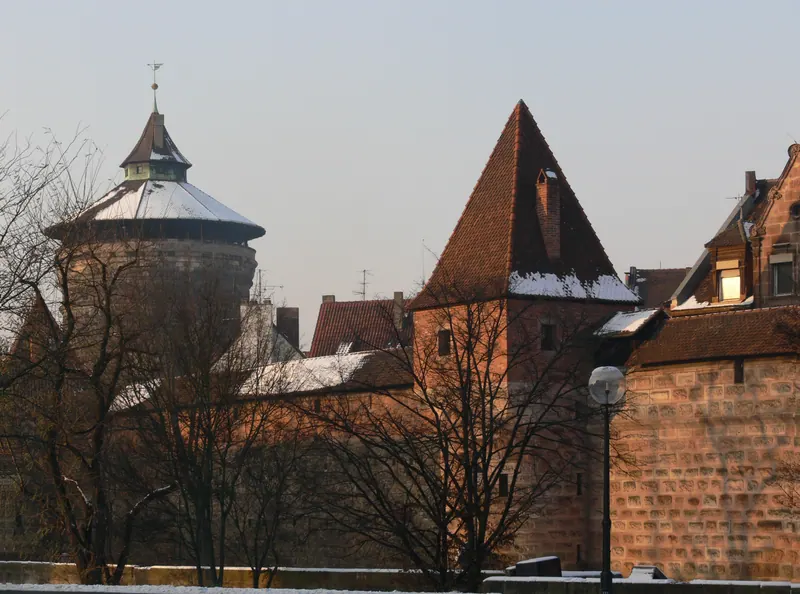
The four round gate towers, at the Laufer Tor, Königstor, Ludwigstor and Neutor, are the things that make this wall look unlike any other in Germany. They began as square Gothic gate towers and were encased in fat cylindrical shells in the 16th century, when gunpowder made angular towers a liability; the Frauentorturm was rebuilt in that form in 1558 by Jörg Unger. They are about 40 m high and more than 18 m across.
Set your expectations before you go. Unlike Rothenburg, Nuremberg has no continuous public gallery on top of its wall. The walls were breached, burned and partly rebuilt after 1945, and the towers are in dozens of separate hands — clubs, artists, private tenants, a hotel. What you do instead is walk the outside: the dry moat and the green strip below the wall, which run for most of the southern and western circuit, put you at the foot of the masonry looking up at it, which is how it was designed to be seen.
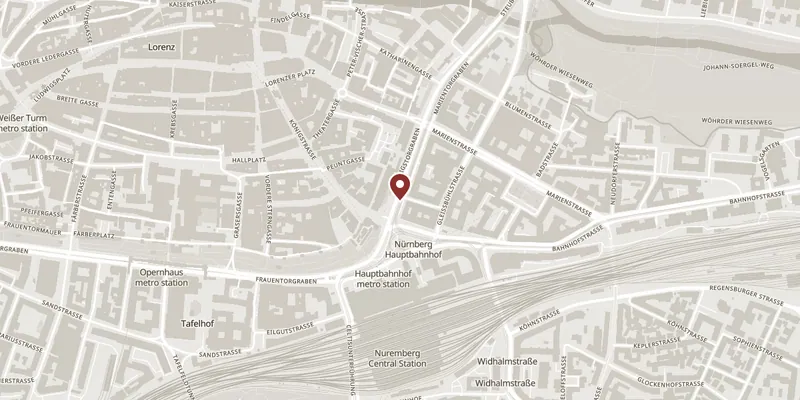
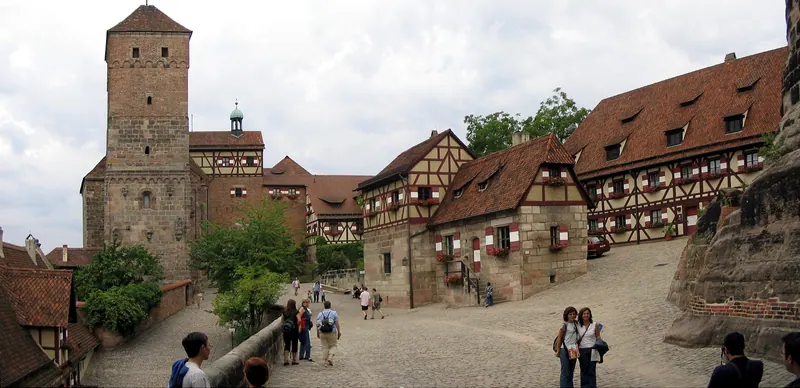
The stretch to walk is the western arc, Königstor round to the Neutor, taking in the Spittlertorturm and the moat gardens; allow about 45 minutes at a slow pace. Go on to the Tiergärtnertor and you come out at the Dürer House with the castle above you.
Inside the Frauentor bastion at the Königstor end sits the Handwerkerhof, built in 1971 in the genuine medieval Waffenhof, the armoury court. The court is real. The half-timbered houses in it are not.