Medieval Booker

Museum ◆ Nuremberg

Albrecht Dürer's House

A four-storey burgher's house of about 1420 under the castle wall, bought by Dürer in 1509 and lived and worked in until his death in 1528. The paintings on the walls are copies and the museum says so out loud; go for the kitchen hearth, the print workshop where the press is actually run, and the original Dürer prints in the gallery rooms.

Where and when

Where
Albrecht-Dürer-Straße 39, 90403 Nürnberg, Nuremberg, Germany Open in Google Maps Walking directions
Era
House built c. 1420; Dürer's from 1509 until his death in 1528; repaired as a museum 1948/49
Opening
Tuesday–Sunday 10:00–18:00; also open on Mondays 10:00–18:00 in July–September and during the Christmas market season (as of August 2026)
Price
€7.50 adult, €2.50 reduced (4–18, students), €2 with a Nürnberg/Fürth/Erlangen/Schwabach pass or in a school group, €8 small-group ticket (one adult plus up to three under-18s), €7 per head in groups of 15+. Adding €4 to any ticket turns it into a day pass for the other municipal museums (as of August 2026)
Best time
Ask at the desk for the next printing demonstration when you buy your ticket and plan the rest of the house around it. Late afternoon is quietest.
Good for
Good with childrenWorks in the rain
Official site
museen.nuernberg.de
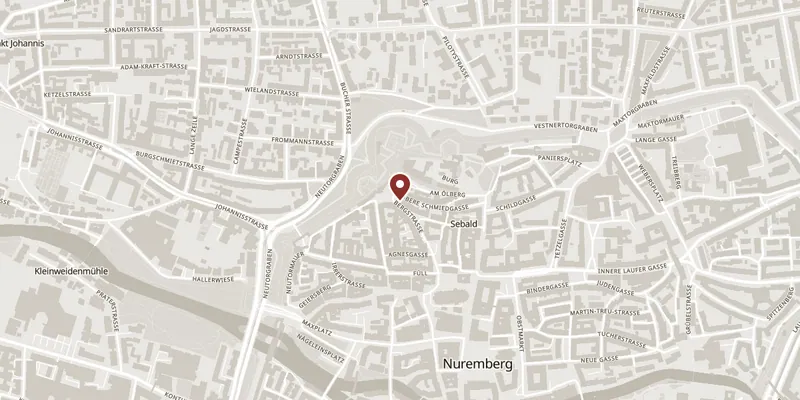
Map showing where Albrecht Dürer's House is
Open in Google Maps Walking directions © MapTiler © OpenStreetMap contributors

Checked

What is Albrecht Dürer's House?

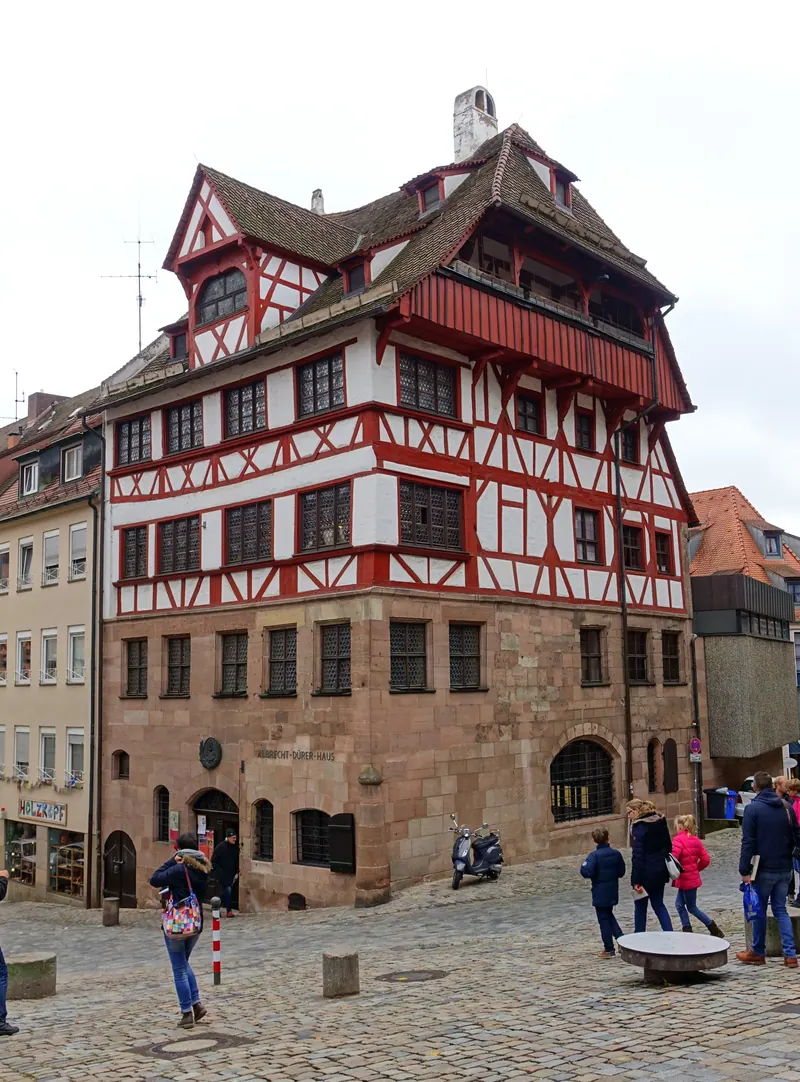
The house was built around 1420: two storeys of sandstone with two half-timbered storeys above, standing just inside the Tiergärtnertor at the foot of the castle rock. Albrecht Dürer acquired it in 1509, at the height of his career, and lived and worked here until he died in 1528. It is the only surviving 16th-century artist’s house in northern Europe.

Be clear about what is original. The house was severely damaged in the raid of 2 January 1945 — the north and west façades were torn open — but the timber frame survived, and it was repaired and reopened as a museum in 1948/49, with a full restoration in 1970/71. The two furnished living rooms were fitted out in 1880 in what the 19th century thought Dürer’s time had looked like. The kitchen on the first floor, with its large original hearth, is the room that genuinely shows you how a wealthy Nuremberg household worked in 1500.

The painting and print workshop is the best part and the reason to time your visit. Historical techniques are demonstrated and explained here, and the large letterpress is run several times a day, so you can watch a Dürer woodblock actually being printed rather than read about it.

Upstairs, the Dürer Hall carries a permanent display with the deliberately blunt title “Original kopiert!” — the best of the city’s collection of painted copies after Dürer. The originals of those pictures are in Vienna, Munich, Madrid and Florence, and the museum’s argument is that the copies are historical objects in their own right. Original Dürer prints are shown in the gallery rooms alongside a multimedia introduction, Albertus Durer Noricus.

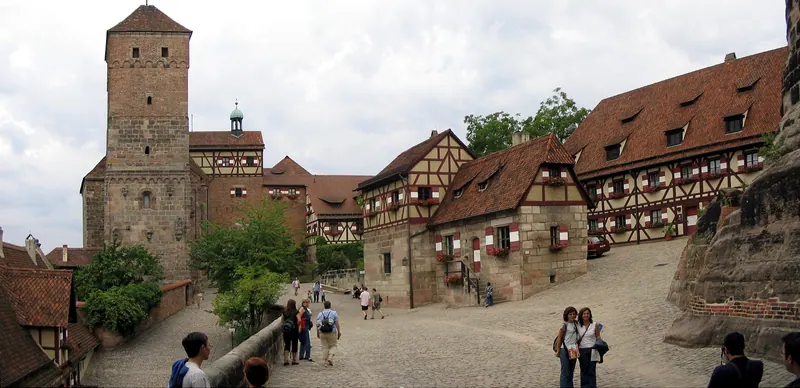
An actress plays Dürer’s wife Agnes on scheduled costumed tours; the museum’s own calendar lists the dates. Outside, the Tiergärtnertorplatz in front of the house is one of the few corners of Nuremberg that still reads as a medieval square.
What visitors say

4.5 from 3,471 ratings

  • Justin and Courtney Davis

    3 out of 5 2 months ago

    The atmosphere and feel inside this old house is great, however the museum itself is very confusing. We did the self guided tour and although there is an app, it’s hard to follow. The rooms do not flow in order, and at times there are multiple number markers in one room so you are unsure which one to listen to. It is a well preserved building though, and the displays are in English, which is a huge plus.

    Read this review on Google
  • Aleks Net

    4 out of 5 2 months ago

    A very interesting and atmospheric museum that is definitely worth visiting, especially for anyone interested in art, history, and the cultural life of old Nuremberg. The Albrecht-Dürer-Haus gives a strong impression of how an important artist could live and work in the city centuries ago. What I especially liked is that the house itself is part of the experience. The rooms, wooden structure, historical details, and interior atmosphere make the visit feel authentic. It is not just a museum with objects behind glass — it feels like entering a real historical place. The museum is also interesting even if you are not an art specialist. It helps you understand Dürer’s world, his time, and the importance of Nuremberg as a city of art, craft, and ideas. I found this place with the help of the Penguindor app — the “penguin” that helps you discover interesting places nearby. Thanks to it, I found a place that is not only beautiful, but also deeply connected with Nuremberg’s identity. Overall, Albrecht-Dürer-Haus is a very memorable stop in the old town. It is calm, cultural, historical, and definitely worth including in a walk through Nuremberg.

    Read this review on Google
  • cher exploring

    3 out of 5 3 months ago

    A nice little place to visit to understand the life of Albrecht Dürer. A pity that everything was destroyed during war. That's not to say that there is no value in visiting though! The reconstructed areas were quite useful in helping you visualise how life might have been like for the Dürer family back then. Prior to this visit, I had not much knowledge of who he was. It was only after this visit that I learnt about his impact on the art scene and on printmaking.

    Read this review on Google

Ratings and reviews from Google. See all on Google Maps

Frequently asked questions

How much does the Albrecht Dürer House cost?

€7.50 for an adult and €2.50 reduced as of August 2026, with a small-group ticket at €8 for one adult and up to three under-18s. Paying €4 more converts any ticket into a day pass for Nuremberg's other municipal museums.

Are there original Dürer works in the Dürer House?

Original prints, yes, in the gallery rooms. The paintings are copies: the permanent display is called "Original kopiert!" and consists of the city's collection of painted copies after Dürer, because the originals are in Vienna, Munich, Madrid and Florence.

Did Albrecht Dürer really live in this house?

Yes. He bought it in 1509 and lived and worked there until his death in 1528. The building itself dates from about 1420 and is the only surviving 16th-century artist's house in northern Europe.

Was the Dürer House destroyed in the war?

It was badly damaged in the raid of 2 January 1945, which tore open the north and west façades, but the timber frame survived. The house was repaired and reopened as a museum in 1948/49 and fully restored in 1970/71.

Can you watch printing at the Dürer House?

Yes. Historical printing techniques are demonstrated in the workshop and the large letterpress is run several times a day. Ask for the next demonstration time when you buy your ticket.

Festivals in Nuremberg

Medieval festivals in Nuremberg
Medieval Christmas

Nürnberger Christkindlesmarkt

Nuremberg, Germany

Nuremberg's Christkindlesmarkt fills the Hauptmarkt and the Rathausplatz from the Friday before the first Advent to Christmas Eve with 168 red-and-white wooden stalls and about 180 traders, opened each year by the Christkind's prologue from the gallery of the Frauenkirche and drawing around two million people; the 2026 market runs 27 November to 24 December. It is not a medieval market: the square is 14th-century and the Frauenkirche was Charles IV's imperial court chapel, but the market itself is first documented in 1678 — a date the market's own historians revised from 1628 — and t...

2026
Family

More places in Nuremberg

Places in Nuremberg
Castle Start here

Kaiserburg (Imperial Castle)

Palas and double chapel from c. 1200; Sinwell tower later 13th century; Palas rebuilt after 1945

The Hohenstaufen castle on the sandstone ridge above the old town, held by the emperors from about 1200 and bought outright by the city between 1422 and 1427. The Palas you tour was rebuilt after 1945; the Romanesque double chapel beside it came through the bombing almost undamaged, so go there first and look down through the opening in the floor.

Good with children Quiet corner
Walking directions
Museum

Germanisches Nationalmuseum

Founded 1852 in the Carthusian monastery of 1380; collections from prehistory to the present

The largest museum of cultural history in the German-speaking world, founded in 1852 and built into and around a late-medieval Carthusian monastery. Two things justify the visit on their own: the arms and armour hall, and Martin Behaim's terrestrial globe of 1492, the oldest globe in existence.

Works in the rain Good with children Free or cheap
Walking directions
Church

St Lorenz

Begun c. 1250; hall choir 1439–77; Kraft's tabernacle 1493–96; Stoss's Annunciation 1517–18

The great parish church of the southern half of the city, begun about 1250 and finished with a late-Gothic hall choir between 1439 and 1477. Two things in it are worth the trip: Adam Kraft's 20-metre stone tabernacle of 1493–96, which he signed by carving himself kneeling under it, and Veit Stoss's suspended Annunciation of 1517–18.

Free or cheap Works in the rain Quiet corner
Walking directions